




Determine the electrostatic self energy of a uniformly charged solid sphere.
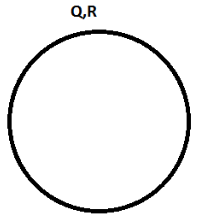
\[
A.\dfrac{k{{Q}^{2}}}{R} \\
B.\dfrac{3k{{Q}^{2}}}{5R} \\
C.\dfrac{3k{{Q}^{2}}}{7R} \\
D.\dfrac{k{{Q}^{2}}}{2R} \]
Answer
 Verified
596.7k+ views
Hint: Firstly, we will have to find the charge element and its relation with the volume charge density of the sphere. Thereafter, we will find the work element produced from the charge element for a very small radius. Assuming that the sphere is made up of ample of such charge elements, we will integrate the work done element and obtain the electrostatic self energy of the sphere.
Complete step by step answer:
Here, we have a uniformly charged solid sphere with radius R and charge Q. To find the electrostatic self energy, first we have to assemble a solid charge sphere so we assume to bring charges one by one from infinity to the sphere. Suppose we have given a charge q and its radius is r. Now, let an extra charge dq is given to it which will increase radius by dr. As we know, work done by this charge dq is given by the formula as below:
\[
dW = dq({V_f} - {V_i}) \\
\Rightarrow dW = dq(\dfrac{{kq}}{r}) \\
\]
Here, dW is a change in work done, \[{V_f} = \dfrac{{kq}}{r}\]is the final potential,\[{V_i} = \infty \]. The total work done to bring charge Q to increase radius by R is obtained as follows:
\[dW = dq(\dfrac{{kq}}{r})\]
But, we know that
\[q=\dfrac{4}{3}\pi {{r}^{3}}\centerdot \rho \]
Where\[\rho \]is the density of the solid sphere. Now, also, the charge element dq is given as\[dq = \rho (4\pi {r^2}dr)\]
Thus, substituting these values in the following equation of work done;
\[
\int{dW=\int{\dfrac{kqdq}{r}}} \\
\Rightarrow W=\int{\dfrac{k4\pi {{r}^{3}}\centerdot 4\pi {{r}^{2}}dr\centerdot {{\rho }^{2}}}{3r}} \\
\Rightarrow W=\dfrac{16{{\pi }^{2}}k{{\rho }^{2}}}{3}\int{{{r}^{4}}dr} \\
\Rightarrow W=\dfrac{16{{\pi }^{2}}k{{\rho }^{2}}}{3}\dfrac{{{r}^{5}}}{5} \\
\]
Now, substituting \[\rho =\dfrac{q}{\dfrac{4\pi {{r}^{3}}}{3}}\]and substituting q with Q and r with R, we obtain as follows:
\[\therefore W=\dfrac{3k{{Q}^{2}}}{5R}\]
Thus, option B is the correct answer.
Note: Irrespective of the charge of the sphere being negatively charged or positively charged, the value of the electrostatic self energy of a uniformly charged sphere will remain positive. This is because the energy is dependent on the square of the charge of the sphere and hence even if the sphere is negatively charged, it will have the same electrostatic self energy.
Complete step by step answer:
Here, we have a uniformly charged solid sphere with radius R and charge Q. To find the electrostatic self energy, first we have to assemble a solid charge sphere so we assume to bring charges one by one from infinity to the sphere. Suppose we have given a charge q and its radius is r. Now, let an extra charge dq is given to it which will increase radius by dr. As we know, work done by this charge dq is given by the formula as below:
\[
dW = dq({V_f} - {V_i}) \\
\Rightarrow dW = dq(\dfrac{{kq}}{r}) \\
\]
Here, dW is a change in work done, \[{V_f} = \dfrac{{kq}}{r}\]is the final potential,\[{V_i} = \infty \]. The total work done to bring charge Q to increase radius by R is obtained as follows:
\[dW = dq(\dfrac{{kq}}{r})\]
But, we know that
\[q=\dfrac{4}{3}\pi {{r}^{3}}\centerdot \rho \]
Where\[\rho \]is the density of the solid sphere. Now, also, the charge element dq is given as\[dq = \rho (4\pi {r^2}dr)\]
Thus, substituting these values in the following equation of work done;
\[
\int{dW=\int{\dfrac{kqdq}{r}}} \\
\Rightarrow W=\int{\dfrac{k4\pi {{r}^{3}}\centerdot 4\pi {{r}^{2}}dr\centerdot {{\rho }^{2}}}{3r}} \\
\Rightarrow W=\dfrac{16{{\pi }^{2}}k{{\rho }^{2}}}{3}\int{{{r}^{4}}dr} \\
\Rightarrow W=\dfrac{16{{\pi }^{2}}k{{\rho }^{2}}}{3}\dfrac{{{r}^{5}}}{5} \\
\]
Now, substituting \[\rho =\dfrac{q}{\dfrac{4\pi {{r}^{3}}}{3}}\]and substituting q with Q and r with R, we obtain as follows:
\[\therefore W=\dfrac{3k{{Q}^{2}}}{5R}\]
Thus, option B is the correct answer.
Note: Irrespective of the charge of the sphere being negatively charged or positively charged, the value of the electrostatic self energy of a uniformly charged sphere will remain positive. This is because the energy is dependent on the square of the charge of the sphere and hence even if the sphere is negatively charged, it will have the same electrostatic self energy.
Recently Updated Pages
Master Class 12 Economics: Engaging Questions & Answers for Success

Master Class 12 English: Engaging Questions & Answers for Success
Master Class 12 Social Science: Engaging Questions & Answers for Success
Master Class 12 Maths: Engaging Questions & Answers for Success
Master Class 12 Physics: Engaging Questions & Answers for Success
Master Class 9 General Knowledge: Engaging Questions & Answers for Success
Trending doubts
Draw ray diagrams each showing i myopic eye and ii class 12 physics CBSE
The ratio of E to B in electromagnetic waves is equal class 12 physics CBSE
The atomic mass of potassium is 391 What is the mass class 12 chemistry CBSE
Sulphuric acid is known as the king of acids State class 12 chemistry CBSE
Which of the following is referred to as the Evil Quartet class 12 biology CBSE
Derive an expression for the electric field intensity class 12 physics CBSE