




Describe Watson and Crick model of DNA.
Answer
 Verified
634.5k+ views
Hint: A double-stranded, antiparallel, right-handed helix is the structure of DNA, as represented in the model of Watson and Crick. The DNA strands' sugar-phosphate backbones make up the outside of the helix. On the inside, the nitrogenous bases are established and form hydrogen-bonded pairs that keep together the DNA strands.
Complete answer:
• DNA stands for Deoxyribonucleic acid, a molecule containing the instructions required to grow, live and reproduce an organism.
• It is a form of nucleic acid and is one of the four main types of macromolecules considered to be important to all life forms.
• DNA's three-dimensional structure, first suggested in \[1953\] by James D. Watson and Francis H. C. Crick, consists of two long helical strands that are coiled to form a double helix around a central axis.
• Two polymer strands coiled around each other are used in each DNA molecule.
• Each strand has a \[5'\]end (with a group of phosphate) and a \[3'\] end (with a hydroxyl group).
• The strands are antiparallel, meaning one strand runs in a direction from \[5'\] to \[3'\] , while the other strand runs in a direction from \[3'\] to \[5'\] .
• The diameter of the double helix is $2nm$ , and at an interval of $3.4nm$ , the double helical structure repeats, corresponding to ten base pairs.
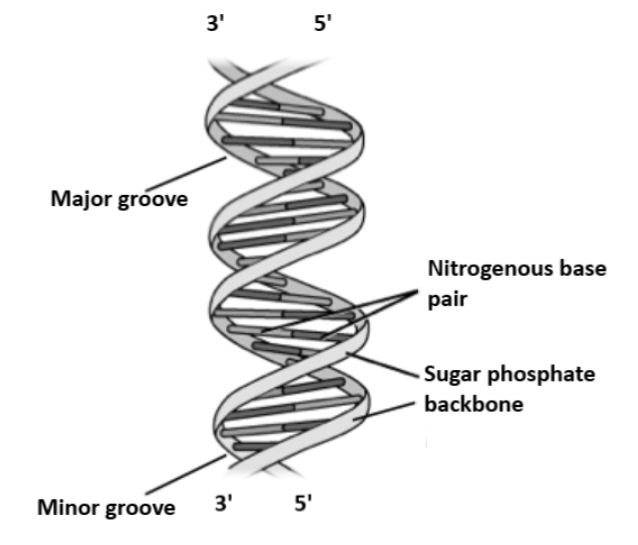
Note: If an A on one strand is detected, it must be combined with a T on the other (and vice versa). Similarly, for a partner on the opposite strand, a G located on one strand must always have a C. These associations of A-T and G-C are known as complementary base pairs. Since a large purine (A or G) is often combined with a small pyrimidine (T or C), the helix's diameter is uniform, reaching approximately \[222\] nanometers.
Complete answer:
• DNA stands for Deoxyribonucleic acid, a molecule containing the instructions required to grow, live and reproduce an organism.
• It is a form of nucleic acid and is one of the four main types of macromolecules considered to be important to all life forms.
• DNA's three-dimensional structure, first suggested in \[1953\] by James D. Watson and Francis H. C. Crick, consists of two long helical strands that are coiled to form a double helix around a central axis.
• Two polymer strands coiled around each other are used in each DNA molecule.
• Each strand has a \[5'\]end (with a group of phosphate) and a \[3'\] end (with a hydroxyl group).
• The strands are antiparallel, meaning one strand runs in a direction from \[5'\] to \[3'\] , while the other strand runs in a direction from \[3'\] to \[5'\] .
• The diameter of the double helix is $2nm$ , and at an interval of $3.4nm$ , the double helical structure repeats, corresponding to ten base pairs.
Note: If an A on one strand is detected, it must be combined with a T on the other (and vice versa). Similarly, for a partner on the opposite strand, a G located on one strand must always have a C. These associations of A-T and G-C are known as complementary base pairs. Since a large purine (A or G) is often combined with a small pyrimidine (T or C), the helix's diameter is uniform, reaching approximately \[222\] nanometers.
Recently Updated Pages
Which of the following graphs shows the variation of class 12 physics CBSE

Draw a labelled diagram of the human male reproductive class 12 biology CBSE
Describe the experiment to compare the emf of two cells class 12 physics CBSE
What is standard hydrogen electrode
What is conventional current and electric current class 12 physics CBSE
2Bromopentane is treated with an alcoholic KOH solution class 12 chemistry CBSE
Trending doubts
A member of Simon commission later became Prime Minister class 12 social science CBSE
What is the Full Form of PVC, PET, HDPE, LDPE, PP and PS ?
Differentiate between internal fertilization and external class 12 biology CBSE
Differentiate between lanthanoids and actinoids class 12 chemistry CBSE
Sketch and label the Malpighian body class 12 biology CBSE
State the principle of an ac generator and explain class 12 physics CBSE