




Describe the T. S. of Spinal cord.
Answer
 Verified
618k+ views
Hint: The spinal cord is a long, slight, rounded structure composed of sensory tissue, which reaches out from the medulla oblongata in the brainstem to the lumbar area of the vertebral section. It encases the focal channel of the spinal rope, which contains cerebrospinal liquid.
Complete answer:
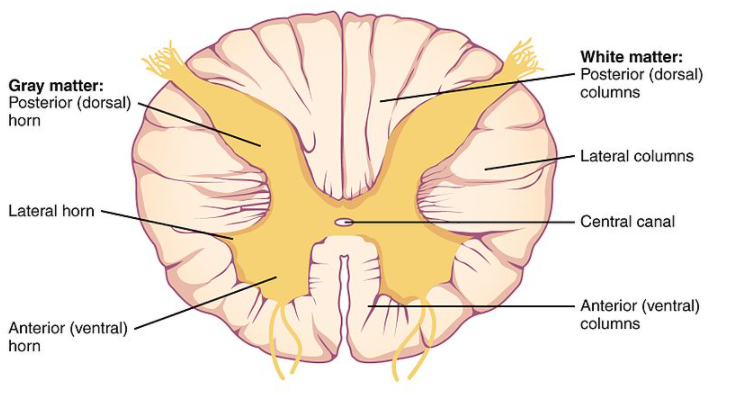
A segment of nerve tissue, that runs down from the base of the skull to the center point of the back. It is covered by three meager layers of defensive tissue called films. The spinal rope and films are encircled by the vertebrae (spines). The spinal rope and the mind make up the focal sensory system (CNS).
The crossover part of the spinal line shows the accompanying subtleties:
• It is encircled by three meninges-external dura mater, center arachnoid mater, and internal pia mater.
• White issue is external and the dim issue is inward.
• Dim issue is H-molded because of two dorsal horns and two ventral horns. The dorsal horns reach to the dorsal base of spinal nerves and the ventral horns reach to the ventral foundation of the spinal nerves.
• Dark issue consists of cell assemblages of neurons, hand-off neurons, and the glial cells.
• White tissue is composed of myelinated axons.
• 31 sets of nerves emerge from the spinal line.
• In the center, there is a focal trench that contains the cerebrospinal liquid.
Note: The spinal cord works essentially in the transmission of nerve signals from the engine cortex to the body, and from the afferent strands of the tangible neurons to the tactile cortex. It is additionally a center for planning numerous reflexes and contains reflex bends that can freely control reflexes.
Complete answer:
A segment of nerve tissue, that runs down from the base of the skull to the center point of the back. It is covered by three meager layers of defensive tissue called films. The spinal rope and films are encircled by the vertebrae (spines). The spinal rope and the mind make up the focal sensory system (CNS).
The crossover part of the spinal line shows the accompanying subtleties:
• It is encircled by three meninges-external dura mater, center arachnoid mater, and internal pia mater.
• White issue is external and the dim issue is inward.
• Dim issue is H-molded because of two dorsal horns and two ventral horns. The dorsal horns reach to the dorsal base of spinal nerves and the ventral horns reach to the ventral foundation of the spinal nerves.
• Dark issue consists of cell assemblages of neurons, hand-off neurons, and the glial cells.
• White tissue is composed of myelinated axons.
• 31 sets of nerves emerge from the spinal line.
• In the center, there is a focal trench that contains the cerebrospinal liquid.
Note: The spinal cord works essentially in the transmission of nerve signals from the engine cortex to the body, and from the afferent strands of the tangible neurons to the tactile cortex. It is additionally a center for planning numerous reflexes and contains reflex bends that can freely control reflexes.
Recently Updated Pages
Basicity of sulphurous acid and sulphuric acid are

Master Class 11 English: Engaging Questions & Answers for Success
Master Class 11 Physics: Engaging Questions & Answers for Success
Master Class 11 Computer Science: Engaging Questions & Answers for Success
Master Class 11 Chemistry: Engaging Questions & Answers for Success
Master Class 11 Social Science: Engaging Questions & Answers for Success
Trending doubts
Difference Between Prokaryotic Cells and Eukaryotic Cells
Two of the body parts which do not appear in MRI are class 11 biology CBSE
One Metric ton is equal to kg A 10000 B 1000 C 100 class 11 physics CBSE
10 examples of friction in our daily life
Draw a diagram of nephron and explain its structur class 11 biology CBSE
What will happen if the mucus is not secreted by the class 11 biology CBSE