




Describe the structure of the common form of ice.
Answer
 Verified
631.5k+ views
Hint: As a naturally occurring crystalline inorganic solid with an ordered structure, ice is considered to be a mineral. Ice is less dense than liquid water and so it floats. Ice is a solid form of water. This has a rigid lattice structure, in a tetrahedral crystalline form.
Complete answer:
Ice is a crystalline form of water.
Ice at normal conditions takes hexagonal form if crystallized at atmospheric pressure, but condenses to cubic form if the temperature is very low.
Each oxygen atom is tetrahedrally surrounded by four H-atoms. The three-dimensional structure of ice represented as:
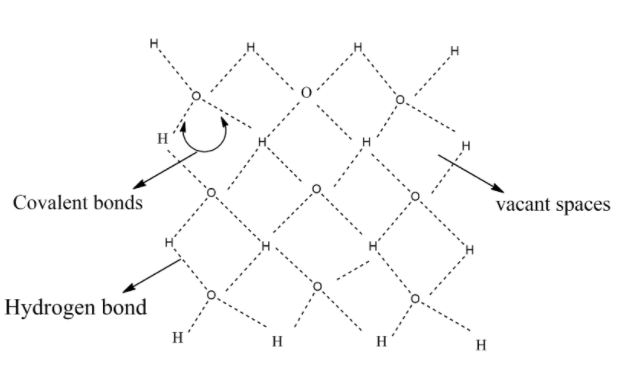
Out of 4 hydrogen atoms surrounded with oxygen atom, 2 hydrogen atoms represented in the above diagram are covalent bonds and the remaining 2 hydrogen atoms are Hydrogen bonds.
The structure also contains wide holes that can hold molecules of appropriate sizes interstitially.
Each O atom is surrounded by 4 other oxygen atoms at a distance of 276 pm.
The vacant spaces in the three-dimensional structure are known as interstitial sites.
Interstitial sites with compatible size atoms can exist in these spaces.
The common structure of ice is a tetrahedral arrangement.
The rigid hydrogen bonds in ice form an open network that causes the solid form of water to be less dense than the liquid form.
Note: Ice reaches its highest density at about ${{4}^{0}}C$. Between ${{4}^{0}}C$ and ${{0}^{o}}C$ , the density gradually decreases as the hydrogen bonds begin to form a network characterized by a general hexagonal structure with open spaces in the middle of the hexagons.
Complete answer:
Ice is a crystalline form of water.
Ice at normal conditions takes hexagonal form if crystallized at atmospheric pressure, but condenses to cubic form if the temperature is very low.
Each oxygen atom is tetrahedrally surrounded by four H-atoms. The three-dimensional structure of ice represented as:
Out of 4 hydrogen atoms surrounded with oxygen atom, 2 hydrogen atoms represented in the above diagram are covalent bonds and the remaining 2 hydrogen atoms are Hydrogen bonds.
The structure also contains wide holes that can hold molecules of appropriate sizes interstitially.
Each O atom is surrounded by 4 other oxygen atoms at a distance of 276 pm.
The vacant spaces in the three-dimensional structure are known as interstitial sites.
Interstitial sites with compatible size atoms can exist in these spaces.
The common structure of ice is a tetrahedral arrangement.
The rigid hydrogen bonds in ice form an open network that causes the solid form of water to be less dense than the liquid form.
Note: Ice reaches its highest density at about ${{4}^{0}}C$. Between ${{4}^{0}}C$ and ${{0}^{o}}C$ , the density gradually decreases as the hydrogen bonds begin to form a network characterized by a general hexagonal structure with open spaces in the middle of the hexagons.
Recently Updated Pages
The given figure shows two endocrine glands marked class 11 biology NEET_UG

Match columnI with columnII and select the correct class 11 biology NEET
Match column I with column II and select the correct class 11 biology NEET_UG
Which floral family has left 9 right + 1 arrangement class 11 biology NEET_UG
Which is not a variety of sheep A Lohi B Beetal C Nellore class 11 biology NEET_UG
Match column I with column II and select the correct class 11 biology NEET_UG
Trending doubts
One Metric ton is equal to kg A 10000 B 1000 C 100 class 11 physics CBSE
What is cell theory Who formulated it class 11 biology CBSE
Phyllotaxy is the arrangement of ALeaflets BLeaves class 11 biology CBSE
Difference Between Prokaryotic Cells and Eukaryotic Cells
The symbiotic association of fungi and algae is called class 11 biology CBSE
Cell theory was formulated by A Schleiden and Schwann class 11 biology CBSE