




Describe the structure of maize grain.
Answer
 Verified
567k+ views
Hint: Maize is one of the foremost staple foods throughout the world, and it consists of a monocot seed and it is yellow in colour externally and triangular in shape. At one aspect of the grain, it has a small opaque oval shaped whitish structure, in which the embryo stays.
Complete answer:
Maize is many times referred to as corn and it is a cereal food. Along with wheat and rice, maize is also a predominant staple meal which human beings are eating throughout the world. The maize plant is normally three meters in length and some naturally grow up to the length of thirteen meters. And this maize plant incorporates the internodes. It consists of a female inflorescence.
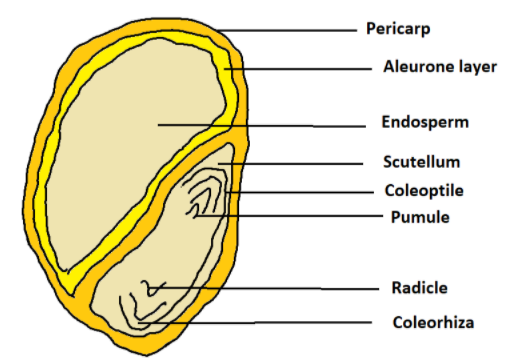
The maize grain is a caryopsis which is one-seeded fruit. The seed coat is fused with the pericarp. The seed contains the following components-
Seed coat- It is a thin layer which surrounds the whole grain. The layer is made up of seed coat and pericarp.
Endosperm- Two unequal portions are found in the maize grain which is divided by epithelium. The larger part is the endosperm which is yellow-white in appearance for storing food in the form of starch. The outermost layer is the protein layer which is known as the aleurone layer.
Embryo- A large shield like cotyledon is present which is called scutellum in which the axis of the embryo is enclosed. The axis at its upper portion contains plumule and at the lower end it contains radicle. These are enclosed in a sheath-like structure called the coleoptile and coleorhiza.
When it comes to the shade of the maize, the yellow color is due to the presence of lutein and zeaxanthin. And in some maize, the kernels are crimson in coloration and it is due to anthocyanins.
Note: Usually, maize is consumed by human beings without delay and it is also used for corn ethanol, corn starch, and corn syrup and also for animal feed. maize plants are short-day plant life and are affected with the aid of the photo periodicity. Immature maize shoots produce the accumulation of a massive amount of effective antibiotic elements and this is helpful naturally against the countless types of pests and insects.
Complete answer:
Maize is many times referred to as corn and it is a cereal food. Along with wheat and rice, maize is also a predominant staple meal which human beings are eating throughout the world. The maize plant is normally three meters in length and some naturally grow up to the length of thirteen meters. And this maize plant incorporates the internodes. It consists of a female inflorescence.
The maize grain is a caryopsis which is one-seeded fruit. The seed coat is fused with the pericarp. The seed contains the following components-
Seed coat- It is a thin layer which surrounds the whole grain. The layer is made up of seed coat and pericarp.
Endosperm- Two unequal portions are found in the maize grain which is divided by epithelium. The larger part is the endosperm which is yellow-white in appearance for storing food in the form of starch. The outermost layer is the protein layer which is known as the aleurone layer.
Embryo- A large shield like cotyledon is present which is called scutellum in which the axis of the embryo is enclosed. The axis at its upper portion contains plumule and at the lower end it contains radicle. These are enclosed in a sheath-like structure called the coleoptile and coleorhiza.
When it comes to the shade of the maize, the yellow color is due to the presence of lutein and zeaxanthin. And in some maize, the kernels are crimson in coloration and it is due to anthocyanins.
Note: Usually, maize is consumed by human beings without delay and it is also used for corn ethanol, corn starch, and corn syrup and also for animal feed. maize plants are short-day plant life and are affected with the aid of the photo periodicity. Immature maize shoots produce the accumulation of a massive amount of effective antibiotic elements and this is helpful naturally against the countless types of pests and insects.
Recently Updated Pages
Master Class 11 English: Engaging Questions & Answers for Success

Master Class 11 Social Science: Engaging Questions & Answers for Success
Master Class 11 Maths: Engaging Questions & Answers for Success
Master Class 11 Biology: Engaging Questions & Answers for Success
Master Class 11 Physics: Engaging Questions & Answers for Success
Master Class 11 Chemistry: Engaging Questions & Answers for Success
Trending doubts
One Metric ton is equal to kg A 10000 B 1000 C 100 class 11 physics CBSE
Difference Between Prokaryotic Cells and Eukaryotic Cells
Find the value of the expression given below sin 30circ class 11 maths CBSE
Two of the body parts which do not appear in MRI are class 11 biology CBSE
Draw a diagram of a plant cell and label at least eight class 11 biology CBSE
10 examples of friction in our daily life