




Describe the structure of a monocot seed.
Answer
 Verified
559.8k+ views
Hint: A monocotyledonous seed has a single cotyledon in it with a thick seed coat and it gets fused with the pericarp. These seeds are endospermic in nature. The cotyledons in the monocot seed are known as scutellum and are supplied with the shoot axis.
Complete answer:
The monocot seed has the outer seed coat and the inner seed coat. Within these layers the embryo is known to occur. This monocot seed is differentiated due to the separate axis. The part of the axis that is present in the decrease phase of the seed is referred to as radical. This part blanketed through the sheath is referred to as coleoptile. The part of the axis that is present in the higher part of the stem is called plumule.
The plumule is covered by a sheath called coleoptile. After the germination of the seed, the water enters into the gap of mycorrhiza and the seed bulges.
This motivates the boom of the seed, in which the stem section of the seed grows from the elongation of the plumule by destroying the layer of coleoptile and the root types from the radicle through the breaking of the coleorhiza. The endosperm is present and located in the internal phase of the seed around the embryo. This is the nutritive layer that provides nutrition for the increase of the embryo; the monocot seed possesses the aleurone layer which is the layer of protein that is existing in between the endosperm and the outer covering of the seed.
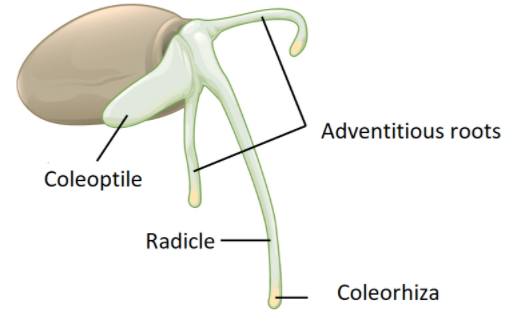
Note: The example for the monocot seeds includes the grains like rice, wheat, maize, barley etc., onion, banana, palm, ginger, coconut, garlic, bamboo, Lillie, tulips etc. All of these flora possess solely one cotyledon or the scutellum in the seed of these plants. The dicotyledonous plants possess two cotyledons. For example-Mango.
Complete answer:
The monocot seed has the outer seed coat and the inner seed coat. Within these layers the embryo is known to occur. This monocot seed is differentiated due to the separate axis. The part of the axis that is present in the decrease phase of the seed is referred to as radical. This part blanketed through the sheath is referred to as coleoptile. The part of the axis that is present in the higher part of the stem is called plumule.
The plumule is covered by a sheath called coleoptile. After the germination of the seed, the water enters into the gap of mycorrhiza and the seed bulges.
This motivates the boom of the seed, in which the stem section of the seed grows from the elongation of the plumule by destroying the layer of coleoptile and the root types from the radicle through the breaking of the coleorhiza. The endosperm is present and located in the internal phase of the seed around the embryo. This is the nutritive layer that provides nutrition for the increase of the embryo; the monocot seed possesses the aleurone layer which is the layer of protein that is existing in between the endosperm and the outer covering of the seed.
Note: The example for the monocot seeds includes the grains like rice, wheat, maize, barley etc., onion, banana, palm, ginger, coconut, garlic, bamboo, Lillie, tulips etc. All of these flora possess solely one cotyledon or the scutellum in the seed of these plants. The dicotyledonous plants possess two cotyledons. For example-Mango.
Recently Updated Pages
Master Class 11 Social Science: Engaging Questions & Answers for Success

Master Class 11 Chemistry: Engaging Questions & Answers for Success
Master Class 9 General Knowledge: Engaging Questions & Answers for Success
Master Class 9 Maths: Engaging Questions & Answers for Success
Master Class 9 Science: Engaging Questions & Answers for Success
Master Class 9 English: Engaging Questions & Answers for Success
Trending doubts
One Metric ton is equal to kg A 10000 B 1000 C 100 class 11 physics CBSE
Difference Between Prokaryotic Cells and Eukaryotic Cells
Two of the body parts which do not appear in MRI are class 11 biology CBSE
1 ton equals to A 100 kg B 1000 kg C 10 kg D 10000 class 11 physics CBSE
Explain zero factorial class 11 maths CBSE
10 examples of friction in our daily life