




Describe the role of rods and cones in visual perception.
Answer
 Verified
629.4k+ views
Hint: Rod and cone cells are types of photoreceptor cells found in the inner layer of the retina. These cells contain light-sensitive proteins known as photopigments. Thus these pigments are responsible for the detection of color and its intensity.
Complete Step by Step Answer:
The inner layer is the retina and it contains three layers of neural cells – from inside to outside – ganglion cells, bipolar cells, and photoreceptor cells. We find two types of photoreceptor cells known as rods and cones.
The daylight or the photopic vision and color vision are provided by the functioning of cones and the twilight or the scotopic vision is provided by the function of the rods. The rods have a purplish- red protein called the rhodopsin or visual purple. It is formed by a derivative of Vitamin- A and hence this vitamin is essential for the proper functioning of eyes.
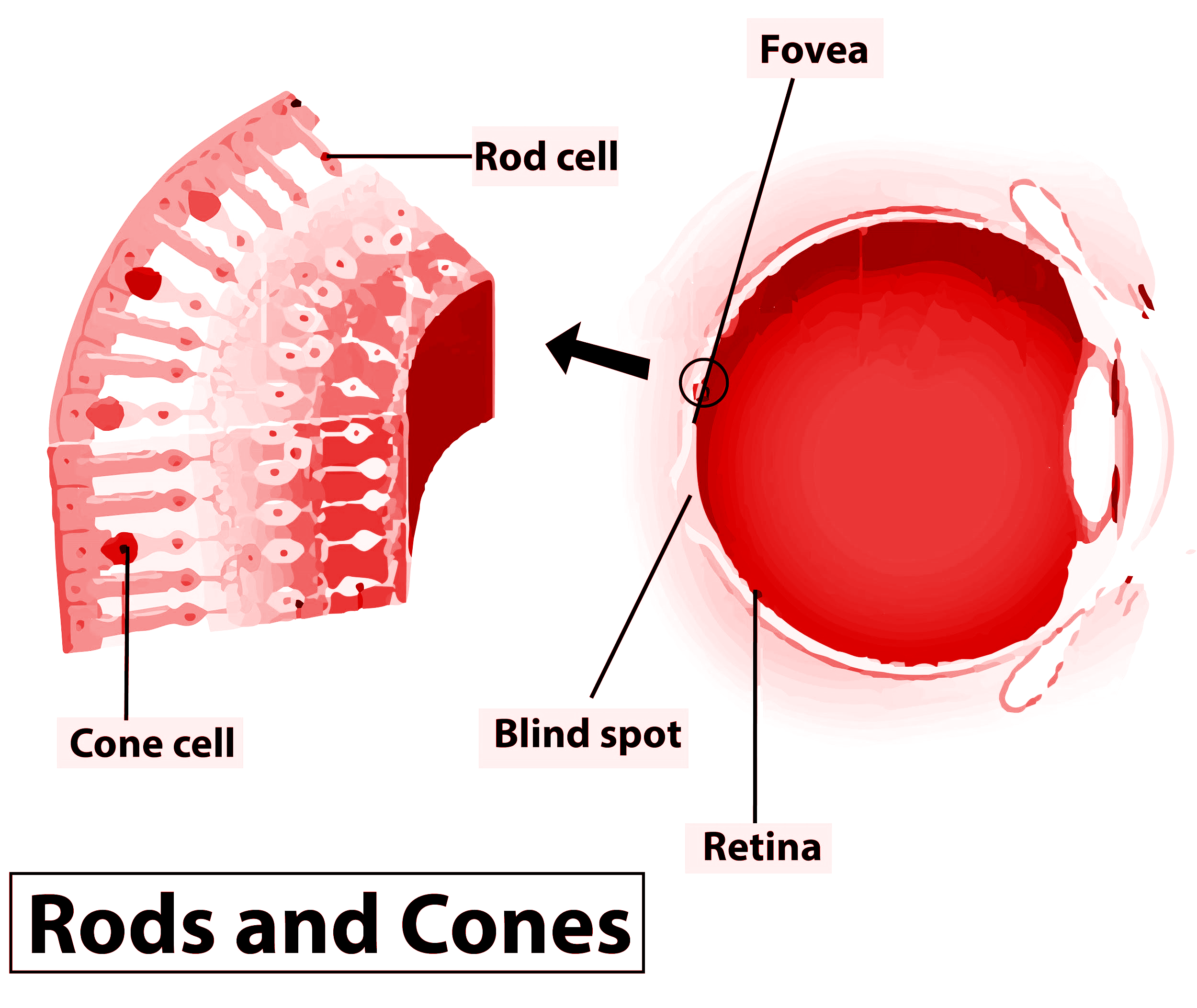
In the human eye, we find three types of cones that possess their own characteristic photopigments that respond to colors of red, green, and blue lights. The sensations of different colors are induced by various combinations of these cones and their photopigments. When these cones are being stimulated equally, a sensation of white light is produced as white light has all colors in it.
Note:
- The optic nerves leave and also allow blood vessels to enter inside the eye at a specific point which is medial to and slightly above the posterior pole of the eyeball. Photoreceptor cells are not seen in this region and no image is formed, hence it is called the blind spot.
- At the posterior pole of the eye just next to the blind spot, there is a yellow- pigmented spot called macula lutea which has a central pit called the fovea.
- The fovea is a thinned-out portion of the retina where cones cells are present but not rod cells. It is the point where the visual acuity (resolution) is the greatest as cones sense are responsible for color detection.
Complete Step by Step Answer:
The inner layer is the retina and it contains three layers of neural cells – from inside to outside – ganglion cells, bipolar cells, and photoreceptor cells. We find two types of photoreceptor cells known as rods and cones.
The daylight or the photopic vision and color vision are provided by the functioning of cones and the twilight or the scotopic vision is provided by the function of the rods. The rods have a purplish- red protein called the rhodopsin or visual purple. It is formed by a derivative of Vitamin- A and hence this vitamin is essential for the proper functioning of eyes.
In the human eye, we find three types of cones that possess their own characteristic photopigments that respond to colors of red, green, and blue lights. The sensations of different colors are induced by various combinations of these cones and their photopigments. When these cones are being stimulated equally, a sensation of white light is produced as white light has all colors in it.
Note:
- The optic nerves leave and also allow blood vessels to enter inside the eye at a specific point which is medial to and slightly above the posterior pole of the eyeball. Photoreceptor cells are not seen in this region and no image is formed, hence it is called the blind spot.
- At the posterior pole of the eye just next to the blind spot, there is a yellow- pigmented spot called macula lutea which has a central pit called the fovea.
- The fovea is a thinned-out portion of the retina where cones cells are present but not rod cells. It is the point where the visual acuity (resolution) is the greatest as cones sense are responsible for color detection.
Recently Updated Pages
Basicity of sulphurous acid and sulphuric acid are

Master Class 11 English: Engaging Questions & Answers for Success
Master Class 11 Physics: Engaging Questions & Answers for Success
Master Class 11 Computer Science: Engaging Questions & Answers for Success
Master Class 11 Chemistry: Engaging Questions & Answers for Success
Master Class 11 Social Science: Engaging Questions & Answers for Success
Trending doubts
Difference Between Prokaryotic Cells and Eukaryotic Cells
Two of the body parts which do not appear in MRI are class 11 biology CBSE
One Metric ton is equal to kg A 10000 B 1000 C 100 class 11 physics CBSE
10 examples of friction in our daily life
Draw a diagram of nephron and explain its structur class 11 biology CBSE
What will happen if the mucus is not secreted by the class 11 biology CBSE