




Describe the process of respiration in fish.
Answer
 Verified
647.4k+ views
Hint: Respiration in aquatic animals is different from terrestrial animals because of the low amount of oxygen present in water.
Complete answer:
Fishes are living in water and possess gills at either side of their head that are made up of feathery structures known as gill filaments. The gills of vertebrates typically grow in the walls of the pharynx, with a series of gill slits opening to the exterior. Fish consume oxygen-rich water through their mouths and pump it through their gills. As water passes from the gill filaments, blood inside the capillary network extracts the dissolved oxygen. The circulatory system then transports the oxygen to all body tissues and finally to the cells while picking up carbon dioxide which is removed from the body through the gills.
Functions of gills:
- Fish gills are organs that allow fish to breathe underwater by exchanging the oxygen and carbon dioxide using gills.
- As water contains a very low amount of dissolved oxygen, fish exchange gases by pulling oxygen-rich water through their mouths and forcing it over their gills.
- These gills are connected with blood vessels for the easy exchange of gases.
- Gills help the vertebrates to increase their surface area for oxygen exchange.
- Gills transfer the ions and water, as well as the exchange of oxygen, carbon dioxide, acids, and ammonia.
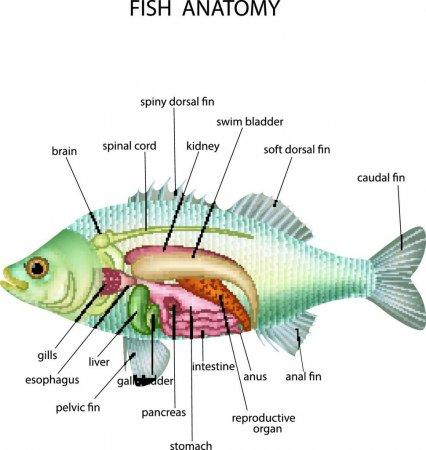
Figure: Internal structure of a fish
Note: Most fish are ectothermic or cold-blooded allowing their body temperatures to differ as ambient temperatures change however, some of the large fishes like white shark and tuna can hold a higher core temperature.
Complete answer:
Fishes are living in water and possess gills at either side of their head that are made up of feathery structures known as gill filaments. The gills of vertebrates typically grow in the walls of the pharynx, with a series of gill slits opening to the exterior. Fish consume oxygen-rich water through their mouths and pump it through their gills. As water passes from the gill filaments, blood inside the capillary network extracts the dissolved oxygen. The circulatory system then transports the oxygen to all body tissues and finally to the cells while picking up carbon dioxide which is removed from the body through the gills.
Functions of gills:
- Fish gills are organs that allow fish to breathe underwater by exchanging the oxygen and carbon dioxide using gills.
- As water contains a very low amount of dissolved oxygen, fish exchange gases by pulling oxygen-rich water through their mouths and forcing it over their gills.
- These gills are connected with blood vessels for the easy exchange of gases.
- Gills help the vertebrates to increase their surface area for oxygen exchange.
- Gills transfer the ions and water, as well as the exchange of oxygen, carbon dioxide, acids, and ammonia.
Figure: Internal structure of a fish
Note: Most fish are ectothermic or cold-blooded allowing their body temperatures to differ as ambient temperatures change however, some of the large fishes like white shark and tuna can hold a higher core temperature.
Recently Updated Pages
Master Class 11 English: Engaging Questions & Answers for Success

Master Class 11 Social Science: Engaging Questions & Answers for Success
Master Class 11 Maths: Engaging Questions & Answers for Success
Master Class 11 Biology: Engaging Questions & Answers for Success
Master Class 11 Physics: Engaging Questions & Answers for Success
Master Class 11 Chemistry: Engaging Questions & Answers for Success
Trending doubts
One Metric ton is equal to kg A 10000 B 1000 C 100 class 11 physics CBSE
What is cell theory Who formulated it class 11 biology CBSE
Phyllotaxy is the arrangement of ALeaflets BLeaves class 11 biology CBSE
Difference Between Prokaryotic Cells and Eukaryotic Cells
The symbiotic association of fungi and algae is called class 11 biology CBSE
Cell theory was formulated by A Schleiden and Schwann class 11 biology CBSE