




Describe the process of $C_{3}$ path of carbon fixation.How many $CO_{2}$ molecules are needed for operation of its one cycle?
Answer
 Verified
579.6k+ views
Hint: Carbon fixation means the assimilation of inorganic carbon and the conversion to organic compounds that can be used as an energy store and for the synthesis of biomolecules. All autotrophs, bacteria, algae and plants fix atmospheric carbon dioxide by photosynthesis or chemosynthesis.
Complete answer:
Photosynthesis is the main process for carbon fixation. Carbon fixation occurs in the dark reaction or light-independent photosynthesis process.
The process of carbon fixation differs slightly in $C_{3}$, $C_{4}$ and CAM plants, but the Calvin Cycle or $C_{3}$ pathway is the main biosynthetic pathway for carbon fixation.
The $C_{3}$ cycle has been discovered by M Calvin. It is the main route for the fixation of carbon dioxide in green plants. The first stable compound formed after carbon dioxide fixation is 3-carbon Phosphoglyceric Acid (PGA). It is therefore called the $C_{3}$ path.
The Calvin cycle has three phases:
1. Carboxylation of RuBPI This step involves the fixation of atmospheric $CO_{2}$ into a stable organic compound 3-Phosphoglyceric acid (3PGA) with the help of the enzyme RuBP, carboxylase-oxygenase or RuBisCo.
2. $CO_{2}$ reduction The 3-C PGA is then reduced by the assimilation power to form 3-C Phosphoglyceraldehyde (PGAL). NADPH2 supplies hydrogen and ATP energy for reduction.
The reaction is catalyzed by the triosephosphate dehydrogenase enzyme. Some PGAL molecules are converted to another triosephosphate called DihydroxyAcetone Phosphate (DHAP) in the presence of enzyme phosphotriose isomerase.
Sugar formation (final products of photosynthesis), 3-C triphosphate phosphate (i.e. PGAL and DHAP) forms 6-C hexose sugar-fructose-1,6-bisphosphate in the presence of the enzyme aldolase. Fructose bisphosphate is then phosphorylated first to monophosphate fructose and then to fructose in the presence of enzyme phosphatase.
Hexose sugar can be further converted to sucrose or starch and stored in the starch cells.3. RuBP Regeneration The 5-C RuBP is constantly required for the fixation of $CO_{2}$ in the Calvin cycle. It is regenerated by another chain of reactions.
Some of the triosephosphate and fructose monophosphate molecules are used in the Calvin cycle for the formation of RuBP to be used again to combine with $CO_{2}$. The net reaction of the Calvin cycle can be shown as
$6RuBP + 6CO_{2} + 18ATP + 12NADPH \to 6RuBP + C_{6}H_{12}O_{6} + 18ADP + 12NADPH + 18Pi$.
One molecule of $CO_{2}$ is fixed at one turn of the $C_{3}$ cycle. oThus, 6 turns of the cycle will be required to fix 6 molecules of $CO_{2}$ i.e. to form $C_{6}H_{12}O_{6}$(glucose).
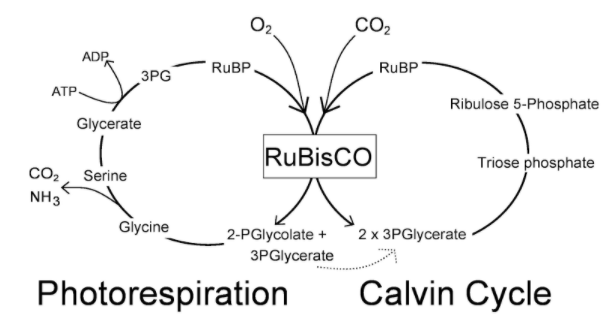
Note: The Calvin cycle is the main pathway for carbon fixation in plants, algae and cyanobacteria. Alternative pathways for carbon fixation are:
Reducing citric acid cycle – in bacteria
3-hydroxypropionate cycle – in bacteria and in archaea.
Reducing acetyl CoA pathway – in bacteria and archaea
Complete answer:
Photosynthesis is the main process for carbon fixation. Carbon fixation occurs in the dark reaction or light-independent photosynthesis process.
The process of carbon fixation differs slightly in $C_{3}$, $C_{4}$ and CAM plants, but the Calvin Cycle or $C_{3}$ pathway is the main biosynthetic pathway for carbon fixation.
The $C_{3}$ cycle has been discovered by M Calvin. It is the main route for the fixation of carbon dioxide in green plants. The first stable compound formed after carbon dioxide fixation is 3-carbon Phosphoglyceric Acid (PGA). It is therefore called the $C_{3}$ path.
The Calvin cycle has three phases:
1. Carboxylation of RuBPI This step involves the fixation of atmospheric $CO_{2}$ into a stable organic compound 3-Phosphoglyceric acid (3PGA) with the help of the enzyme RuBP, carboxylase-oxygenase or RuBisCo.
2. $CO_{2}$ reduction The 3-C PGA is then reduced by the assimilation power to form 3-C Phosphoglyceraldehyde (PGAL). NADPH2 supplies hydrogen and ATP energy for reduction.
The reaction is catalyzed by the triosephosphate dehydrogenase enzyme. Some PGAL molecules are converted to another triosephosphate called DihydroxyAcetone Phosphate (DHAP) in the presence of enzyme phosphotriose isomerase.
Sugar formation (final products of photosynthesis), 3-C triphosphate phosphate (i.e. PGAL and DHAP) forms 6-C hexose sugar-fructose-1,6-bisphosphate in the presence of the enzyme aldolase. Fructose bisphosphate is then phosphorylated first to monophosphate fructose and then to fructose in the presence of enzyme phosphatase.
Hexose sugar can be further converted to sucrose or starch and stored in the starch cells.3. RuBP Regeneration The 5-C RuBP is constantly required for the fixation of $CO_{2}$ in the Calvin cycle. It is regenerated by another chain of reactions.
Some of the triosephosphate and fructose monophosphate molecules are used in the Calvin cycle for the formation of RuBP to be used again to combine with $CO_{2}$. The net reaction of the Calvin cycle can be shown as
$6RuBP + 6CO_{2} + 18ATP + 12NADPH \to 6RuBP + C_{6}H_{12}O_{6} + 18ADP + 12NADPH + 18Pi$.
One molecule of $CO_{2}$ is fixed at one turn of the $C_{3}$ cycle. oThus, 6 turns of the cycle will be required to fix 6 molecules of $CO_{2}$ i.e. to form $C_{6}H_{12}O_{6}$(glucose).
Note: The Calvin cycle is the main pathway for carbon fixation in plants, algae and cyanobacteria. Alternative pathways for carbon fixation are:
Reducing citric acid cycle – in bacteria
3-hydroxypropionate cycle – in bacteria and in archaea.
Reducing acetyl CoA pathway – in bacteria and archaea
Recently Updated Pages
Master Class 11 English: Engaging Questions & Answers for Success

Master Class 11 Social Science: Engaging Questions & Answers for Success
Master Class 11 Maths: Engaging Questions & Answers for Success
Master Class 11 Biology: Engaging Questions & Answers for Success
Master Class 11 Physics: Engaging Questions & Answers for Success
Master Class 11 Chemistry: Engaging Questions & Answers for Success
Trending doubts
One Metric ton is equal to kg A 10000 B 1000 C 100 class 11 physics CBSE
What is cell theory Who formulated it class 11 biology CBSE
Phyllotaxy is the arrangement of ALeaflets BLeaves class 11 biology CBSE
Difference Between Prokaryotic Cells and Eukaryotic Cells
The symbiotic association of fungi and algae is called class 11 biology CBSE
Cell theory was formulated by A Schleiden and Schwann class 11 biology CBSE