




Describe the hypogeal type of seed germination.
Answer
 Verified
612k+ views
Hint: Seed germination could also be defined because the fundamental process by which different plant species grow from one seed into a plant. This process influences both crop yield and quality.
Complete step by step answer:
In hypogeal quiet germination, the cotyledons don't begin on the soil surface. In such seeds, the epicotyl (i.e., a part of the embryonic axis between plumule and cotyledons) elongates propel the plumule away from the soil. All monocotyledons show hypogeal germination. Among dicotyledons, gram, pea, and groundnut are few usual samples of hypogeal germination. In monocotyledons (e.g., wheat, maize, rice, coconut) radicle and plumule begin by piercing the coleorhiza and coleoptile respectively. The plumule grows upward and therefore the first leaf comes out of the coleoptile. The radicle forms the first root which is soon replaced by many fibrous roots.
Additional information: The complete process of seed germination is administered as are: - Throughout the starting stage of germination, the seeds catch up water rapidly and this leads to swelling and softening of the testa at an optimum temperature. This stage is mentioned as an Imbibition. It starts the expansion process by activation of enzymes. The seed activates its internal physiology and starts to breathe and produce proteins and metabolizes the stored food. This is often a lag phase of the seed germination.
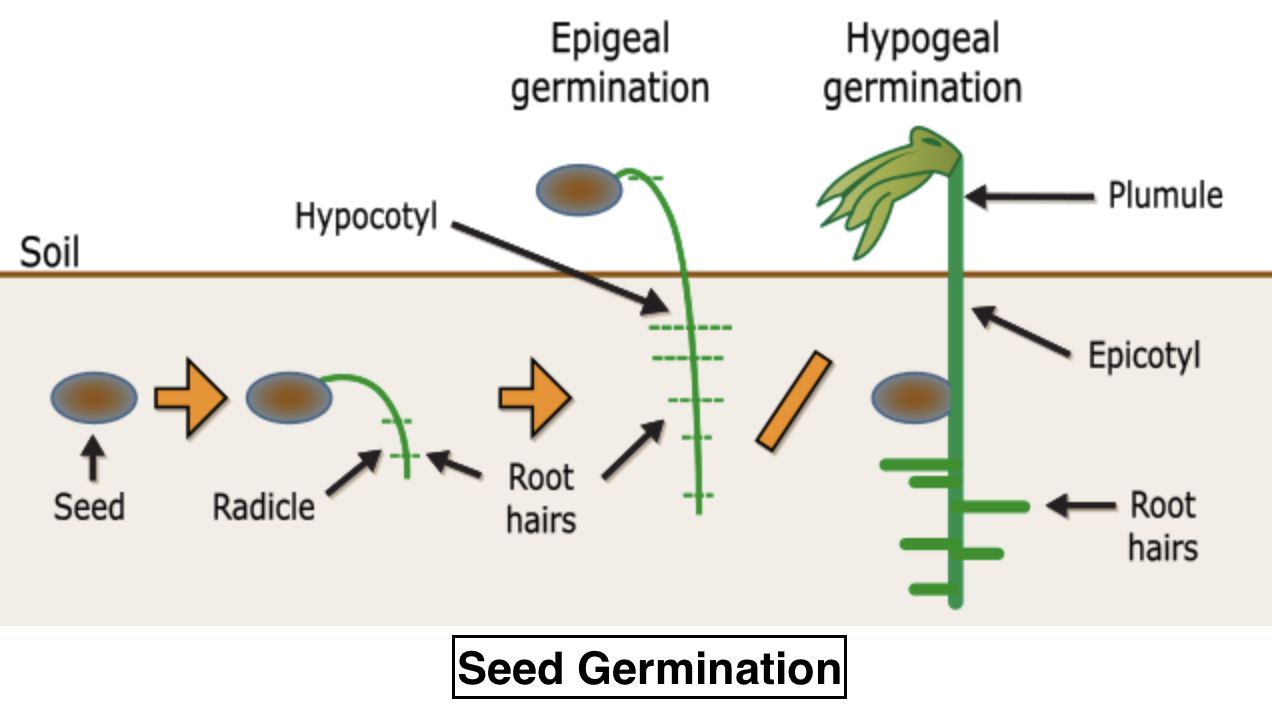
- By rupturing the testa, the radicle emerges to make it a primary root. The seed starts absorbing underground water. After the emergence of the radicle and therefore the plumule, the shoot starts growing upwards. - In the ultimate stage of seed germination, the cells of the seeds become metabolically active, elongate, and divide to offer rise to the seedling.
Note: The poor or additional supply of water affects seed germination. Temperature affects the expansion rate also because of the metabolism of the seed. Oxygen is required in germinating seeds as they respire vigorously and release the energy required for their growth. Therefore, deficiency of oxygen affects seed germination.
Complete step by step answer:
In hypogeal quiet germination, the cotyledons don't begin on the soil surface. In such seeds, the epicotyl (i.e., a part of the embryonic axis between plumule and cotyledons) elongates propel the plumule away from the soil. All monocotyledons show hypogeal germination. Among dicotyledons, gram, pea, and groundnut are few usual samples of hypogeal germination. In monocotyledons (e.g., wheat, maize, rice, coconut) radicle and plumule begin by piercing the coleorhiza and coleoptile respectively. The plumule grows upward and therefore the first leaf comes out of the coleoptile. The radicle forms the first root which is soon replaced by many fibrous roots.
Additional information: The complete process of seed germination is administered as are: - Throughout the starting stage of germination, the seeds catch up water rapidly and this leads to swelling and softening of the testa at an optimum temperature. This stage is mentioned as an Imbibition. It starts the expansion process by activation of enzymes. The seed activates its internal physiology and starts to breathe and produce proteins and metabolizes the stored food. This is often a lag phase of the seed germination.
- By rupturing the testa, the radicle emerges to make it a primary root. The seed starts absorbing underground water. After the emergence of the radicle and therefore the plumule, the shoot starts growing upwards. - In the ultimate stage of seed germination, the cells of the seeds become metabolically active, elongate, and divide to offer rise to the seedling.
Note: The poor or additional supply of water affects seed germination. Temperature affects the expansion rate also because of the metabolism of the seed. Oxygen is required in germinating seeds as they respire vigorously and release the energy required for their growth. Therefore, deficiency of oxygen affects seed germination.
Recently Updated Pages
Master Class 12 Economics: Engaging Questions & Answers for Success

Master Class 12 English: Engaging Questions & Answers for Success
Master Class 12 Social Science: Engaging Questions & Answers for Success
Master Class 12 Maths: Engaging Questions & Answers for Success
Master Class 12 Physics: Engaging Questions & Answers for Success
Master Class 11 Social Science: Engaging Questions & Answers for Success
Trending doubts
One Metric ton is equal to kg A 10000 B 1000 C 100 class 11 physics CBSE
Difference Between Prokaryotic Cells and Eukaryotic Cells
Find the value of the expression given below sin 30circ class 11 maths CBSE
Two of the body parts which do not appear in MRI are class 11 biology CBSE
1 ton equals to A 100 kg B 1000 kg C 10 kg D 10000 class 11 physics CBSE
Draw a diagram of nephron and explain its structur class 11 biology CBSE