




Describe the advantages and disadvantages of cross-pollination to the plant.
Answer
 Verified
659.7k+ views
Hint: Pollination is the process of transfer of pollen grains from the male of a flower to the female stigma. The transfer of pollen from another plant to the flower of another plant is known as cross-pollination.
Complete step-by-step answer:
Pollination is important because it leads to the production of fruits and seeds which in turn can create more plants.
Advantages of cross-pollination:
- Genetics recombination- as the pollination occurs between flowers of two different plants this results in the origin of new varieties. It helps in evolution.
-The offspring produced through cross-pollination is healthy, viable, and stronger (resistant) due to hybrid vigour.
- The seeds produced in this method are in greater quantities and are more viable.
- Give higher yields if only cross-pollination is allowed to occur in numerous crop plants (such as sunflower, mustard, clover, etc.)
- Variations are produced due to cross-pollination resulting in the origin of disease-resistant plants.
- Undesirable characters of the plant can be eliminated, and the possibility to get new desirable characters.
Disadvantages of cross-pollination:
- Cross-pollination depends on the agents, hence, not always sure that the pollination may occur. Pollination may fail due to the distance barrier.
- From an economic point of view, cross-pollination is not beneficial. There is a huge waste of pollen grains in this process and the plants waste a lot of energy on various contrivances required to ensure cross-pollination.
- Flowers of the plant may have to be large, showy, scented, and have sweet nectar to attract the agents of pollination.
- Cross-pollination may introduce some undesirable characters.
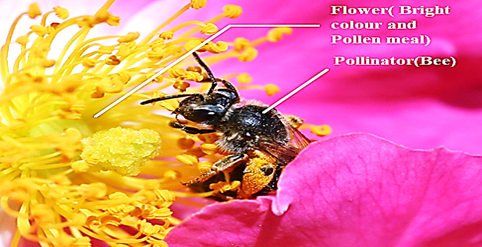
Note: Elements such as animals (bees, birds, and bats, etc.), water, wind, and even plants themselves are pollinating agents. These agents help pollinate within a species or between species so that it can produce hybrid offspring in nature and plant breeding work.
Complete step-by-step answer:
Pollination is important because it leads to the production of fruits and seeds which in turn can create more plants.
Advantages of cross-pollination:
- Genetics recombination- as the pollination occurs between flowers of two different plants this results in the origin of new varieties. It helps in evolution.
-The offspring produced through cross-pollination is healthy, viable, and stronger (resistant) due to hybrid vigour.
- The seeds produced in this method are in greater quantities and are more viable.
- Give higher yields if only cross-pollination is allowed to occur in numerous crop plants (such as sunflower, mustard, clover, etc.)
- Variations are produced due to cross-pollination resulting in the origin of disease-resistant plants.
- Undesirable characters of the plant can be eliminated, and the possibility to get new desirable characters.
Disadvantages of cross-pollination:
- Cross-pollination depends on the agents, hence, not always sure that the pollination may occur. Pollination may fail due to the distance barrier.
- From an economic point of view, cross-pollination is not beneficial. There is a huge waste of pollen grains in this process and the plants waste a lot of energy on various contrivances required to ensure cross-pollination.
- Flowers of the plant may have to be large, showy, scented, and have sweet nectar to attract the agents of pollination.
- Cross-pollination may introduce some undesirable characters.
Note: Elements such as animals (bees, birds, and bats, etc.), water, wind, and even plants themselves are pollinating agents. These agents help pollinate within a species or between species so that it can produce hybrid offspring in nature and plant breeding work.
Recently Updated Pages
Which will be the least stable resonating structure class 11 chemistry CBSE

How many 5 digit telephone numbers can be construc-class-11-maths-CBSE
How do you find the angle of the resultant vector class 11 physics CBSE
Draw labelled diagram of the following i Gram seed class 11 biology CBSE
1 Quintal is equal to a 110 kg b 10 kg c 100kg d 1000 class 11 physics CBSE
What is the need and importance of classification class 11 biology CBSE
Trending doubts
Find the value of the expression given below sin 30circ class 11 maths CBSE
One Metric ton is equal to kg A 10000 B 1000 C 100 class 11 physics CBSE
10 examples of friction in our daily life
Draw a diagram of a plant cell and label at least eight class 11 biology CBSE
Proton was discovered by A Thomson B Rutherford C Chadwick class 11 chemistry CBSE
10 examples of diffusion in everyday life