




Describe 'agranulocytes' with the help of diagrams.
Answer
 Verified
609.6k+ views
Hint: Certain white blood cells have the presence of granules in them. These types of cells are called granulocytes and certain cells do not have granules in the cytoplasm called agranulocytes.
Complete step by step answer:
Agranulocytes are a kind of white blood cells (WBCs) also known as leukocytes that do not have the presence of cytoplasmic granules. The two major types of agranulocytes are Lymphocytes and Monocytes.
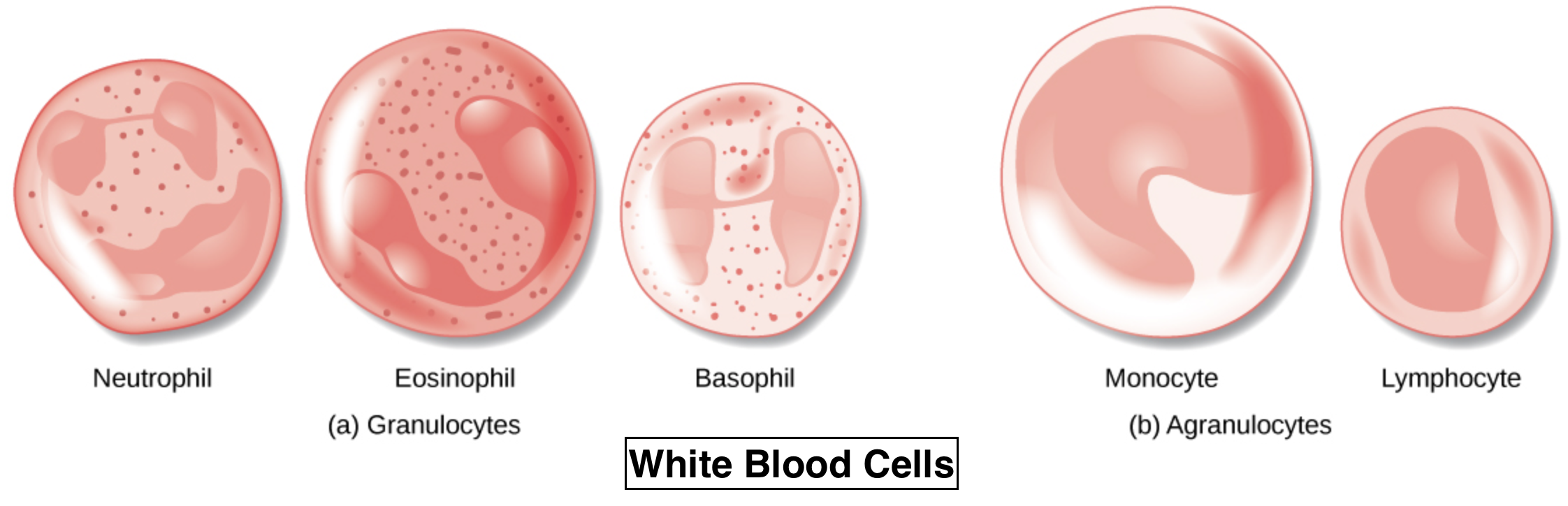
Lymphocytes are tiny cells with spherical nuclei and very less cytoplasm. Lymphocytes are divided into two types which are B lymphocytes (B cells) that produce antibodies that join with antigens and aim the pathogens for destruction and (T cells) T- lymphocytes which directly destroy the cells that have antigens on its surface. Monocytes are mononuclear leukocytes and are phagocytic and get transported by the blood to different parts where they divide into macrophages which are also phagocytic cells.
White blood cells aid in immunity, they identify antigens by antigen- antibody reaction and destroy them using various immune strategies.
Note:
- Human immunity is of two types, which are acquired immunity and inborn immunity. Inborn immunity is the defence system of humans as an infant which is mostly derived from the mother.
- Acquired immunity is the type of immunity that humans develop over time as they grow. When they come in contact with an antigen they preserve it in the cell memory for better protection when the same antigen attacks.
- When the immune cells become faulty and start to attack its own cells, it is known as autoimmune diseases.
Complete step by step answer:
Agranulocytes are a kind of white blood cells (WBCs) also known as leukocytes that do not have the presence of cytoplasmic granules. The two major types of agranulocytes are Lymphocytes and Monocytes.
Lymphocytes are tiny cells with spherical nuclei and very less cytoplasm. Lymphocytes are divided into two types which are B lymphocytes (B cells) that produce antibodies that join with antigens and aim the pathogens for destruction and (T cells) T- lymphocytes which directly destroy the cells that have antigens on its surface. Monocytes are mononuclear leukocytes and are phagocytic and get transported by the blood to different parts where they divide into macrophages which are also phagocytic cells.
White blood cells aid in immunity, they identify antigens by antigen- antibody reaction and destroy them using various immune strategies.
Note:
- Human immunity is of two types, which are acquired immunity and inborn immunity. Inborn immunity is the defence system of humans as an infant which is mostly derived from the mother.
- Acquired immunity is the type of immunity that humans develop over time as they grow. When they come in contact with an antigen they preserve it in the cell memory for better protection when the same antigen attacks.
- When the immune cells become faulty and start to attack its own cells, it is known as autoimmune diseases.
Recently Updated Pages
Master Class 12 Economics: Engaging Questions & Answers for Success

Master Class 12 English: Engaging Questions & Answers for Success
Master Class 12 Social Science: Engaging Questions & Answers for Success
Master Class 12 Maths: Engaging Questions & Answers for Success
Master Class 12 Physics: Engaging Questions & Answers for Success
Master Class 9 General Knowledge: Engaging Questions & Answers for Success
Trending doubts
One Metric ton is equal to kg A 10000 B 1000 C 100 class 11 physics CBSE
Difference Between Prokaryotic Cells and Eukaryotic Cells
Two of the body parts which do not appear in MRI are class 11 biology CBSE
1 ton equals to A 100 kg B 1000 kg C 10 kg D 10000 class 11 physics CBSE
Draw a diagram of nephron and explain its structur class 11 biology CBSE
10 examples of friction in our daily life