




Derive the thin lens formula.
Answer
 Verified
630.9k+ views
Hint: Try to learn about different types of lenses. Learn the concepts of image formation using lenses. Then apply this concept to a thin convex lens and do the formation image part by part to obtain a thin lens formula.
Complete step by step answer:
Consider a thin convex lens.
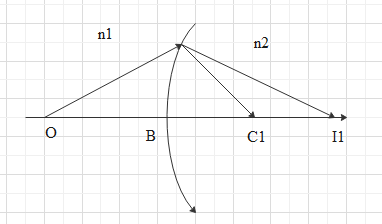
Let the first reflecting surface of the lens form an image at ${{I}_{1}}$ of object at O.
Relation between the object and image distance in terms of the refractive index can be given as,
$\dfrac{{{n}_{1}}}{OB}+\dfrac{{{n}_{2}}}{B{{I}_{1}}}=\dfrac{{{n}_{2}}-{{n}_{1}}}{B{{C}_{1}}}\text{ }\to \text{ 1}$
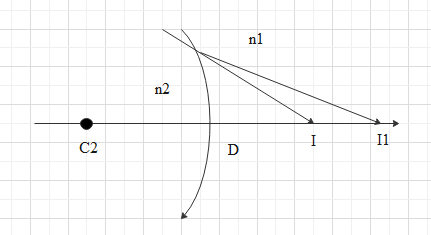
The image at ${{I}_{1}}$ acts as a virtual object for the second surface of the lens and it will form an image at $I$.
$-\dfrac{{{n}_{2}}}{D{{I}_{1}}}+\dfrac{{{n}_{1}}}{DI}=\dfrac{{{n}_{2}}-{{n}_{1}}}{D{{C}_{2}}}\text{ }\to \text{ 2}$
Now, for a thin lens we will get $B{{I}_{1}}\cong D{{I}_{1}}$
Putting this value on equation 1 and 2, and then adding the two equations, we get,
$\begin{align}
& \dfrac{{{n}_{1}}}{OB}+\dfrac{{{n}_{2}}}{B{{I}_{1}}}-\dfrac{{{n}_{2}}}{B{{I}_{1}}}+\dfrac{{{n}_{1}}}{DI}=\dfrac{{{n}_{2}}-{{n}_{1}}}{B{{C}_{1}}}\text{+}\dfrac{{{n}_{2}}-{{n}_{1}}}{D{{C}_{2}}}\text{ } \\
& \dfrac{{{n}_{1}}}{OB}+\dfrac{{{n}_{1}}}{DI}=\left( {{n}_{2}}-{{n}_{1}} \right)\left( \dfrac{1}{B{{C}_{1}}}\text{+}\dfrac{1}{D{{C}_{2}}} \right)\text{ }\to \text{ 3} \\
\end{align}$
Now, suppose the object is at infinity, i.e. $OB\to \infty $ and $DI=f$ , then we can write the above equation as,
$\begin{align}
& \dfrac{{{n}_{1}}}{\infty }+\dfrac{{{n}_{1}}}{f}=\left( {{n}_{2}}-{{n}_{1}} \right)\left( \dfrac{1}{B{{C}_{1}}}\text{+}\dfrac{1}{D{{C}_{2}}} \right) \\
& \dfrac{{{n}_{1}}}{f}=\left( {{n}_{2}}-{{n}_{1}} \right)\left( \dfrac{1}{B{{C}_{1}}}\text{+}\dfrac{1}{D{{C}_{2}}} \right)\text{ }\to \text{ 4} \\
\end{align}$
Comparing equation 3 and 4 we get that,
$\begin{align}
& \dfrac{{{n}_{1}}}{OB}+\dfrac{{{n}_{1}}}{DI}=\dfrac{{{n}_{1}}}{f} \\
& \dfrac{1}{OB}+\dfrac{1}{DI}=\dfrac{1}{f} \\
\end{align}$
Again, in thin lens approximation we can say that B and D are both close to the optical centre of the lens. Applying the sign convention, we can write,
$BO=-u\text{ and }DI=+v$
Where, u is the object distance and v is the image distance.
So, the above equation can be written as,
$\begin{align}
& \dfrac{1}{-u}+\dfrac{1}{v}=\dfrac{1}{f} \\
& \dfrac{1}{v}-\dfrac{1}{u}=\dfrac{1}{f} \\
\end{align}$
This is the thin lens formula.
Note: Here, we have derived the thin lens formula considering the image formation process in a convex lens. But this formula is also valid for the concave lens for both real and virtual images.
In a spherical mirror we have two focal points. These two focal points are equidistant from the mirrors optical centre.
Complete step by step answer:
Consider a thin convex lens.
Let the first reflecting surface of the lens form an image at ${{I}_{1}}$ of object at O.
Relation between the object and image distance in terms of the refractive index can be given as,
$\dfrac{{{n}_{1}}}{OB}+\dfrac{{{n}_{2}}}{B{{I}_{1}}}=\dfrac{{{n}_{2}}-{{n}_{1}}}{B{{C}_{1}}}\text{ }\to \text{ 1}$
The image at ${{I}_{1}}$ acts as a virtual object for the second surface of the lens and it will form an image at $I$.
$-\dfrac{{{n}_{2}}}{D{{I}_{1}}}+\dfrac{{{n}_{1}}}{DI}=\dfrac{{{n}_{2}}-{{n}_{1}}}{D{{C}_{2}}}\text{ }\to \text{ 2}$
Now, for a thin lens we will get $B{{I}_{1}}\cong D{{I}_{1}}$
Putting this value on equation 1 and 2, and then adding the two equations, we get,
$\begin{align}
& \dfrac{{{n}_{1}}}{OB}+\dfrac{{{n}_{2}}}{B{{I}_{1}}}-\dfrac{{{n}_{2}}}{B{{I}_{1}}}+\dfrac{{{n}_{1}}}{DI}=\dfrac{{{n}_{2}}-{{n}_{1}}}{B{{C}_{1}}}\text{+}\dfrac{{{n}_{2}}-{{n}_{1}}}{D{{C}_{2}}}\text{ } \\
& \dfrac{{{n}_{1}}}{OB}+\dfrac{{{n}_{1}}}{DI}=\left( {{n}_{2}}-{{n}_{1}} \right)\left( \dfrac{1}{B{{C}_{1}}}\text{+}\dfrac{1}{D{{C}_{2}}} \right)\text{ }\to \text{ 3} \\
\end{align}$
Now, suppose the object is at infinity, i.e. $OB\to \infty $ and $DI=f$ , then we can write the above equation as,
$\begin{align}
& \dfrac{{{n}_{1}}}{\infty }+\dfrac{{{n}_{1}}}{f}=\left( {{n}_{2}}-{{n}_{1}} \right)\left( \dfrac{1}{B{{C}_{1}}}\text{+}\dfrac{1}{D{{C}_{2}}} \right) \\
& \dfrac{{{n}_{1}}}{f}=\left( {{n}_{2}}-{{n}_{1}} \right)\left( \dfrac{1}{B{{C}_{1}}}\text{+}\dfrac{1}{D{{C}_{2}}} \right)\text{ }\to \text{ 4} \\
\end{align}$
Comparing equation 3 and 4 we get that,
$\begin{align}
& \dfrac{{{n}_{1}}}{OB}+\dfrac{{{n}_{1}}}{DI}=\dfrac{{{n}_{1}}}{f} \\
& \dfrac{1}{OB}+\dfrac{1}{DI}=\dfrac{1}{f} \\
\end{align}$
Again, in thin lens approximation we can say that B and D are both close to the optical centre of the lens. Applying the sign convention, we can write,
$BO=-u\text{ and }DI=+v$
Where, u is the object distance and v is the image distance.
So, the above equation can be written as,
$\begin{align}
& \dfrac{1}{-u}+\dfrac{1}{v}=\dfrac{1}{f} \\
& \dfrac{1}{v}-\dfrac{1}{u}=\dfrac{1}{f} \\
\end{align}$
This is the thin lens formula.
Note: Here, we have derived the thin lens formula considering the image formation process in a convex lens. But this formula is also valid for the concave lens for both real and virtual images.
In a spherical mirror we have two focal points. These two focal points are equidistant from the mirrors optical centre.
Recently Updated Pages
Master Class 12 Economics: Engaging Questions & Answers for Success

Master Class 12 English: Engaging Questions & Answers for Success
Master Class 12 Social Science: Engaging Questions & Answers for Success
Master Class 12 Maths: Engaging Questions & Answers for Success
Master Class 12 Physics: Engaging Questions & Answers for Success
Master Class 9 General Knowledge: Engaging Questions & Answers for Success
Trending doubts
Which are the Top 10 Largest Countries of the World?
Draw a labelled sketch of the human eye class 12 physics CBSE
Differentiate between homogeneous and heterogeneous class 12 chemistry CBSE
Why is the cell called the structural and functional class 12 biology CBSE
Draw ray diagrams each showing i myopic eye and ii class 12 physics CBSE
Which is the correct genotypic ratio of mendel dihybrid class 12 biology CBSE