



Define the structure of the root.
Answer
 Verified
569.1k+ views
Hint: Root is a plant organ that supports the absorption of soil nutrients and water. It is found at the end mostly. It consists of three areas: the meristematic zone, the elongation zone and the differentiation zone.
Complete answer:
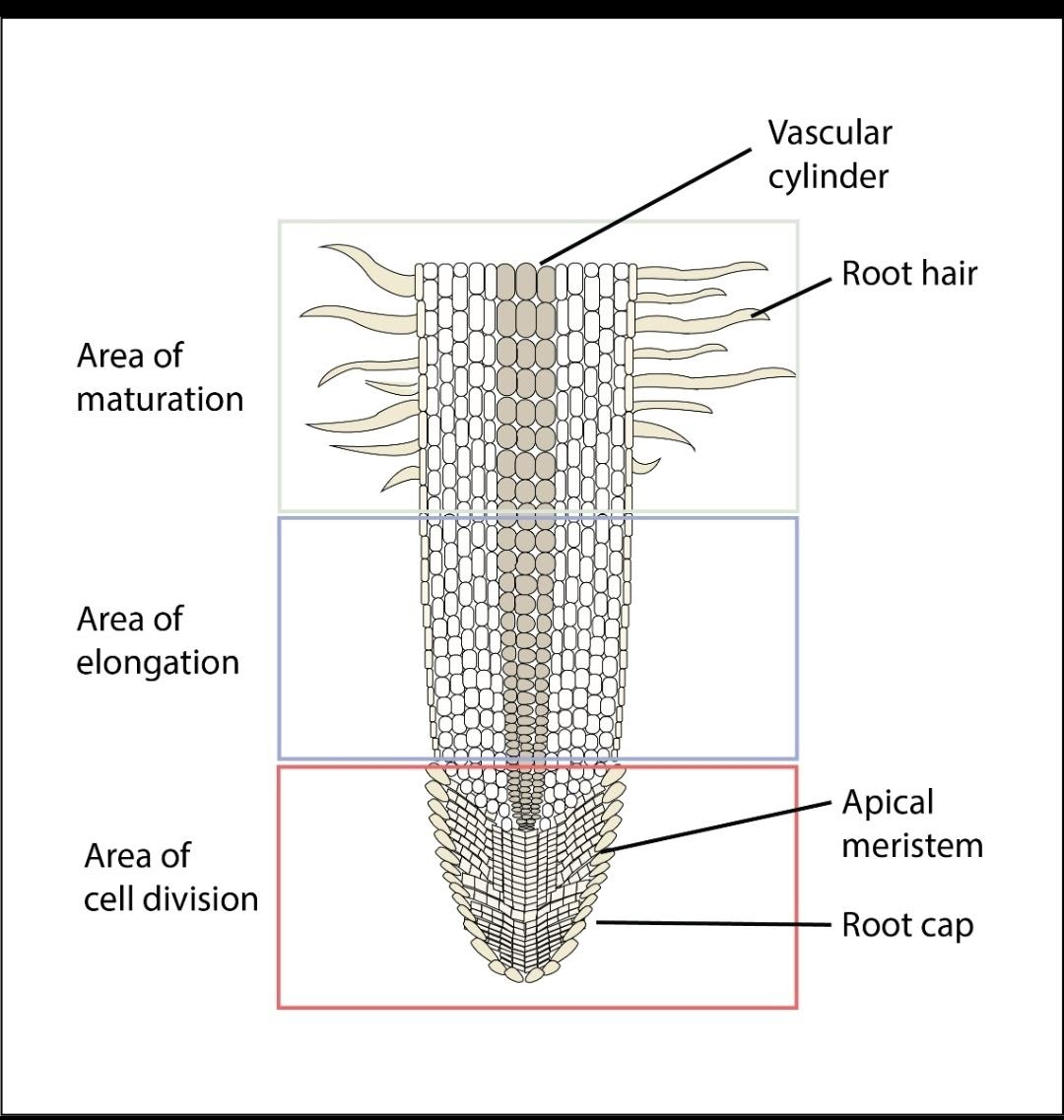
A typical root system is divided into five regions.
Root cap: The root cap, also known as calyptra, is the root tip. It aids the root in receiving and transmitting environmental signals. It produces mucilage, which aids the plant's penetration of the soil. As the root moves through the soil, it is easily weakened. It also safeguards the meristematic zone.
Meristematic zone (point of development): It is located just above the root tip and provides the root with the basal area. It increases the number of cells in the root cap. Undifferentiated meristematic cells undergo rapid mitosis.
Zone of elongation: increases the root length and lies just behind the meristematic area. This area has external cells that help water and minerals to be absorbed. It lets the root get into the ground deeper.
Zone of differentiation: also, the hair zone of the root. It is the area where xylem, phloem, pericycle, body, periblem and endodermis differentiate. Epiblema cells stretch out to form single-cell root hair.
The maturation zone: It makes up the majority of the root system. Different types of cells emerged as a result of cell differentiation. This zone's primary functions are security, storage, and conductance. The epidermis is the outer layer, the cortex is the deeper layer, and vascular bundles are found in the central area.
Note: The cortex of the root is located between the epidermis and the vascular tissue, while the pith is located between the epidermis and the vascular tissue. Between the root's centre and the vascular tissue is the pith.
Complete answer:
A typical root system is divided into five regions.
Root cap: The root cap, also known as calyptra, is the root tip. It aids the root in receiving and transmitting environmental signals. It produces mucilage, which aids the plant's penetration of the soil. As the root moves through the soil, it is easily weakened. It also safeguards the meristematic zone.
Meristematic zone (point of development): It is located just above the root tip and provides the root with the basal area. It increases the number of cells in the root cap. Undifferentiated meristematic cells undergo rapid mitosis.
Zone of elongation: increases the root length and lies just behind the meristematic area. This area has external cells that help water and minerals to be absorbed. It lets the root get into the ground deeper.
Zone of differentiation: also, the hair zone of the root. It is the area where xylem, phloem, pericycle, body, periblem and endodermis differentiate. Epiblema cells stretch out to form single-cell root hair.
The maturation zone: It makes up the majority of the root system. Different types of cells emerged as a result of cell differentiation. This zone's primary functions are security, storage, and conductance. The epidermis is the outer layer, the cortex is the deeper layer, and vascular bundles are found in the central area.
Note: The cortex of the root is located between the epidermis and the vascular tissue, while the pith is located between the epidermis and the vascular tissue. Between the root's centre and the vascular tissue is the pith.
Recently Updated Pages
Master Class 11 Social Science: Engaging Questions & Answers for Success

Master Class 11 English: Engaging Questions & Answers for Success
Master Class 11 Accountancy: Engaging Questions & Answers for Success
Master Class 11 Physics: Engaging Questions & Answers for Success
Master Class 11 Computer Science: Engaging Questions & Answers for Success
Master Class 11 Business Studies: Engaging Questions & Answers for Success
Trending doubts
Find the value of the expression given below sin 30circ class 11 maths CBSE
One Metric ton is equal to kg A 10000 B 1000 C 100 class 11 physics CBSE
Draw a diagram of nephron and explain its structur class 11 biology CBSE
10 examples of friction in our daily life
Proton was discovered by A Thomson B Rutherford C Chadwick class 11 chemistry CBSE
The teeth used for biting and cutting food are called class 11 biology CBSE