




Define regeneration and fragmentation.
Answer
 Verified
620.7k+ views
Hint: Both are types of asexual reproduction. In asexual reproduction, the only one parent gives rise to new organisms. In fragmentation reproduction fully new organisms arise from pre-existing cells, whereas in regeneration only a certain part or full body can re-grow.
Complete answer:
Regeneration: Regeneration is a process where complete or partial body parts can regrow through specialized stem cells present in it. When organisms are broken into several pieces then each piece can regrow their missing parts. A most common example we can see in our environment is regrowth of lizard’s tail. It is generally seen in multicellular complex body structure organisms.
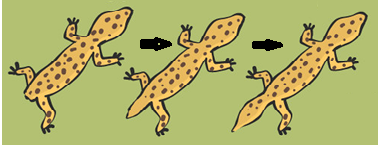
Fragmentation: In this process, organisms are split into small pieces and each piece grows into new organisms. These new offspring are cloned to their parents. A most common example is spirogyra. Fragmentation is seen in multicellular simple body organisms.
Additional information: In regeneration can also see in other organisms like an octopus, jellyfish, etc. Fungi, annelid worm, sea anemones, sponges etc can undergo fragmentation. Both vertebrates and invertebrates can undergo regeneration. Whereas, in fragmentation, only invertebrates can undergo. Plants also undergo both regeneration and fragmentation processes. Especially non-vascular plants in case of fragmentation.
Note: Both processes look similar to each other because new organisms are rising from broken or split body parts. But in the case of fragmentation, no missing body part can regrow. In these cases, only new separated organisms are formed. However, in regeneration new organisms as well as missing body parts can regrow.
Complete answer:
Regeneration: Regeneration is a process where complete or partial body parts can regrow through specialized stem cells present in it. When organisms are broken into several pieces then each piece can regrow their missing parts. A most common example we can see in our environment is regrowth of lizard’s tail. It is generally seen in multicellular complex body structure organisms.
Fragmentation: In this process, organisms are split into small pieces and each piece grows into new organisms. These new offspring are cloned to their parents. A most common example is spirogyra. Fragmentation is seen in multicellular simple body organisms.
Additional information: In regeneration can also see in other organisms like an octopus, jellyfish, etc. Fungi, annelid worm, sea anemones, sponges etc can undergo fragmentation. Both vertebrates and invertebrates can undergo regeneration. Whereas, in fragmentation, only invertebrates can undergo. Plants also undergo both regeneration and fragmentation processes. Especially non-vascular plants in case of fragmentation.
Note: Both processes look similar to each other because new organisms are rising from broken or split body parts. But in the case of fragmentation, no missing body part can regrow. In these cases, only new separated organisms are formed. However, in regeneration new organisms as well as missing body parts can regrow.
Recently Updated Pages
Master Class 12 Business Studies: Engaging Questions & Answers for Success

Master Class 12 Chemistry: Engaging Questions & Answers for Success
Master Class 12 Biology: Engaging Questions & Answers for Success
Class 12 Question and Answer - Your Ultimate Solutions Guide
Master Class 11 English: Engaging Questions & Answers for Success
Master Class 11 Social Science: Engaging Questions & Answers for Success
Trending doubts
Which are the Top 10 Largest Countries of the World?
Draw a labelled sketch of the human eye class 12 physics CBSE
Differentiate between homogeneous and heterogeneous class 12 chemistry CBSE
Differentiate between Pyramid of energy and pyramid class 12 biology CBSE
Why is the cell called the structural and functional class 12 biology CBSE
Draw the diagram of the pyramid of energy Explain In class 12 biology CBSE