




Define Refracted ray.
Answer
 Verified
557.1k+ views
Hint: We start by defining the process, that is refraction and how and why refraction occurs. Then we move onto defining the asked part with the help of a diagram for easier and simple understanding.
Complete answer:
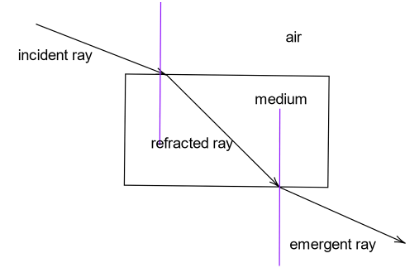
Refraction:When a ray of light travels from one medium to another, there will be a change in the speed of light. The process responsible for this is called refraction.
Incident ray:The ray falling on the surface separating two media is called incident ray. The angle it makes with the normal (the purple line) is called the incident angle.
Refracted ray: When the incident ray travels through the interface separating two media, it undergoes a change in velocity and direction according to the value of density of the medium as a result of interaction with the medium is called refracted ray. Just like the incident angle, it is the angle the refracted ray makes with the normal (the purple line in the figure).Refraction occurs when an incident ray comes in contact with a different medium and the result of refraction is the change in speed and direction of the light ray.
Note: The direction change after refraction is governed by the density of the medium. If the medium is denser, the ray moves towards the normal and if the ray is rarer the ray moves away from the normal. Refraction is also governed by Snell’s law, the formula of Snell’s law is, \[{n_1}\sin {\theta _1} = {n_2}\sin {\theta _2}\] where \[{n_1}\] and \[{n_2}\] are the refractive indices of the medium.
Complete answer:
Refraction:When a ray of light travels from one medium to another, there will be a change in the speed of light. The process responsible for this is called refraction.
Incident ray:The ray falling on the surface separating two media is called incident ray. The angle it makes with the normal (the purple line) is called the incident angle.
Refracted ray: When the incident ray travels through the interface separating two media, it undergoes a change in velocity and direction according to the value of density of the medium as a result of interaction with the medium is called refracted ray. Just like the incident angle, it is the angle the refracted ray makes with the normal (the purple line in the figure).Refraction occurs when an incident ray comes in contact with a different medium and the result of refraction is the change in speed and direction of the light ray.
Note: The direction change after refraction is governed by the density of the medium. If the medium is denser, the ray moves towards the normal and if the ray is rarer the ray moves away from the normal. Refraction is also governed by Snell’s law, the formula of Snell’s law is, \[{n_1}\sin {\theta _1} = {n_2}\sin {\theta _2}\] where \[{n_1}\] and \[{n_2}\] are the refractive indices of the medium.
Recently Updated Pages
Differentiate between voluntary action and reflex class 10 biology CBSE

The uses of bleaching powder are A It is used bleaching class 10 chemistry CBSE
Fill in the blanks with abstract nouns of the words class 10 english CBSE
How many threedigit numbers are there class 10 maths CBSE
What is a reflex arc class 10 biology CBSE
Construct a square whose diagonal is 6cm Measure the class 10 maths CBSE
Trending doubts
Explain the Treaty of Vienna of 1815 class 10 social science CBSE
The slogan Jai Hind was given by A Lal Bahadur Shastri class 10 social science CBSE
10 examples of evaporation in daily life with explanations
What is the full form of POSCO class 10 social science CBSE
Identify the feminine form of noun nephew a shenephew class 10 english CBSE
Make a sketch of the human nerve cell What function class 10 biology CBSE