




Define oscillatory motion.
Answer
 Verified
626.7k+ views
Hint: A motion is said to be oscillatory if its diagram in displacement-time graph is either
A. Sinusoidal with constant amplitude. (undamped)
B. Sinusoidal with decreasing amplitude. (damped)
Complete step-by-step answer:
We first need to know about the simple harmonic motion where the force on a body is proportional to its displacement from a mean position. Its equation of motion can be given by,
$$m\dfrac{d^2y}{dt^2}+R\dfrac{dy}{dt}+ky=0$$
Where R is the damping force per unit velocity of the object. k is called the force constant. The equation is modified as,
$$\dfrac{d^2y}{dt^2}+2b\dfrac{dy}{dt}+\omega_0^2y=0$$
Here, $$2b=\dfrac{R}{m}$$ and $$\omega_0^2=\dfrac{k}{m}$$
Undamped oscillatory motion- In this case, R=0 $$\Rightarrow$$ b=0. Hence the equation reduces to,
$$\dfrac{d^2y}{dt^2}+\omega_0^2y=0$$
The solution will be, $$y=A.cos(\omega_0t-\theta) $$
Where, A is the amplitude of oscillation and $$\theta$$ depends on the initial conditions. Its diagram looks like…..
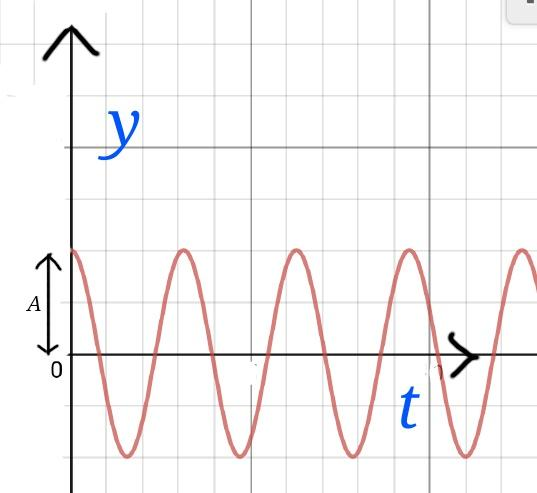
Its energy is given by,
$$E=E_k+E_p=\dfrac{1}{2}m(\dfrac{dy}{dt})^2+\dfrac{1}{2}m\omega_0^2y^2\\=\dfrac{1}{2}m\omega_0^2A^2 $$
Damped oscillation- In case $$b\neq 0$$, oscillation can only be observed if $$b\leq \omega_0$$ and in all the other cases no oscillation will be observed.
If $$b\geq \omega_0$$ ,the motion is called over damped.
If $$b=\omega_0$$, the motion is said to be critically damped.
In these two cases there is no oscillation. For oscillation (damped), $$b\leq \omega_0$$
In this case, the solution is given by, $$y=A.e^{-bt}.cos(\omega t-\theta)$$
Here, $$\omega=\sqrt{\omega_0^2-b^2}$$
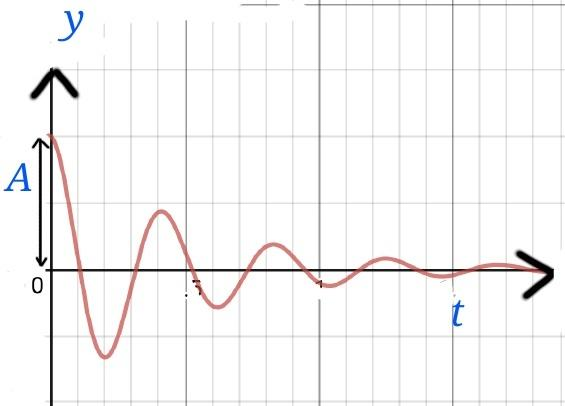
The diagram will look like this.
In this case, the amplitude decreases as , $$A_1=Ae^{-bt}$$
Its energy can be shown to be $$E=\dfrac{1}{2}m\omega_0^2A^2e^{-2bt}$$
Note: There is another type of oscillation that is called forced oscillation. In this case, the system is forced to move in oscillation by an oscillatory external force.
A. Sinusoidal with constant amplitude. (undamped)
B. Sinusoidal with decreasing amplitude. (damped)
Complete step-by-step answer:
We first need to know about the simple harmonic motion where the force on a body is proportional to its displacement from a mean position. Its equation of motion can be given by,
$$m\dfrac{d^2y}{dt^2}+R\dfrac{dy}{dt}+ky=0$$
Where R is the damping force per unit velocity of the object. k is called the force constant. The equation is modified as,
$$\dfrac{d^2y}{dt^2}+2b\dfrac{dy}{dt}+\omega_0^2y=0$$
Here, $$2b=\dfrac{R}{m}$$ and $$\omega_0^2=\dfrac{k}{m}$$
Undamped oscillatory motion- In this case, R=0 $$\Rightarrow$$ b=0. Hence the equation reduces to,
$$\dfrac{d^2y}{dt^2}+\omega_0^2y=0$$
The solution will be, $$y=A.cos(\omega_0t-\theta) $$
Where, A is the amplitude of oscillation and $$\theta$$ depends on the initial conditions. Its diagram looks like…..
Its energy is given by,
$$E=E_k+E_p=\dfrac{1}{2}m(\dfrac{dy}{dt})^2+\dfrac{1}{2}m\omega_0^2y^2\\=\dfrac{1}{2}m\omega_0^2A^2 $$
Damped oscillation- In case $$b\neq 0$$, oscillation can only be observed if $$b\leq \omega_0$$ and in all the other cases no oscillation will be observed.
If $$b\geq \omega_0$$ ,the motion is called over damped.
If $$b=\omega_0$$, the motion is said to be critically damped.
In these two cases there is no oscillation. For oscillation (damped), $$b\leq \omega_0$$
In this case, the solution is given by, $$y=A.e^{-bt}.cos(\omega t-\theta)$$
Here, $$\omega=\sqrt{\omega_0^2-b^2}$$
The diagram will look like this.
In this case, the amplitude decreases as , $$A_1=Ae^{-bt}$$
Its energy can be shown to be $$E=\dfrac{1}{2}m\omega_0^2A^2e^{-2bt}$$
Note: There is another type of oscillation that is called forced oscillation. In this case, the system is forced to move in oscillation by an oscillatory external force.
Recently Updated Pages
Master Class 11 English: Engaging Questions & Answers for Success

Master Class 11 Maths: Engaging Questions & Answers for Success
Class 11 Question and Answer - Your Ultimate Solutions Guide
Master Class 11 Biology: Engaging Questions & Answers for Success
Master Class 11 Physics: Engaging Questions & Answers for Success
Master Class 11 Accountancy: Engaging Questions & Answers for Success
Trending doubts
Differentiate between an exothermic and an endothermic class 11 chemistry CBSE
One Metric ton is equal to kg A 10000 B 1000 C 100 class 11 physics CBSE
Difference Between Prokaryotic Cells and Eukaryotic Cells
There are 720 permutations of the digits 1 2 3 4 5 class 11 maths CBSE
Draw a diagram of a plant cell and label at least eight class 11 biology CBSE
1 Quintal is equal to a 110 kg b 10 kg c 100kg d 1000 class 11 physics CBSE