




Define many-one function. Give an example of many-one functions.
Answer
 Verified
593.4k+ views
Hint: As we know that a function $f:X \to Y$ that is from variable $X$ to variable $Y$ is said to be one-one functions if there exist only one element from domain connected with only one and unique element from co-domain. Similarly ,we can say that a function$f:X \to Y$ that is from variable $X$ to variable $Y$ is said to be many-one functions if there exist two or more elements from the domain connected with the same element from the co-domain.
With the help of this definition, we can give an example, consider elements of $X$ be $\{ 1,2\} $ and elements of $Y$ be $\{ x\} $ and $f:X \to Y$ such that $f = \{ (1,x),(2,x)\} $ . here element one and two both connected with the same element that is $x$ . This is how a function can have many-one relationships.
Complete step-by-step answer:
Many-one function is defined as , A function$f:X \to Y$ that is from variable $X$ to variable $Y$ is said to be many-one functions if there exist two or more elements from a domain connected with the same element from the co-domain .
Let us consider an example ,
Let the domain or elements of $X$ be $\{ 1,2.3,4,5,6\} $ ,
Let the co-domain or elements of $Y$ be $\{ x,y,z\} $ and
$f:X \to Y$
Such that $f = \{ (1,x),(2,x),(3,x),(4,y),(5,z)\} $
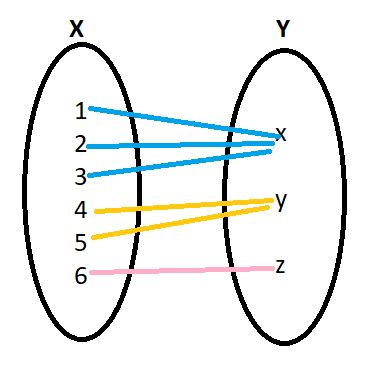
Here elements one , two and three all are connected with the same element that is $x$ , and the elements four and five are connected with the same element that is $y$. This is how a function can have many-one relationships.
Note: Range is defined as the set of elements from $y$ that actually come out whereas the co-domain of a function is given by the set of values that can possibly become a range of the function. In this particular question the range of the function is equal to the co-domain of the function.
With the help of this definition, we can give an example, consider elements of $X$ be $\{ 1,2\} $ and elements of $Y$ be $\{ x\} $ and $f:X \to Y$ such that $f = \{ (1,x),(2,x)\} $ . here element one and two both connected with the same element that is $x$ . This is how a function can have many-one relationships.
Complete step-by-step answer:
Many-one function is defined as , A function$f:X \to Y$ that is from variable $X$ to variable $Y$ is said to be many-one functions if there exist two or more elements from a domain connected with the same element from the co-domain .
Let us consider an example ,
Let the domain or elements of $X$ be $\{ 1,2.3,4,5,6\} $ ,
Let the co-domain or elements of $Y$ be $\{ x,y,z\} $ and
$f:X \to Y$
Such that $f = \{ (1,x),(2,x),(3,x),(4,y),(5,z)\} $
Here elements one , two and three all are connected with the same element that is $x$ , and the elements four and five are connected with the same element that is $y$. This is how a function can have many-one relationships.
Note: Range is defined as the set of elements from $y$ that actually come out whereas the co-domain of a function is given by the set of values that can possibly become a range of the function. In this particular question the range of the function is equal to the co-domain of the function.
Recently Updated Pages
The given figure shows two endocrine glands marked class 11 biology NEET_UG

Match columnI with columnII and select the correct class 11 biology NEET
Match column I with column II and select the correct class 11 biology NEET_UG
Which floral family has left 9 right + 1 arrangement class 11 biology NEET_UG
Which is not a variety of sheep A Lohi B Beetal C Nellore class 11 biology NEET_UG
Match column I with column II and select the correct class 11 biology NEET_UG
Trending doubts
Difference Between Prokaryotic Cells and Eukaryotic Cells
One Metric ton is equal to kg A 10000 B 1000 C 100 class 11 physics CBSE
Two of the body parts which do not appear in MRI are class 11 biology CBSE
10 examples of friction in our daily life
Draw a diagram of nephron and explain its structur class 11 biology CBSE
Draw a diagram of a plant cell and label at least eight class 11 biology CBSE