




Define dhekli.
Answer
 Verified
634.8k+ views
Hint: A traditional system of irrigation.
Complete answer:
Irrigation is the process of watering plants to make it ready for agriculture. Water is vital for plant growth. The supply of water comes from various water resources like wells, ponds, lakes, canals, etc.
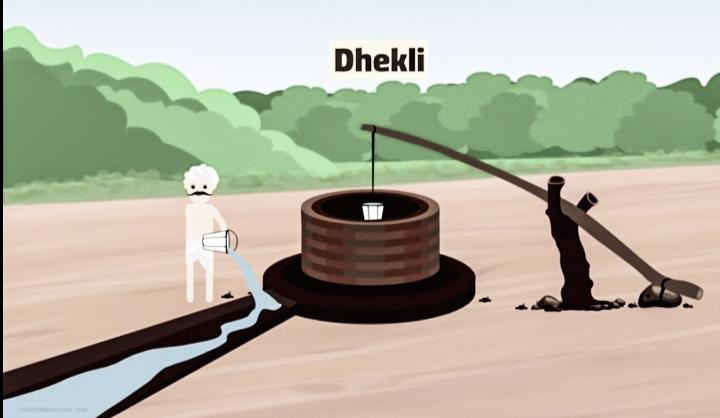
There are different types of irrigation processes. Dhekli is a process of drawing water from a well or lifting of water that takes place with the help of ropes and buckets to the irrigation land.
Additional information:
1. Irrigation is necessary for the growth and photosynthesis in plants.
2. It increases soil fertility by adding moisture to it and increasing the yield from the farm.
3. Irrigation methods are divided into two systems:
> Traditional irrigation method -these methods were used in earlier years and are also used in few rural areas even today.
> Modern irrigation methods – these methods are invented recently and are more effective. They use water economically without much wastage.
4. In Dhekli, the farmer places a long wooden log near the well with one long arm tied to a stone and the other short arm to a bucket.
5. The farmers lower empty buckets into wells to fill water and lift the bucket by a log which acts as a lever system.
Note: Traditional irrigation methods are: Moat (Also called pulley system), Chain pump (Buckets attached to a chain connected by two wheels to lift the chain), Dhekli, and Rahat (uses animals labor) while modern irrigation methods are: Drip irrigation system (plastic pipes are laid near crops in rows from which water seeps out), and Sprinkler system (it is like rain, the water sprinkles through a pipe).
Complete answer:
Irrigation is the process of watering plants to make it ready for agriculture. Water is vital for plant growth. The supply of water comes from various water resources like wells, ponds, lakes, canals, etc.
There are different types of irrigation processes. Dhekli is a process of drawing water from a well or lifting of water that takes place with the help of ropes and buckets to the irrigation land.
Additional information:
1. Irrigation is necessary for the growth and photosynthesis in plants.
2. It increases soil fertility by adding moisture to it and increasing the yield from the farm.
3. Irrigation methods are divided into two systems:
> Traditional irrigation method -these methods were used in earlier years and are also used in few rural areas even today.
> Modern irrigation methods – these methods are invented recently and are more effective. They use water economically without much wastage.
4. In Dhekli, the farmer places a long wooden log near the well with one long arm tied to a stone and the other short arm to a bucket.
5. The farmers lower empty buckets into wells to fill water and lift the bucket by a log which acts as a lever system.
Note: Traditional irrigation methods are: Moat (Also called pulley system), Chain pump (Buckets attached to a chain connected by two wheels to lift the chain), Dhekli, and Rahat (uses animals labor) while modern irrigation methods are: Drip irrigation system (plastic pipes are laid near crops in rows from which water seeps out), and Sprinkler system (it is like rain, the water sprinkles through a pipe).
Recently Updated Pages
Master Class 12 Economics: Engaging Questions & Answers for Success

Master Class 12 English: Engaging Questions & Answers for Success
Master Class 12 Social Science: Engaging Questions & Answers for Success
Master Class 12 Maths: Engaging Questions & Answers for Success
Master Class 12 Physics: Engaging Questions & Answers for Success
Master Class 9 General Knowledge: Engaging Questions & Answers for Success
Trending doubts
Explain the Treaty of Vienna of 1815 class 10 social science CBSE
Who Won 36 Oscar Awards? Record Holder Revealed
What is the median of the first 10 natural numbers class 10 maths CBSE
Why is it 530 pm in india when it is 1200 afternoon class 10 social science CBSE
Make a sketch of the human nerve cell What function class 10 biology CBSE
What is the full form of POSCO class 10 social science CBSE