




Define crest and trough.
Answer
 Verified
579.6k+ views
Hint: To answer this question, you should recall the concept of periodic disturbances. The height and depth of crest and trough determine the amplitude of the wave.
Complete step-by-step answer: A wave is defined as the periodical disturbance which is travelled through the medium from particle to particle and if we observe the movement of the wave then the phase is changed with time. There are characteristic feature of waves like frequency, wavelength, wave number, the velocity of wave etc. Concerning the shape of a wave or periodic disturbance, the most important parts of waves are crest and trough by which it is travelled from one part to another part. The upper region or part is called the crest while the lower part or region is called the trough. The height of each crest is equal to the extent of depth of each trough. The diagrammatic representation can be visualized as follows:
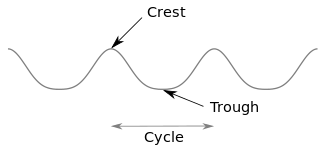
Note:Wavelength of a wave is defined as the distance between two nearest points of the adjacent crest or trough. This is the distance between the wave cycles which are propagated in space. It is a length therefore it is measured in terms of units of length like meters or centimetres or millimetres or Nano-meters or Angstrom units. You should know about constructive and destructive interference. When two waves meet in such a way that their crests line up together, then it’s called constructive interference which results in a wave of higher amplitude. While, in the other case, destructive interference, the crest of one wave meets the trough of another, and the result is a lower total amplitude.
Complete step-by-step answer: A wave is defined as the periodical disturbance which is travelled through the medium from particle to particle and if we observe the movement of the wave then the phase is changed with time. There are characteristic feature of waves like frequency, wavelength, wave number, the velocity of wave etc. Concerning the shape of a wave or periodic disturbance, the most important parts of waves are crest and trough by which it is travelled from one part to another part. The upper region or part is called the crest while the lower part or region is called the trough. The height of each crest is equal to the extent of depth of each trough. The diagrammatic representation can be visualized as follows:
Note:Wavelength of a wave is defined as the distance between two nearest points of the adjacent crest or trough. This is the distance between the wave cycles which are propagated in space. It is a length therefore it is measured in terms of units of length like meters or centimetres or millimetres or Nano-meters or Angstrom units. You should know about constructive and destructive interference. When two waves meet in such a way that their crests line up together, then it’s called constructive interference which results in a wave of higher amplitude. While, in the other case, destructive interference, the crest of one wave meets the trough of another, and the result is a lower total amplitude.
Recently Updated Pages
Master Class 11 Social Science: Engaging Questions & Answers for Success

Master Class 11 English: Engaging Questions & Answers for Success
Master Class 11 Maths: Engaging Questions & Answers for Success
Master Class 11 Chemistry: Engaging Questions & Answers for Success
Master Class 11 Biology: Engaging Questions & Answers for Success
Class 11 Question and Answer - Your Ultimate Solutions Guide
Trending doubts
One Metric ton is equal to kg A 10000 B 1000 C 100 class 11 physics CBSE
Difference Between Prokaryotic Cells and Eukaryotic Cells
Find the value of the expression given below sin 30circ class 11 maths CBSE
1 ton equals to A 100 kg B 1000 kg C 10 kg D 10000 class 11 physics CBSE
Two of the body parts which do not appear in MRI are class 11 biology CBSE
Draw a diagram of nephron and explain its structur class 11 biology CBSE