




Define centripetal acceleration. Drive expression for centripetal acceleration of a particle moving with uniform speed v along a circular path of radius. Give the direction of the acceleration.
Answer
 Verified
559.3k+ views
Hint: Centripetal acceleration occurs due to centripetal force. It is also called radial acceleration. Centripetal force tends to move a body in a circular path. It acts towards the centre of the body in which a body is traversing.
Complete step-by-step answer:
Centripetal Acceleration is the acceleration which acts towards the centre of the body. It is the property of a body. It is the property of a body performing circular motion.
It arises due to centripetal force which acts constantly towards the centre of the circle. It is perpendicular to the velocity. It is due to that change in velocity (in terms of direction such acceleration appears)
\[ac=\dfrac{\vartriangle V}{\vartriangle t}=\dfrac{{{V}^{2}}}{R}\]
V = velocity of particle
R = Radius
Suppose a body moving \[{{V}_{1}}\] with velocity transverses velocity changes to \[{{V}_{2}}\] .(In terms of direction) the net change in velocity generates the acceleration.
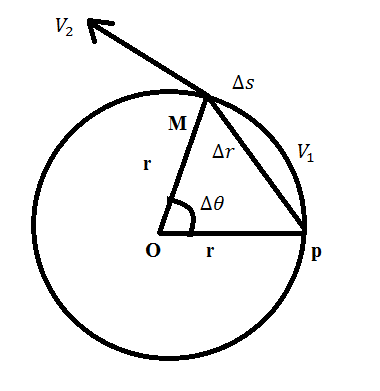
\[\vartriangle V={{V}_{2}}-{{V}_{1}}\]
\[\vartriangle s\to \]Change of radius of the length PM
\[\vartriangle r\to \]Displacement or arc length PM
As \[ac=\dfrac{\vartriangle V}{\vartriangle t}\] (the acceleration is towards center) \[\vartriangle Q\]as is small and \[\vartriangle s\approx \vartriangle r\]
.Now for magnitude,
The triangles PTR and OPM are similar above magnitude wise \[{{\text{V}}_{\text{1}}}\text{=}{{\text{V}}_{\text{2}}}\]so they form a 2 isosceles triangles.
So using property of similar triangles,
\[\frac{\vartriangle V}{V}=\dfrac{\vartriangle s}{r}\] …… 1
Centripetal acceleration is \[\dfrac{\vartriangle V}{\vartriangle t}\]
Multiply and divide by
\[\dfrac{\vartriangle \text{V}}{\vartriangle t}=\dfrac{\vartriangle s}{\vartriangle t}\frac{V}{r}\]
\[\dfrac{\vartriangle \text{V}}{\vartriangle t}=\] Acceleration (centripetal)
And that \[\dfrac{\vartriangle s}{\vartriangle t}=\] velocity (V) = linear / tangential velocity / speed
So
\[\text{ac=}\dfrac{{{\text{V}}^{\text{2}}}}{\text{R}}\] …. 2
So we have linear or that ac is perpendicular to linear or tangential velocity
Note:
Centrifugal force: It is the reaction centripetal force and acts away from the centre. Its magnitude is equal to that of centripetal force.
Complete step-by-step answer:
Centripetal Acceleration is the acceleration which acts towards the centre of the body. It is the property of a body. It is the property of a body performing circular motion.
It arises due to centripetal force which acts constantly towards the centre of the circle. It is perpendicular to the velocity. It is due to that change in velocity (in terms of direction such acceleration appears)
\[ac=\dfrac{\vartriangle V}{\vartriangle t}=\dfrac{{{V}^{2}}}{R}\]
V = velocity of particle
R = Radius
Suppose a body moving \[{{V}_{1}}\] with velocity transverses velocity changes to \[{{V}_{2}}\] .(In terms of direction) the net change in velocity generates the acceleration.
\[\vartriangle V={{V}_{2}}-{{V}_{1}}\]
\[\vartriangle s\to \]Change of radius of the length PM
\[\vartriangle r\to \]Displacement or arc length PM
As \[ac=\dfrac{\vartriangle V}{\vartriangle t}\] (the acceleration is towards center) \[\vartriangle Q\]as is small and \[\vartriangle s\approx \vartriangle r\]
.Now for magnitude,
The triangles PTR and OPM are similar above magnitude wise \[{{\text{V}}_{\text{1}}}\text{=}{{\text{V}}_{\text{2}}}\]so they form a 2 isosceles triangles.
So using property of similar triangles,
\[\frac{\vartriangle V}{V}=\dfrac{\vartriangle s}{r}\] …… 1
Centripetal acceleration is \[\dfrac{\vartriangle V}{\vartriangle t}\]
Multiply and divide by
\[\dfrac{\vartriangle \text{V}}{\vartriangle t}=\dfrac{\vartriangle s}{\vartriangle t}\frac{V}{r}\]
\[\dfrac{\vartriangle \text{V}}{\vartriangle t}=\] Acceleration (centripetal)
And that \[\dfrac{\vartriangle s}{\vartriangle t}=\] velocity (V) = linear / tangential velocity / speed
So
\[\text{ac=}\dfrac{{{\text{V}}^{\text{2}}}}{\text{R}}\] …. 2
So we have linear or that ac is perpendicular to linear or tangential velocity
Note:
Centrifugal force: It is the reaction centripetal force and acts away from the centre. Its magnitude is equal to that of centripetal force.
Recently Updated Pages
Master Class 11 English: Engaging Questions & Answers for Success

Master Class 11 Social Science: Engaging Questions & Answers for Success
Master Class 11 Maths: Engaging Questions & Answers for Success
Master Class 11 Chemistry: Engaging Questions & Answers for Success
Master Class 11 Biology: Engaging Questions & Answers for Success
Master Class 11 Physics: Engaging Questions & Answers for Success
Trending doubts
One Metric ton is equal to kg A 10000 B 1000 C 100 class 11 physics CBSE
Difference Between Prokaryotic Cells and Eukaryotic Cells
Find the value of the expression given below sin 30circ class 11 maths CBSE
1 ton equals to A 100 kg B 1000 kg C 10 kg D 10000 class 11 physics CBSE
Two of the body parts which do not appear in MRI are class 11 biology CBSE
What are hard magnetic materials class 11 physics CBSE