




What is DDT and is it biodegradable or non-biodegradable?
Answer
 Verified
543.6k+ views
Hint :Insecticides are the chemical compounds prepared synthetically to get rid of various insects. Insects are harmful to agriculture because they decorate the crop. insecticides are widely used by the farmer to protect their crop from insects like beetles, ladybugs, bees etc. Substances which are not decomposed by microbes present in the environment into simpler forms which are less toxic to the environment are known as non-biodegradable.
Complete Step By Step Answer:
DDT chemically known as 2,2(bis-p-chlorophenyl)-1,1,1-trichloroethane.
DDT is composed of two benzene rings joined together by a single carbon atom having a total number of five chlorine atoms. DDT is made up of very complex structures.
The molecular complexity of DDT protects it from various microbes in nature which have capability to break it down into different products.
DDT is an organochlorine compound which is stable in the environment.
DDT is used to kill malaria and other insect borne disease.DDT is less toxic to humans because it is less soluble in water.
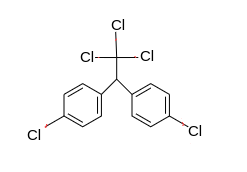
Physical and chemical properties of DDT show that it is less a colorless compound and do not show any distinct odour. DDT shows the effect of accumulation due to which it passes from one living organism to another living organism.
micro-organism present in the environment are unable to act on DDT to break it into simpler compounds which are less harmful for the environment.
Due to the inability of DDT to be broken down by microbes it remains present in the environment and is a major cause of insecticide pollution.
DDT is removed from human use because no enzyme is yet discovered which is capable of acting on it.
Hence, DDT is a non-biodegradable compound because it remains unaffected by micro-organism like microbial peroxidase, oxygenase , reducatse, hydrolase etc.
Note :
DDT is a potent carcinogen and causes cancer in humans on ingestion. Other non-biodegradable components include plastic bags, plastic containers, carry bags
made up of polyethylene. biodegradable components are animal or human urine, faecal waste, sewage material.
Complete Step By Step Answer:
DDT chemically known as 2,2(bis-p-chlorophenyl)-1,1,1-trichloroethane.
DDT is composed of two benzene rings joined together by a single carbon atom having a total number of five chlorine atoms. DDT is made up of very complex structures.
The molecular complexity of DDT protects it from various microbes in nature which have capability to break it down into different products.
DDT is an organochlorine compound which is stable in the environment.
DDT is used to kill malaria and other insect borne disease.DDT is less toxic to humans because it is less soluble in water.
Physical and chemical properties of DDT show that it is less a colorless compound and do not show any distinct odour. DDT shows the effect of accumulation due to which it passes from one living organism to another living organism.
micro-organism present in the environment are unable to act on DDT to break it into simpler compounds which are less harmful for the environment.
Due to the inability of DDT to be broken down by microbes it remains present in the environment and is a major cause of insecticide pollution.
DDT is removed from human use because no enzyme is yet discovered which is capable of acting on it.
Hence, DDT is a non-biodegradable compound because it remains unaffected by micro-organism like microbial peroxidase, oxygenase , reducatse, hydrolase etc.
Note :
DDT is a potent carcinogen and causes cancer in humans on ingestion. Other non-biodegradable components include plastic bags, plastic containers, carry bags
made up of polyethylene. biodegradable components are animal or human urine, faecal waste, sewage material.
Recently Updated Pages
Master Class 12 Economics: Engaging Questions & Answers for Success

Master Class 12 English: Engaging Questions & Answers for Success
Master Class 12 Social Science: Engaging Questions & Answers for Success
Master Class 12 Maths: Engaging Questions & Answers for Success
Master Class 12 Physics: Engaging Questions & Answers for Success
Master Class 11 Social Science: Engaging Questions & Answers for Success
Trending doubts
One Metric ton is equal to kg A 10000 B 1000 C 100 class 11 physics CBSE
Difference Between Prokaryotic Cells and Eukaryotic Cells
Find the value of the expression given below sin 30circ class 11 maths CBSE
Two of the body parts which do not appear in MRI are class 11 biology CBSE
Draw a diagram of nephron and explain its structur class 11 biology CBSE
10 examples of friction in our daily life