




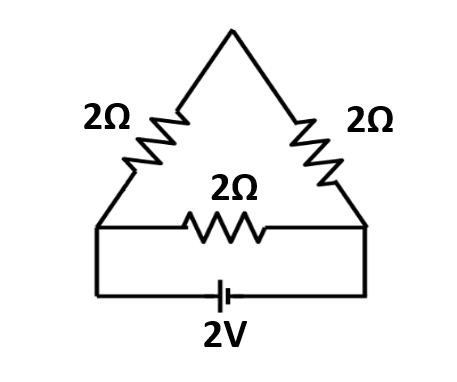
What is the current in the circuit shown below:
Answer
 Verified
561.6k+ views
Hint: The current is equal through all objects in the series. Through each resistor in a series circuit, the current through all the resistors is identical to the current through all the resistors in series with it. The total resistance in a series circuit is identical to the sum of resistance of each series resistor. When two or more resistors are separately connected between the same two separate points, they are parallel. A parallel circuit gives more than one path for current.
Complete answer:
In the given circuit, the two $2 \Omega$ resistances are in series with each other then the equivalent resistance is equal to the sum of two $2 \Omega$ resistances.
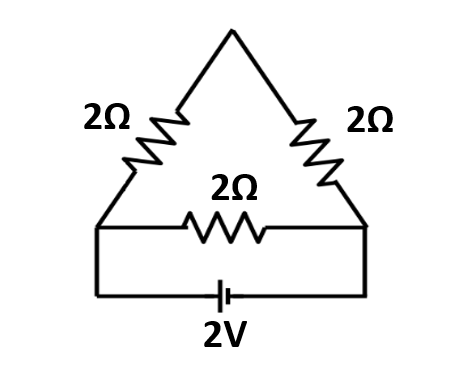
The equivalent resistance = $ 2 + 2 = 4 \Omega$
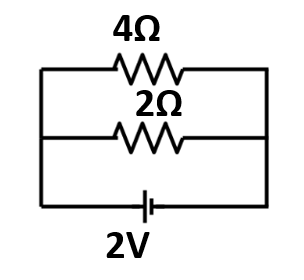
The $2 \Omega$ and $4 \Omega$ are in parallel with each other.
The equivalent resistance is:
$R_{p} = \dfrac{2 \times 4}{2 + 4} = \dfrac{8}{6} = \dfrac{4}{3} \Omega$
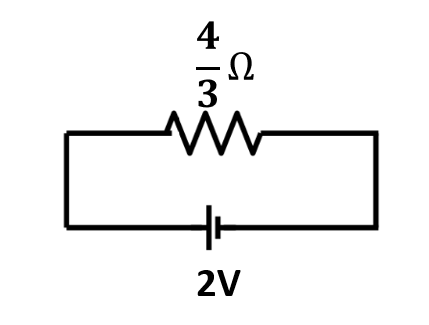
Current, $I =\dfrac{V}{R}$
$I =\dfrac{2 \times 3 }{4} = 1.5A$
Current in the circuit is $1.5 A$.
Note:
When resistors are combined in series, the resistor values combine because each resistor offers resistance to the current in the same proportion to its resistance. A more significant number of resistors joined in series produces more opposition to the current. More opposition indicates a resistance with higher value. Thus, every time a resistor is combined in series, the total resistance rises.
Complete answer:
In the given circuit, the two $2 \Omega$ resistances are in series with each other then the equivalent resistance is equal to the sum of two $2 \Omega$ resistances.
The equivalent resistance = $ 2 + 2 = 4 \Omega$
The $2 \Omega$ and $4 \Omega$ are in parallel with each other.
The equivalent resistance is:
$R_{p} = \dfrac{2 \times 4}{2 + 4} = \dfrac{8}{6} = \dfrac{4}{3} \Omega$
Current, $I =\dfrac{V}{R}$
$I =\dfrac{2 \times 3 }{4} = 1.5A$
Current in the circuit is $1.5 A$.
Note:
When resistors are combined in series, the resistor values combine because each resistor offers resistance to the current in the same proportion to its resistance. A more significant number of resistors joined in series produces more opposition to the current. More opposition indicates a resistance with higher value. Thus, every time a resistor is combined in series, the total resistance rises.
Recently Updated Pages
Master Class 11 English: Engaging Questions & Answers for Success

Master Class 11 Social Science: Engaging Questions & Answers for Success
Master Class 11 Maths: Engaging Questions & Answers for Success
Master Class 11 Biology: Engaging Questions & Answers for Success
Master Class 11 Physics: Engaging Questions & Answers for Success
Master Class 11 Chemistry: Engaging Questions & Answers for Success
Trending doubts
1 ton equals to A 100 kg B 1000 kg C 10 kg D 10000 class 11 physics CBSE
Find the value of the expression given below sin 30circ class 11 maths CBSE
What are hard magnetic materials class 11 physics CBSE
Draw a diagram of nephron and explain its structur class 11 biology CBSE
Lysosomes are known as suicidal bags of cell why class 11 biology CBSE
Bond order ofO2 O2+ O2 and O22 is in order A O2 langle class 11 chemistry CBSE