




What is the \[\csc \], \[\sec \] and \[\cot \] of point \[(3,4)\]?
Answer
 Verified
534.9k+ views
Hint: We are given a question asking us to find the given trigonometric functions of point \[(3,4)\]. We know that a single point cannot have any angles, so we will first draw a triangle using the origin. We will name the point \[(3,4)\] as point A and the angle formed at A be \[\theta \]. So, the lengths of the triangle formed is, the horizontal line on the x – axis is 3 units and the vertical line along the point A is 4 units long. And using the Pythagoras theorem, we have the length of the hypotenuse is 5 units. Now, we will substitute the values in the formula of the trigonometric functions asked in the question. Hence, we will have the required values.
Complete step by step solution:
According to the given question, we are asked to find the values of some of the trigonometric functions at a given point.
The given point is \[(3,4)\] and we have to find the values of the trigonometric functions \[\csc \], \[\sec \] and \[\cot \].
We know that, at a single point we cannot make an angle, but two lines if joined together can form an angle.
We will name the given point \[(3,4)\] as point A. Next, we will draw a right angle and for this we will use the origin for the same.
Let the angle formed at the point A be \[\theta \].
So, we have a triangle formed whose length of the sides are as follows,
The horizontal length on the x – axis will be 3 units long, that is, perpendicular is 3 units long and the vertical length (or the base) from the x – axis to the point A will be 4 units long.
The figure for the above is as follows,
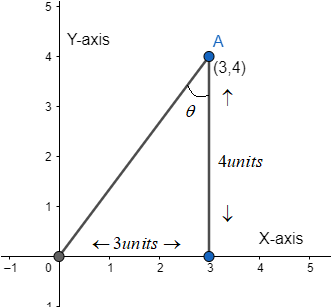
Using the Pythagoras theorem here, we will get the length of hypotenuse here, so we will get,
\[{{(Hypotenuse)}^{2}}={{(Perpendicular)}^{2}}+{{(Base)}^{2}}\]
Substituting the known values here, we get,
\[\Rightarrow {{(Hypotenuse)}^{2}}={{(3)}^{2}}+{{(4)}^{2}}\]
Solving further,
\[\Rightarrow {{(Hypotenuse)}^{2}}=9+16=25\]
\[\Rightarrow Hypotenuse=5units\]
Now, substituting the lengths of the triangle in the formula of the trigonometric functions asked, we get,
\[\csc \theta =\dfrac{\text{Hypotenuse}}{Perpendicular}\]
\[\Rightarrow \csc \theta =\dfrac{5}{3}\]
Next,
\[\sec \theta =\dfrac{\text{Hypotenuse}}{Base}\]
\[\Rightarrow \sec \theta =\dfrac{5}{4}\]
And next we have,
\[\cot \theta =\dfrac{Base}{Perpendicular}\]
\[\Rightarrow \cot \theta =\dfrac{4}{3}\]
Note: The correct formula of the asked trigonometric functions should be written. The inverse should not be written in any case. The triangle formation must be done step wise and always remember that the perpendicular is the side which is opposite to the angle and not the one adjacent to the angle.
Complete step by step solution:
According to the given question, we are asked to find the values of some of the trigonometric functions at a given point.
The given point is \[(3,4)\] and we have to find the values of the trigonometric functions \[\csc \], \[\sec \] and \[\cot \].
We know that, at a single point we cannot make an angle, but two lines if joined together can form an angle.
We will name the given point \[(3,4)\] as point A. Next, we will draw a right angle and for this we will use the origin for the same.
Let the angle formed at the point A be \[\theta \].
So, we have a triangle formed whose length of the sides are as follows,
The horizontal length on the x – axis will be 3 units long, that is, perpendicular is 3 units long and the vertical length (or the base) from the x – axis to the point A will be 4 units long.
The figure for the above is as follows,
Using the Pythagoras theorem here, we will get the length of hypotenuse here, so we will get,
\[{{(Hypotenuse)}^{2}}={{(Perpendicular)}^{2}}+{{(Base)}^{2}}\]
Substituting the known values here, we get,
\[\Rightarrow {{(Hypotenuse)}^{2}}={{(3)}^{2}}+{{(4)}^{2}}\]
Solving further,
\[\Rightarrow {{(Hypotenuse)}^{2}}=9+16=25\]
\[\Rightarrow Hypotenuse=5units\]
Now, substituting the lengths of the triangle in the formula of the trigonometric functions asked, we get,
\[\csc \theta =\dfrac{\text{Hypotenuse}}{Perpendicular}\]
\[\Rightarrow \csc \theta =\dfrac{5}{3}\]
Next,
\[\sec \theta =\dfrac{\text{Hypotenuse}}{Base}\]
\[\Rightarrow \sec \theta =\dfrac{5}{4}\]
And next we have,
\[\cot \theta =\dfrac{Base}{Perpendicular}\]
\[\Rightarrow \cot \theta =\dfrac{4}{3}\]
Note: The correct formula of the asked trigonometric functions should be written. The inverse should not be written in any case. The triangle formation must be done step wise and always remember that the perpendicular is the side which is opposite to the angle and not the one adjacent to the angle.
Recently Updated Pages
Master Class 10 Computer Science: Engaging Questions & Answers for Success

Master Class 10 General Knowledge: Engaging Questions & Answers for Success
Master Class 10 English: Engaging Questions & Answers for Success
Master Class 10 Social Science: Engaging Questions & Answers for Success
Master Class 10 Maths: Engaging Questions & Answers for Success
Master Class 10 Science: Engaging Questions & Answers for Success
Trending doubts
What is the median of the first 10 natural numbers class 10 maths CBSE
Which women's tennis player has 24 Grand Slam singles titles?
Who is the Brand Ambassador of Incredible India?
Why is there a time difference of about 5 hours between class 10 social science CBSE
Write a letter to the principal requesting him to grant class 10 english CBSE
State and prove converse of BPT Basic Proportionality class 10 maths CBSE