




Crustacean fishery involves which of the following species?
(a) Lobster and prawn
(b) Shells of cuttlefish
(c) Mussels and squids
(d) Oysters and crab
Answer
 Verified
629.7k+ views
Hint: The species involved in the crustacean fishery are the arthropods that are aquatic and popular as seafood. Their bodies are highly fragmented but united at various points and encapsulated by a tough exoskeleton.
Complete answer:
Crustacean fishery is a type of fishery that is concerned with the catching and harvesting of crustaceans, usually the ones which are abundant in shallower and more accessible areas of water bodies. It includes lobsters, shrimps or prawns, and crabs. Due to their high protein content, they have a high market value in the seafood market.
Additional Information: Crustaceans are a class of Arthropoda, wherein, their body is divisible into cephalothorax and abdomen. The head and thorax unite or fuse to form a cephalothorax. Dorsally, the cephalothorax is covered by a thick exoskeletal carapace. Two pairs of the antenna are present along with a pair of stalked compound eyes.E.g. Lobsters (Palinurus), Prawn(Palaemon), Crab(Cancer).
Cuttlefish, squids, oysters, and mussels belong to phylum mollusca. Phylum mollusca are divided into six classes including Cephalopoda and Pelecypoda. Cuttlefish and squids are cephalopods(literal meaning is head foot). Their head and foot regions are combined and modified into a structure that has eyes and tentacles.
Mussels and oysters are pelecypods wherein their shell is made up of two halves. Thus, they are also known as Bivalvia. They are also used as food.
So, the correct answer is ‘Lobster and prawn’.
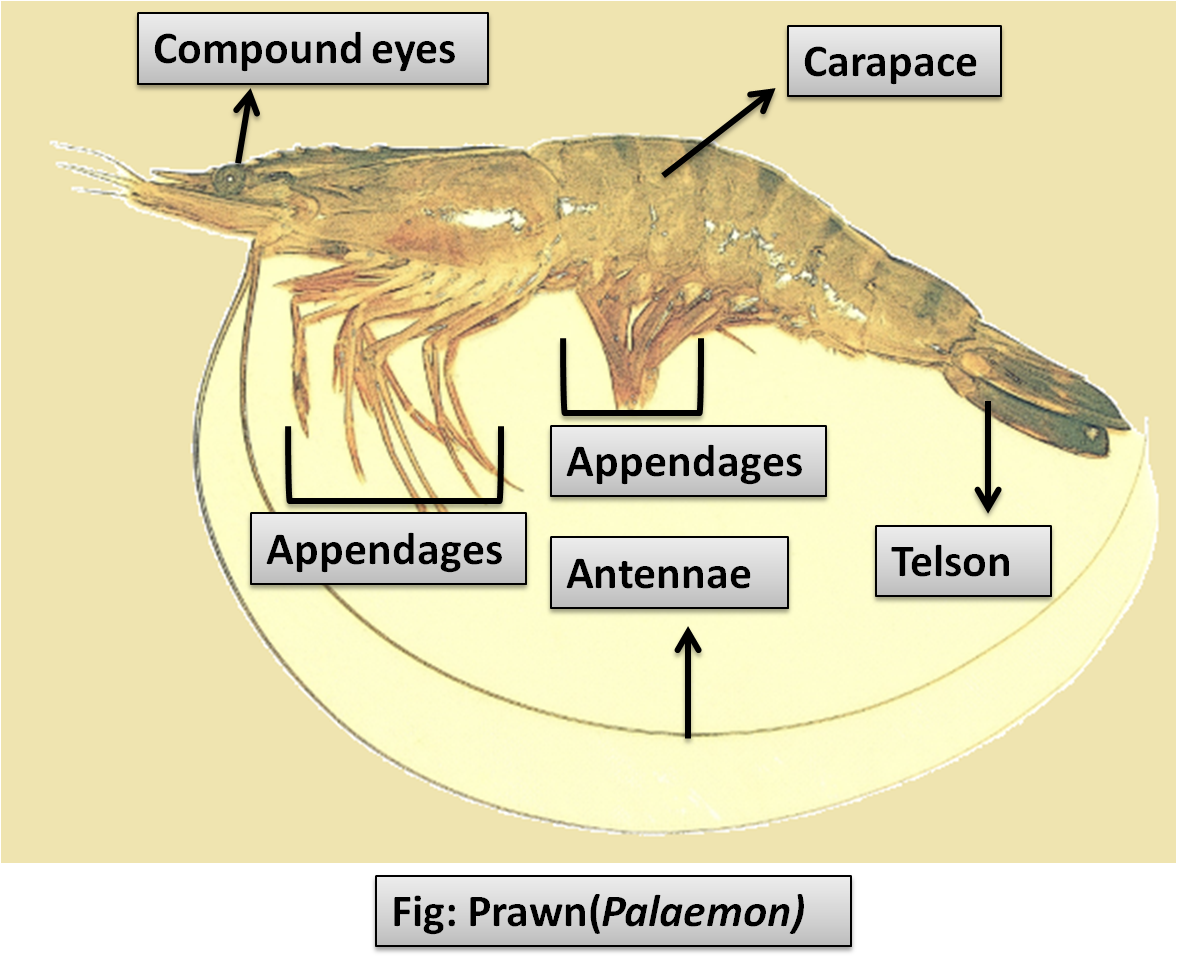
Note: Lobster possesses five pairs of appendages whose function ranges from crushing the prey to cutting or pinching. They feed on small snails or shellfishes. Prawns bear nineteen appendages, out of which the cephalothorax bears 13 pairs of appendages while the abdomen bears six. The hard exoskeleton of the crustaceans is known as the carapace. The extended portion of carapace over their anterior eyes is known as the rostrum. Its posterior end of the abdomen is called the telson.
Complete answer:
Crustacean fishery is a type of fishery that is concerned with the catching and harvesting of crustaceans, usually the ones which are abundant in shallower and more accessible areas of water bodies. It includes lobsters, shrimps or prawns, and crabs. Due to their high protein content, they have a high market value in the seafood market.
Additional Information: Crustaceans are a class of Arthropoda, wherein, their body is divisible into cephalothorax and abdomen. The head and thorax unite or fuse to form a cephalothorax. Dorsally, the cephalothorax is covered by a thick exoskeletal carapace. Two pairs of the antenna are present along with a pair of stalked compound eyes.E.g. Lobsters (Palinurus), Prawn(Palaemon), Crab(Cancer).
Cuttlefish, squids, oysters, and mussels belong to phylum mollusca. Phylum mollusca are divided into six classes including Cephalopoda and Pelecypoda. Cuttlefish and squids are cephalopods(literal meaning is head foot). Their head and foot regions are combined and modified into a structure that has eyes and tentacles.
Mussels and oysters are pelecypods wherein their shell is made up of two halves. Thus, they are also known as Bivalvia. They are also used as food.
So, the correct answer is ‘Lobster and prawn’.
Note: Lobster possesses five pairs of appendages whose function ranges from crushing the prey to cutting or pinching. They feed on small snails or shellfishes. Prawns bear nineteen appendages, out of which the cephalothorax bears 13 pairs of appendages while the abdomen bears six. The hard exoskeleton of the crustaceans is known as the carapace. The extended portion of carapace over their anterior eyes is known as the rostrum. Its posterior end of the abdomen is called the telson.
Recently Updated Pages
Master Class 11 Social Science: Engaging Questions & Answers for Success

Master Class 11 English: Engaging Questions & Answers for Success
Master Class 11 Maths: Engaging Questions & Answers for Success
Master Class 11 Chemistry: Engaging Questions & Answers for Success
Master Class 11 Biology: Engaging Questions & Answers for Success
Class 11 Question and Answer - Your Ultimate Solutions Guide
Trending doubts
One Metric ton is equal to kg A 10000 B 1000 C 100 class 11 physics CBSE
Difference Between Prokaryotic Cells and Eukaryotic Cells
Find the value of the expression given below sin 30circ class 11 maths CBSE
1 ton equals to A 100 kg B 1000 kg C 10 kg D 10000 class 11 physics CBSE
Two of the body parts which do not appear in MRI are class 11 biology CBSE
Draw a diagram of nephron and explain its structur class 11 biology CBSE