




Cranial nerves emerge from the
A. Spinal cord
B. Brain
C. Abdomen
D. Trachea
Answer
 Verified
589.2k+ views
Hint: The nervous system of the human body consists of the central nervous system (CNS) and the peripheral nervous system (PNS). The nervous system is responsible for transporting signals from one part of the body to another and coordination. The brain and the spinal cord are the most prominent parts of the central nervous system.
Complete answer: Cranial nerves emerge directly from the brain which is the main part of the central nervous system. The cranial nerves perform functions such as transmitting information between the brain and different parts of the body. Primarily the signals are transmitted to and from the head and neck regions including special senses such as hearing, vision, smell and taste. Each cranial nerves emerges from either side and are paired. There are about twelve pairs of cranial nerves each performing their own specific functions such as sensory, motor or both. The motor cranial nerves assist in controlling the muscle movements in the neck and head. Whereas, the sensory cranial nerves assist the vertebrates in vision, smell, taste and hearing. The twelve pairs of cranial nerves include the olfactory nerve, the optic nerve, the oculomotor nerve, the trochlear nerve, the trigeminal nerve, the abducens nerve, the facial nerves, the vestibulocochlear nerve, the glossopharyngeal nerve, the vagus nerve, the hypoglossal nerve and the accessory nerve.
Therefore, the correct answer is option B.
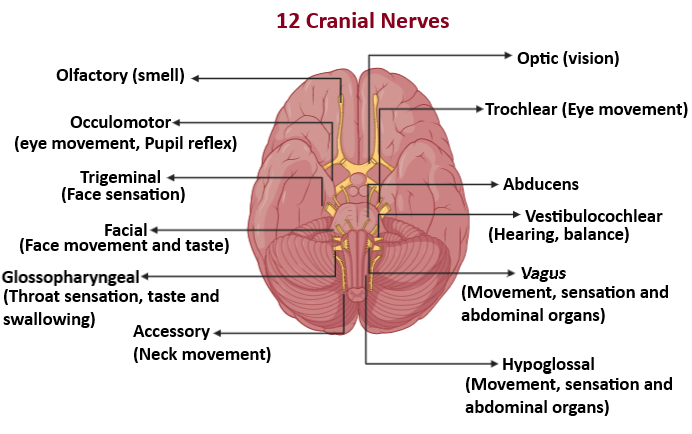
Note: The brain is determined to be one of the largest and most complex organs in the human body and is made up of more than a hundred billion nerves. These nerves communicate through connections called the synapses and transmit information to and from the brain and other parts of the body.
Complete answer: Cranial nerves emerge directly from the brain which is the main part of the central nervous system. The cranial nerves perform functions such as transmitting information between the brain and different parts of the body. Primarily the signals are transmitted to and from the head and neck regions including special senses such as hearing, vision, smell and taste. Each cranial nerves emerges from either side and are paired. There are about twelve pairs of cranial nerves each performing their own specific functions such as sensory, motor or both. The motor cranial nerves assist in controlling the muscle movements in the neck and head. Whereas, the sensory cranial nerves assist the vertebrates in vision, smell, taste and hearing. The twelve pairs of cranial nerves include the olfactory nerve, the optic nerve, the oculomotor nerve, the trochlear nerve, the trigeminal nerve, the abducens nerve, the facial nerves, the vestibulocochlear nerve, the glossopharyngeal nerve, the vagus nerve, the hypoglossal nerve and the accessory nerve.
Therefore, the correct answer is option B.
Note: The brain is determined to be one of the largest and most complex organs in the human body and is made up of more than a hundred billion nerves. These nerves communicate through connections called the synapses and transmit information to and from the brain and other parts of the body.
Recently Updated Pages
Master Class 11 Social Science: Engaging Questions & Answers for Success

Master Class 11 Physics: Engaging Questions & Answers for Success
Master Class 11 Maths: Engaging Questions & Answers for Success
Master Class 11 Economics: Engaging Questions & Answers for Success
Master Class 11 Computer Science: Engaging Questions & Answers for Success
Master Class 11 Chemistry: Engaging Questions & Answers for Success
Trending doubts
One Metric ton is equal to kg A 10000 B 1000 C 100 class 11 physics CBSE
There are 720 permutations of the digits 1 2 3 4 5 class 11 maths CBSE
1 Quintal is equal to a 110 kg b 10 kg c 100kg d 1000 class 11 physics CBSE
State and prove Bernoullis theorem class 11 physics CBSE
Difference Between Prokaryotic Cells and Eukaryotic Cells
Which among the following are examples of coming together class 11 social science CBSE