




Cotyledons are edible in the drupe of -
(a) Mango
(b) Almond
(c) Coconut
(d) Zizyphus
Answer
 Verified
628.5k+ views
Hint: A drupe is a fleshy fruit with thin skin and a seed in the center with a hard covering. Some of the plants inside the hardened stone contain an edible seed.
Complete step by step answer:
- The term fruit is used for the ripened ovary of a plant. It forms a protective covering for the seed and the embryo of a plant. As the seed develops, the fruit also develops.
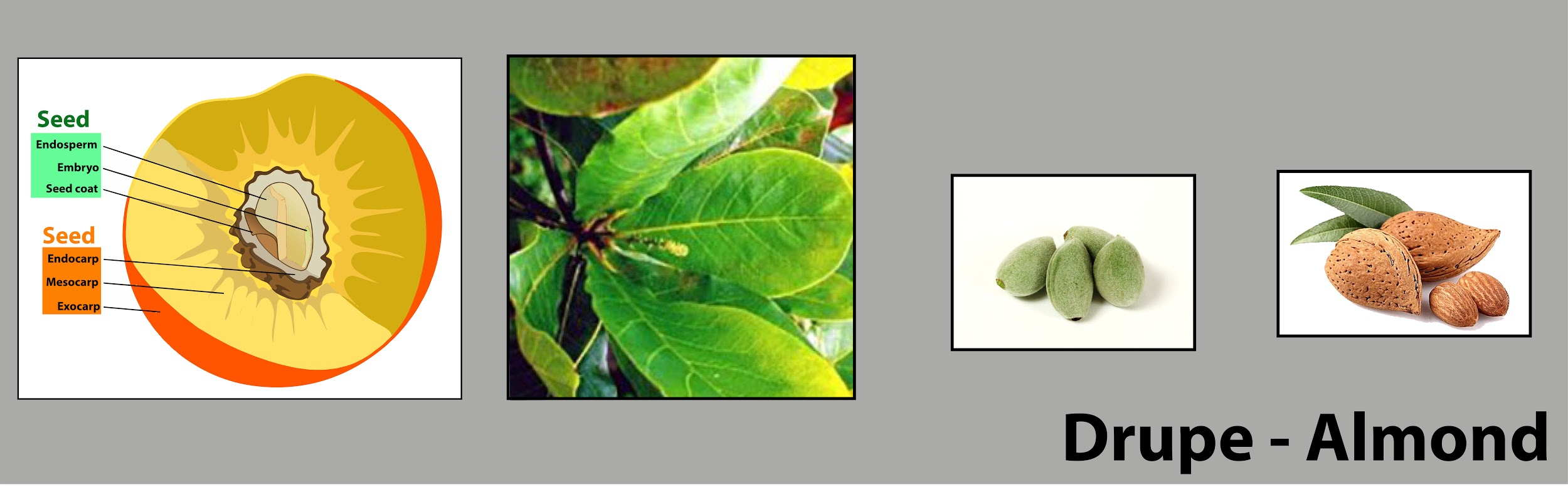
- A drupe is an example of a fruit with a thin epicarp, an indehiscent mesocarp, and a hardened endocarp. The seed inside the covering is edible in the case of almonds.
- When the endocarp of the almond fruit is broken, the cotyledons revealed are edible.
Additional information:
- Generally, a fruit has three parts - exocarp or the outermost skin/covering, mesocarp or the middle part of the fruit, and the endocarp or the inner part of the fruit. The mesocarp is generally the fleshy and edible part of the fruit. In other cases, the endocarp is the edible part.
- Mango has an edible mesocarp.
- Coconut has an edible endosperm.
- Zizyphus or Jujube has an edible epicarp and mesocarp.
So, the correct answer is ‘Almond’.
Note:
- Dehiscent fruits release their seeds into the environment readily (like peas) while indehiscent fruits rely on the decay for the spread.
- The brown layer of the almond seed is the seed coat and the white cotyledons form the embryo.
- Almonds are commonly known as nuts but scientifically are not; they are drupes. Other examples of drupes are pistachio, cherries, plums, etc.
Complete step by step answer:
- The term fruit is used for the ripened ovary of a plant. It forms a protective covering for the seed and the embryo of a plant. As the seed develops, the fruit also develops.
- A drupe is an example of a fruit with a thin epicarp, an indehiscent mesocarp, and a hardened endocarp. The seed inside the covering is edible in the case of almonds.
- When the endocarp of the almond fruit is broken, the cotyledons revealed are edible.
Additional information:
- Generally, a fruit has three parts - exocarp or the outermost skin/covering, mesocarp or the middle part of the fruit, and the endocarp or the inner part of the fruit. The mesocarp is generally the fleshy and edible part of the fruit. In other cases, the endocarp is the edible part.
- Mango has an edible mesocarp.
- Coconut has an edible endosperm.
- Zizyphus or Jujube has an edible epicarp and mesocarp.
So, the correct answer is ‘Almond’.
Note:
- Dehiscent fruits release their seeds into the environment readily (like peas) while indehiscent fruits rely on the decay for the spread.
- The brown layer of the almond seed is the seed coat and the white cotyledons form the embryo.
- Almonds are commonly known as nuts but scientifically are not; they are drupes. Other examples of drupes are pistachio, cherries, plums, etc.
Recently Updated Pages
Basicity of sulphurous acid and sulphuric acid are

Master Class 11 English: Engaging Questions & Answers for Success
Master Class 11 Physics: Engaging Questions & Answers for Success
Master Class 11 Computer Science: Engaging Questions & Answers for Success
Master Class 11 Chemistry: Engaging Questions & Answers for Success
Master Class 11 Social Science: Engaging Questions & Answers for Success
Trending doubts
Difference Between Prokaryotic Cells and Eukaryotic Cells
Two of the body parts which do not appear in MRI are class 11 biology CBSE
One Metric ton is equal to kg A 10000 B 1000 C 100 class 11 physics CBSE
10 examples of friction in our daily life
Draw a diagram of nephron and explain its structur class 11 biology CBSE
What will happen if the mucus is not secreted by the class 11 biology CBSE