




Coralloid roots of Cycas are useful in
(A)$N_2$-fixation
(B)Absorption of water
(C)Transpiration
(D)Fixation
Answer
 Verified
572.7k+ views
Hint: Cycads are the main known gymnosperms that are advantageous through a personal relationship with cyanobacteria. Nine genera of cycads have been portrayed and include around 150 species, all endemic to tropical and subtropical territories.
Complete answer:
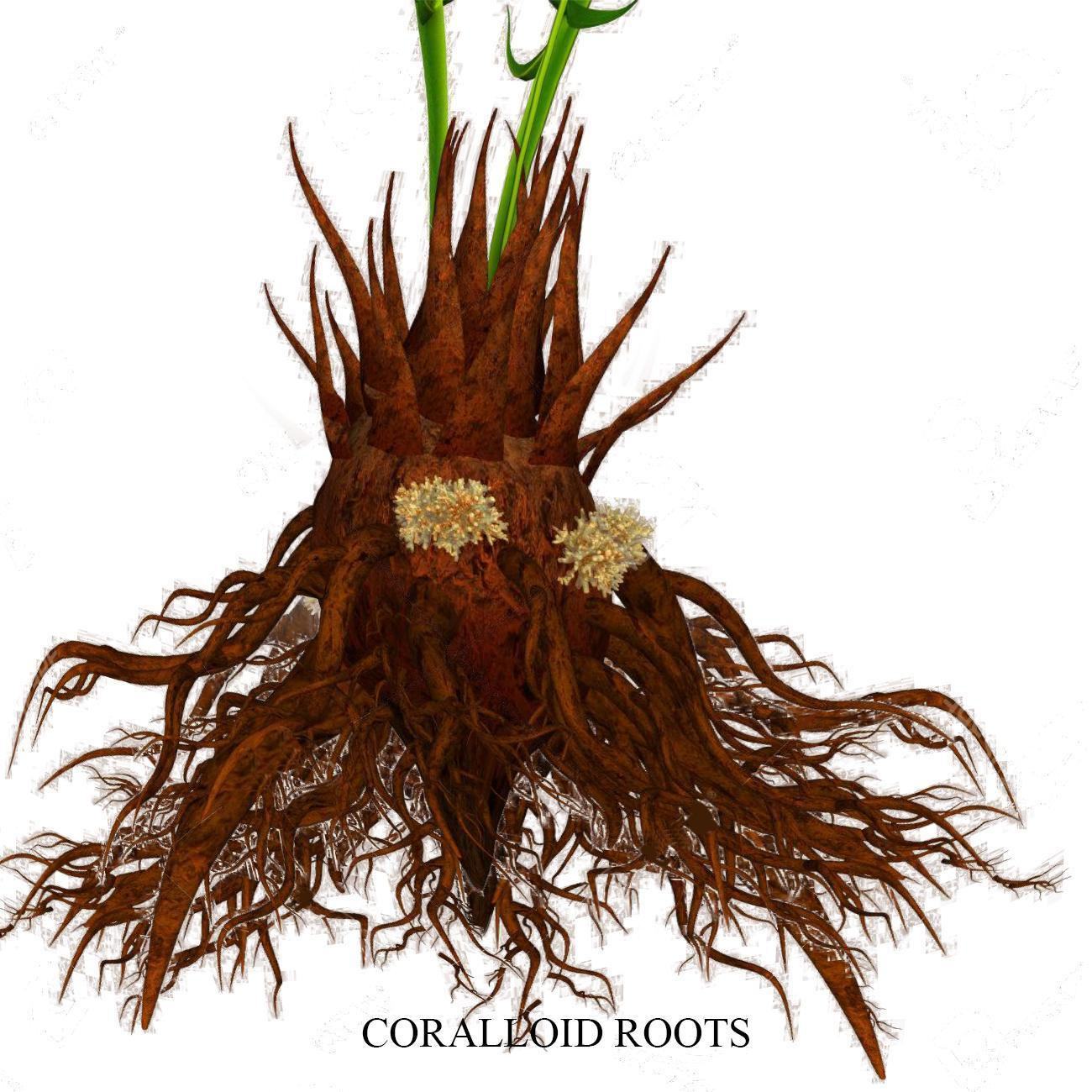
Coralloid foundations of Cycas are helpful in Nitrogen obsession. It is contrarily genotypic roots that contain nitrogen obsession microbes like cyanobacterium. They are found in cycad plants. It is significant as it flexibly provides nitrogen to the microorganisms which is needed for the development and improvement of the plant.
The cyanobacteria (cyanobionts) are arranged in phenomenal roots named coralloid roots, which include different dichotomously fanned structures arising out of the even roots. The coralloid roots are apogeotropic and can be found at different profundities, from the above surface to 30 cm or more subterranean, shaping an enormous coralloid root mass, coming to up to 500 g net weight. The method of a section of the cyanobacteria into the coralloid roots is as yet a riddle albeit various theories have been proposed, for example, passage by means of lenticels, papillose sheath, or through breaks in the dermal layer. Cycad seedlings at first structure a strong, beefy taproot that continues in underground structures for a long time yet is enlarged by auxiliary roots which likewise are very thick and meaty. The taproots, bigger auxiliary roots, and, sometimes, underground stems, have contractile components in the essence and cortex that draw the stem all the more profoundly into the ground.
So the correct answer is $N_2$-fixation.
Note:
It has additionally been recommended that the intrusion may happen at the base, the developing peak, or at an intercalary situation along the coralloid root. As of late, reconstitution of the cycad–cyanobacteria beneficial interaction was effectively accomplished, in this manner opening additional opportunities for contemplating the disease cycle.
Complete answer:
Coralloid foundations of Cycas are helpful in Nitrogen obsession. It is contrarily genotypic roots that contain nitrogen obsession microbes like cyanobacterium. They are found in cycad plants. It is significant as it flexibly provides nitrogen to the microorganisms which is needed for the development and improvement of the plant.
The cyanobacteria (cyanobionts) are arranged in phenomenal roots named coralloid roots, which include different dichotomously fanned structures arising out of the even roots. The coralloid roots are apogeotropic and can be found at different profundities, from the above surface to 30 cm or more subterranean, shaping an enormous coralloid root mass, coming to up to 500 g net weight. The method of a section of the cyanobacteria into the coralloid roots is as yet a riddle albeit various theories have been proposed, for example, passage by means of lenticels, papillose sheath, or through breaks in the dermal layer. Cycad seedlings at first structure a strong, beefy taproot that continues in underground structures for a long time yet is enlarged by auxiliary roots which likewise are very thick and meaty. The taproots, bigger auxiliary roots, and, sometimes, underground stems, have contractile components in the essence and cortex that draw the stem all the more profoundly into the ground.
So the correct answer is $N_2$-fixation.
Note:
It has additionally been recommended that the intrusion may happen at the base, the developing peak, or at an intercalary situation along the coralloid root. As of late, reconstitution of the cycad–cyanobacteria beneficial interaction was effectively accomplished, in this manner opening additional opportunities for contemplating the disease cycle.
Recently Updated Pages
Master Class 12 Economics: Engaging Questions & Answers for Success

Master Class 12 English: Engaging Questions & Answers for Success
Master Class 12 Social Science: Engaging Questions & Answers for Success
Master Class 12 Maths: Engaging Questions & Answers for Success
Master Class 12 Physics: Engaging Questions & Answers for Success
Master Class 9 General Knowledge: Engaging Questions & Answers for Success
Trending doubts
One Metric ton is equal to kg A 10000 B 1000 C 100 class 11 physics CBSE
Difference Between Prokaryotic Cells and Eukaryotic Cells
Find the value of the expression given below sin 30circ class 11 maths CBSE
Two of the body parts which do not appear in MRI are class 11 biology CBSE
Draw a diagram of nephron and explain its structur class 11 biology CBSE
10 examples of friction in our daily life