




How to convert benzene to benzophenone?
Answer
 Verified
573.6k+ views
Hint: We know that the Friedel Crafts Acylation is the one where the reactant is an alkyl-aryl halide and benzene which reacts in the presence of a catalyst to form a benzophenone. The type of reaction is an electrophilic aromatic substitution reaction.
Complete answer:
As we know that the Friedel Crafts Acylation method is used to obtain alkanes. But in this method, the reaction proceeds in two steps. In the first step, an acylated product is formed and then on further reduction an alkane is formed. The type of reaction is an electrophilic aromatic substitution reaction. It allows the syntheses of monoarylated products from the reaction between arenes and acyl chlorides. To process these reactions, Lewis Acid as catalyst is required as the reaction mechanism involves forming complexes of both the substrate and reactant as well.
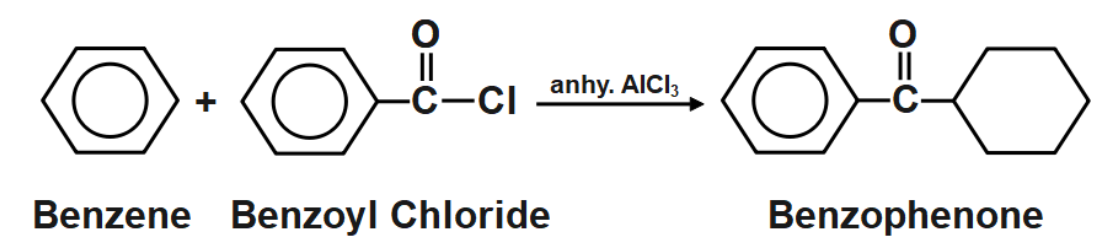
The Friedel-Crafts acylation of benzene with benzoyl chloride within the presence of a Lewis Acid (e.g., \[AlC{{l}_{3}}\] ) and once benzene react with benzoyl chloride within the presence of \[AlC{{l}_{3}}\] as a catalyst to create benzophenone. This reaction is thought to be because of the Friedel-crafts acylation. The carbonyl gas of acid chloride forms complexes with \[AlC{{l}_{3}}.\] Acylium particles are created that could be a strong electrophile. Acylium particle attacks benzene ring to create arenium particle The arenium particle undergoes loss of proton and removal of \[HCl.\] The resultant product from these three steps are benzophenone.
Note:
Remember that the aluminium chloride is a Lewis acid and majorly used in a variety of reactions especially in substitution reactions. The reaction will take place and benzophenone will be formed but it will be so unstable that it will further react with the catalyst and form triphenylmethanol with phenyl magnesium bromide.
Complete answer:
As we know that the Friedel Crafts Acylation method is used to obtain alkanes. But in this method, the reaction proceeds in two steps. In the first step, an acylated product is formed and then on further reduction an alkane is formed. The type of reaction is an electrophilic aromatic substitution reaction. It allows the syntheses of monoarylated products from the reaction between arenes and acyl chlorides. To process these reactions, Lewis Acid as catalyst is required as the reaction mechanism involves forming complexes of both the substrate and reactant as well.
The Friedel-Crafts acylation of benzene with benzoyl chloride within the presence of a Lewis Acid (e.g., \[AlC{{l}_{3}}\] ) and once benzene react with benzoyl chloride within the presence of \[AlC{{l}_{3}}\] as a catalyst to create benzophenone. This reaction is thought to be because of the Friedel-crafts acylation. The carbonyl gas of acid chloride forms complexes with \[AlC{{l}_{3}}.\] Acylium particles are created that could be a strong electrophile. Acylium particle attacks benzene ring to create arenium particle The arenium particle undergoes loss of proton and removal of \[HCl.\] The resultant product from these three steps are benzophenone.
Note:
Remember that the aluminium chloride is a Lewis acid and majorly used in a variety of reactions especially in substitution reactions. The reaction will take place and benzophenone will be formed but it will be so unstable that it will further react with the catalyst and form triphenylmethanol with phenyl magnesium bromide.
Recently Updated Pages
If x a + bt + ct2 where x is in meters and t is in class 11 physics CBSE

A car covers the first half distance between two places class 11 physics CBSE
The resultant of two vectors overrightarrow P and overrightarrow class 11 physics CBSE
Find the value of cos 135 class 11 maths CBSE
A mass M is held in place by an applied force F and class 11 physics CBSE
A solution of glucose in water is labelled as 10 dfracwv class 11 chemistry CBSE
Trending doubts
One Metric ton is equal to kg A 10000 B 1000 C 100 class 11 physics CBSE
Find the value of the expression given below sin 30circ class 11 maths CBSE
What do you mean by retardation What is its SI uni class 11 physics CBSE
Draw a diagram of nephron and explain its structur class 11 biology CBSE
10 examples of friction in our daily life
Difference between physical and chemical change class 11 chemistry CBSE