




Convert ${{40}^{\circ }}{{20}^{'}}$ into radian. \[\]
Answer
 Verified
613.2k+ views
Hint: We recall the definitions of degree and radian as the units to measure angles. We use the formula $R=\dfrac{\pi D}{180}$ to convert from degree to radian where D is the measure of angle in degree and R is the measure of angle in radian.
Complete step-by-step answer:
We know that degree is a unit for measurement of angle in a plane . If D is the measurement of the angle and it is denoted in degree with a small circle superscript $'\circ '$ as ${{D}^{\circ }}$. One degree is equal to the angle subtended at the centre by an arc of length equal to $\dfrac{1}{360}$ of circle. A degree is further divided into minutes and seconds. 1 degree is equal to 60 minutes and 1minuite is equal to 60 seconds. \[\]
We also know that radian is the standard unit for measurement of angle in plane. If R is the measurement of the angle and it is denoted in radian with a small ‘c’ superscript symbol as ${{R}^{c}}$.1 radian is equal to the measure of angle made at the centre of a circle by an arc whose length is equal to the radius of the circle.\[\]
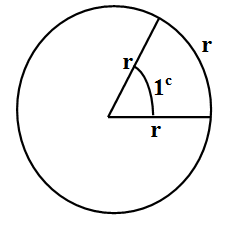
We convert the equal measures ${{R}^{c}}$ and ${{D}^{\circ }}$into other units using fowling formulae.
\[\begin{align}
& {{D}^{\circ }}=\dfrac{180}{\pi }\times {{R}^{c}} \\
& {{R}^{c}}=\dfrac{\pi }{180}\times {{D}^{\circ }} \\
\end{align}\]
We are asked to convert the given measure of an angle in degree ${{40}^{\circ }}{{20}^{'}}$ into radian. Let us first convert the given measure in degree and minutes into fractions.
We know that ${{60}^{'}}$ minute is ${{1}^{\circ }}$, then ${{1}^{'}}$ is ${{\left( \dfrac{1}{60} \right)}^{\circ }}$ and then ${{20}^{'}}$ in degree is ${{\left( 20\times \dfrac{1}{60} \right)}^{\circ }}={{\left( \dfrac{1}{3} \right)}^{\circ }}$. So the measure ${{40}^{\circ }}{{20}^{'}}$ in fraction is ${{40}^{\circ }}+{{\left( \dfrac{1}{3} \right)}^{\circ }}={{\left( \dfrac{120+1}{3} \right)}^{\circ }}={{\left( \dfrac{121}{3} \right)}^{\circ }}$
Now we use the formula for converting degrees into radian where $D=\dfrac{121}{3}$. We have;
\[{{R}^{c}}=\dfrac{\pi }{180}\times {{D}^{\circ }}=\dfrac{\pi }{180}\times \dfrac{121}{3}={{\left( \dfrac{121}{540}\pi \right)}^{c}}\]
The measure of angle in radian is ${{\left( \dfrac{121}{540}\pi \right)}^{c}}$.\[\]
Note: We have used the unitary method for direct variation to convert ${{20}^{'}}$ into degree. We note that a circular angle or complete angle is measured in ${{360}^{\circ }}$ or $2{{\pi }^{c}}$. So we use unitary method for direct variation we have ${{360}^{\circ }}=2{{\pi }^{c}}\Rightarrow {{1}^{\circ }}={{\left( \dfrac{\pi }{180} \right)}^{c}},{{360}^{\circ }}=2{{\pi }^{c}}\Rightarrow {{1}^{c}}={{\left( \dfrac{180}{\pi } \right)}^{\circ }}$ . Another unit of measure of angle is gradians (gons) which measures the complete angle as ${{400}^{g}}$.
Complete step-by-step answer:
We know that degree is a unit for measurement of angle in a plane . If D is the measurement of the angle and it is denoted in degree with a small circle superscript $'\circ '$ as ${{D}^{\circ }}$. One degree is equal to the angle subtended at the centre by an arc of length equal to $\dfrac{1}{360}$ of circle. A degree is further divided into minutes and seconds. 1 degree is equal to 60 minutes and 1minuite is equal to 60 seconds. \[\]
We also know that radian is the standard unit for measurement of angle in plane. If R is the measurement of the angle and it is denoted in radian with a small ‘c’ superscript symbol as ${{R}^{c}}$.1 radian is equal to the measure of angle made at the centre of a circle by an arc whose length is equal to the radius of the circle.\[\]
We convert the equal measures ${{R}^{c}}$ and ${{D}^{\circ }}$into other units using fowling formulae.
\[\begin{align}
& {{D}^{\circ }}=\dfrac{180}{\pi }\times {{R}^{c}} \\
& {{R}^{c}}=\dfrac{\pi }{180}\times {{D}^{\circ }} \\
\end{align}\]
We are asked to convert the given measure of an angle in degree ${{40}^{\circ }}{{20}^{'}}$ into radian. Let us first convert the given measure in degree and minutes into fractions.
We know that ${{60}^{'}}$ minute is ${{1}^{\circ }}$, then ${{1}^{'}}$ is ${{\left( \dfrac{1}{60} \right)}^{\circ }}$ and then ${{20}^{'}}$ in degree is ${{\left( 20\times \dfrac{1}{60} \right)}^{\circ }}={{\left( \dfrac{1}{3} \right)}^{\circ }}$. So the measure ${{40}^{\circ }}{{20}^{'}}$ in fraction is ${{40}^{\circ }}+{{\left( \dfrac{1}{3} \right)}^{\circ }}={{\left( \dfrac{120+1}{3} \right)}^{\circ }}={{\left( \dfrac{121}{3} \right)}^{\circ }}$
Now we use the formula for converting degrees into radian where $D=\dfrac{121}{3}$. We have;
\[{{R}^{c}}=\dfrac{\pi }{180}\times {{D}^{\circ }}=\dfrac{\pi }{180}\times \dfrac{121}{3}={{\left( \dfrac{121}{540}\pi \right)}^{c}}\]
The measure of angle in radian is ${{\left( \dfrac{121}{540}\pi \right)}^{c}}$.\[\]
Note: We have used the unitary method for direct variation to convert ${{20}^{'}}$ into degree. We note that a circular angle or complete angle is measured in ${{360}^{\circ }}$ or $2{{\pi }^{c}}$. So we use unitary method for direct variation we have ${{360}^{\circ }}=2{{\pi }^{c}}\Rightarrow {{1}^{\circ }}={{\left( \dfrac{\pi }{180} \right)}^{c}},{{360}^{\circ }}=2{{\pi }^{c}}\Rightarrow {{1}^{c}}={{\left( \dfrac{180}{\pi } \right)}^{\circ }}$ . Another unit of measure of angle is gradians (gons) which measures the complete angle as ${{400}^{g}}$.
Recently Updated Pages
Master Class 11 English: Engaging Questions & Answers for Success

Master Class 11 Social Science: Engaging Questions & Answers for Success
Master Class 11 Maths: Engaging Questions & Answers for Success
Master Class 11 Biology: Engaging Questions & Answers for Success
Master Class 11 Physics: Engaging Questions & Answers for Success
Master Class 11 Chemistry: Engaging Questions & Answers for Success
Trending doubts
Explain the Treaty of Vienna of 1815 class 10 social science CBSE
What is the Total Duration of Football Match?
The shortest day of the year in India
In which year voting age was reduced from 21 to 18?
10 examples of evaporation in daily life with explanations
What planets have no moons Which one has only one moon class 10 physics CBSE