




Construct a triangle PQR if PQ = 5 cm, $\angle PQR={{105}^{\circ }}$ and $\angle QRP={{40}^{\circ }}$.
Answer
 Verified
665.7k+ views
Hint: In order to solve this question, we will first draw a rough sketch of the triangle which will possibly form an obtuse angle triangle and then by using the protractor, pencil and ruler, we will construct the triangle. Also, we need to remember that the sum of all angles of a triangle is 180˚.
Complete step-by-step solution -
In this question, we have been asked to construct a triangle PQR if PQ = 5 cm, $\angle PQR={{105}^{\circ }}$ and $\angle QRP={{40}^{\circ }}$. To solve this question, we should know that the sum of all the interior angles of a triangle is 180˚. So, for triangle PQR, we can say,
$\angle PQR+\angle QRP+\angle RPQ={{180}^{\circ }}$
Now, we will put the value of $\angle PQR={{105}^{\circ }}$ and $\angle QRP={{40}^{\circ }}$ in the above equation, so we will get,
$\begin{align}
& {{105}^{\circ }}+{{40}^{\circ }}+\angle RPQ={{180}^{\circ }} \\
& \angle RPQ={{180}^{\circ }}-{{105}^{\circ }}-{{40}^{\circ }} \\
& \angle RPQ={{35}^{\circ }} \\
\end{align}$
So, we can say, the triangle will look something like the figure shown below.
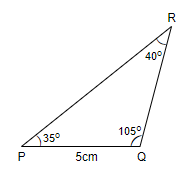
Now, to construct an accurate triangle, we will follow a few steps. So, we get,
Step 1: We will draw a line segment of 5 cm as PQ. So, we get,
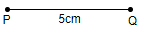
Step 2: Now, we will place the center of the protractor over point Q. And we will measure 105˚ from left to right, mark that angle, draw the line and extend it.
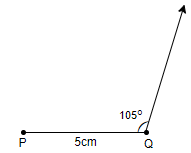
Step 3: Now, we do not know where the point R lies, so we will first draw the angle 35˚ from point P. So, we will place the center of the protractor over the point P, measure an angle of 35˚ from left to right and then we will extend that line so that it meets the line drawn from point Q at a point. And then, we will mark the point where the two lines meet as R. So, we get,
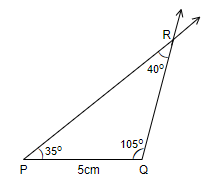
Therefore, we have constructed the triangle PQR for PQ = 5 cm, $\angle PQR={{105}^{\circ }}$ and $\angle QRP={{40}^{\circ }}$.
Note: While solving this question, if we make $\angle QRP$ instead of $\angle RPQ$, then we will probably not get the correct triangle because we do not know the length of QR. What we only have is the length of PQ, so we will probably make those angles which can be formed on the line PQ. Also, after constructing the triangle we can check if the angle QRP is 40˚ to check if our construction is correct or not.
Complete step-by-step solution -
In this question, we have been asked to construct a triangle PQR if PQ = 5 cm, $\angle PQR={{105}^{\circ }}$ and $\angle QRP={{40}^{\circ }}$. To solve this question, we should know that the sum of all the interior angles of a triangle is 180˚. So, for triangle PQR, we can say,
$\angle PQR+\angle QRP+\angle RPQ={{180}^{\circ }}$
Now, we will put the value of $\angle PQR={{105}^{\circ }}$ and $\angle QRP={{40}^{\circ }}$ in the above equation, so we will get,
$\begin{align}
& {{105}^{\circ }}+{{40}^{\circ }}+\angle RPQ={{180}^{\circ }} \\
& \angle RPQ={{180}^{\circ }}-{{105}^{\circ }}-{{40}^{\circ }} \\
& \angle RPQ={{35}^{\circ }} \\
\end{align}$
So, we can say, the triangle will look something like the figure shown below.
Now, to construct an accurate triangle, we will follow a few steps. So, we get,
Step 1: We will draw a line segment of 5 cm as PQ. So, we get,
Step 2: Now, we will place the center of the protractor over point Q. And we will measure 105˚ from left to right, mark that angle, draw the line and extend it.
Step 3: Now, we do not know where the point R lies, so we will first draw the angle 35˚ from point P. So, we will place the center of the protractor over the point P, measure an angle of 35˚ from left to right and then we will extend that line so that it meets the line drawn from point Q at a point. And then, we will mark the point where the two lines meet as R. So, we get,
Therefore, we have constructed the triangle PQR for PQ = 5 cm, $\angle PQR={{105}^{\circ }}$ and $\angle QRP={{40}^{\circ }}$.
Note: While solving this question, if we make $\angle QRP$ instead of $\angle RPQ$, then we will probably not get the correct triangle because we do not know the length of QR. What we only have is the length of PQ, so we will probably make those angles which can be formed on the line PQ. Also, after constructing the triangle we can check if the angle QRP is 40˚ to check if our construction is correct or not.
Recently Updated Pages
Write any three differences between metals and nonmetals class 10 social science CBSE

Amit standing on a horizontal plane finds a bird flying class 10 maths CBSE
Two circles of radii 5 cm and 3 cm intersect at two class 10 maths CBSE
Solve the following i John and Jivanti together have class 10 maths CBSE
What is the relation between orthocenter circumcentre class 10 maths CBSE
Two plane mirrors are inclined at 70circ A ray incident class 10 physics CBSE
Trending doubts
Explain the Treaty of Vienna of 1815 class 10 social science CBSE
1 GB equals how many MB?
10 examples of evaporation in daily life with explanations
What is the full form of POSCO class 10 social science CBSE
Which is the hottest planet in the Solar system A Earth class 10 social science CBSE
Name any four life processes in living things class 10 biology CBSE