




Construct a quadrilateral ROAM, where RO = 4cm, OA = 5cm, \[\angle R={{50}^{\circ }},\angle O={{110}^{\circ }}\] and \[\angle A={{70}^{\circ }}\].
Answer
 Verified
600.9k+ views
Hint: Assume RO as the base of the quadrilateral of length 4cm. Use a protractor to draw an angle of \[{{50}^{\circ }}\] at point R and an angle of \[{{110}^{\circ }}\] at point O. Use scale to mark a length of 5cm from point O on the extended line of angle and name it A. Now, draw an angle of \[{{70}^{\circ }}\] at point A and extend the line to meet the extended line of \[\angle R\] at the point M.
Complete step by step answer:
Here, we have been provided with the following information regarding a quadrilateral ROAM: - RO = 4cm, OA = 5cm, \[\angle R={{50}^{\circ }},\angle O={{110}^{\circ }}\] and \[\angle A={{70}^{\circ }}\]. We have to construct the quadrilateral ROAM. So, follow the following steps to draw the quadrilateral: -
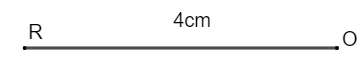
Step 1: - Consider RO as the base of the quadrilateral and construct a line of length 4cm using scale. Mark the endpoints as R and O.
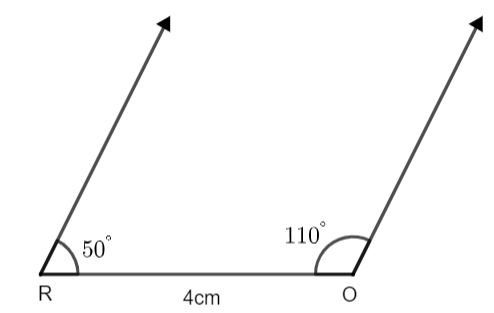
Step 2: - Place a protractor at point R and draw an angle of \[{{50}^{\circ }}\] and extend the line. Similarly, place the protractor at point O and construct an angle of \[{{110}^{\circ }}\] towards the left side and extend the line.
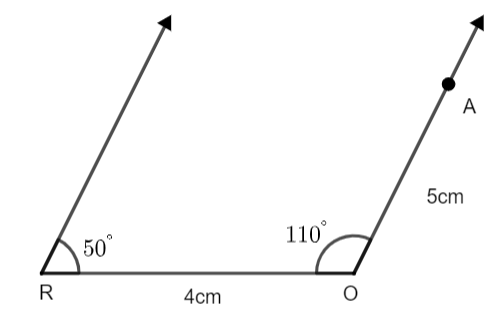
Step 3: - Use scale to mark a point A at a distance of 5cm from O on the extended line.
Step 4: - Place the protractor at point A with OA as the baseline of the protractor and draw an angle of \[{{70}^{\circ }}\]. Extend the line to meet the extended line of R at M.
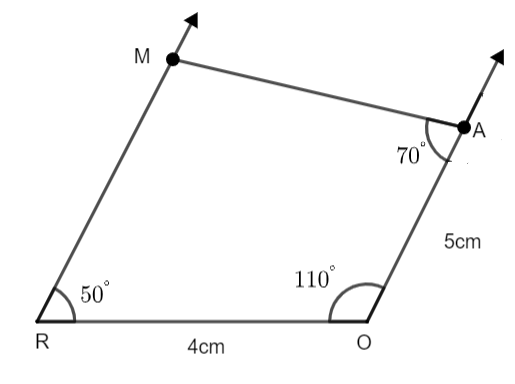
Hence, our quadrilateral ROAM is complete.
Note: One may note that here we have considered RO = 4cm as the base of our quadrilateral. We can also assume the other given side OA = 5cm as the base of our quadrilateral. Remember that two sides are unknown so never assume them as the base. The length of these sides can be calculated by using a scale. The fourth angle can be determined with the help of a protractor or we can subtract the sum of given three angles from \[{{360}^{\circ }}\].
Complete step by step answer:
Here, we have been provided with the following information regarding a quadrilateral ROAM: - RO = 4cm, OA = 5cm, \[\angle R={{50}^{\circ }},\angle O={{110}^{\circ }}\] and \[\angle A={{70}^{\circ }}\]. We have to construct the quadrilateral ROAM. So, follow the following steps to draw the quadrilateral: -
Step 1: - Consider RO as the base of the quadrilateral and construct a line of length 4cm using scale. Mark the endpoints as R and O.
Step 2: - Place a protractor at point R and draw an angle of \[{{50}^{\circ }}\] and extend the line. Similarly, place the protractor at point O and construct an angle of \[{{110}^{\circ }}\] towards the left side and extend the line.
Step 3: - Use scale to mark a point A at a distance of 5cm from O on the extended line.
Step 4: - Place the protractor at point A with OA as the baseline of the protractor and draw an angle of \[{{70}^{\circ }}\]. Extend the line to meet the extended line of R at M.
Hence, our quadrilateral ROAM is complete.
Note: One may note that here we have considered RO = 4cm as the base of our quadrilateral. We can also assume the other given side OA = 5cm as the base of our quadrilateral. Remember that two sides are unknown so never assume them as the base. The length of these sides can be calculated by using a scale. The fourth angle can be determined with the help of a protractor or we can subtract the sum of given three angles from \[{{360}^{\circ }}\].
Recently Updated Pages
Master Class 12 Business Studies: Engaging Questions & Answers for Success

Master Class 12 Biology: Engaging Questions & Answers for Success
Master Class 12 Chemistry: Engaging Questions & Answers for Success
Class 12 Question and Answer - Your Ultimate Solutions Guide
Master Class 11 Social Science: Engaging Questions & Answers for Success
Master Class 11 English: Engaging Questions & Answers for Success
Trending doubts
Explain the Treaty of Vienna of 1815 class 10 social science CBSE
Which Indian city is known as the "City of Victory"?
Which instrument is used to measure the Blood Pressure?
Who Won 36 Oscar Awards? Record Holder Revealed
What is the median of the first 10 natural numbers class 10 maths CBSE
Why is it 530 pm in india when it is 1200 afternoon class 10 social science CBSE