




Construct a quadrilateral \[\] LMNO such that l (LM) = l (LO) = 6 cm, l (ON) = l (NM) = 4.5cm, l(OM) = 7.5 cm.
Answer
 Verified
611.7k+ views
HINT: For solving the questions that involve construction, we have to follow specific steps that are unique to a particular question which might include the construction of some known angles.
The construction of some common angles must be known beforehand as they might be used in these types of questions.
Complete step-by-step answer:
As mentioned in the question, we have to construct a quadrilateral \[\] LMNO.
Now, we will follow the below mentioned steps in a chronological manner to obtain or construct the required quadrilateral.
1) Firstly, we will draw a horizontal line segment LM=6cm.
2)Now, from point L, we will draw an arc having radius=6cm.
3) Then, from point M, we will draw another arc having radius=7.5cm in such a way that it intersects with the arc that we have drawn in step 2. The point of intersection of these two arcs that are made by us is point O.
4) Now, we will join points LO and OM. LO is the side of the quadrilateral that we are constructing while OM is the diagonal of this quadrilateral which we are constructing.
5) Now, we will draw an arc having radius =4.5cm from point O.
6) From point M, we will then draw another arc having radius=4.5cm such that it intersects with the arc that we have drawn in step 5.The point of intersection is N.
7) On joining points O and N and points M and N, we get ON and MN that are also the sides of quadrilateral \[\] LMNO.
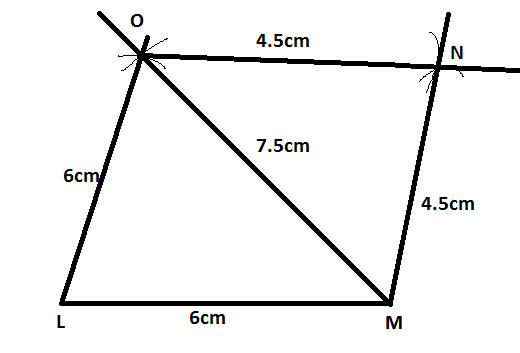
Hence, we obtained the quadrilateral \[\] LMNO.
NOTE: -
The students can make an error if they don’t follow the correct procedure and that too in order because otherwise the students would not get to the right figure as in such questions, following the procedure correctly is very important to get to the correct shape.
The construction of some common angles must be known beforehand as they might be used in these types of questions.
Complete step-by-step answer:
As mentioned in the question, we have to construct a quadrilateral \[\] LMNO.
Now, we will follow the below mentioned steps in a chronological manner to obtain or construct the required quadrilateral.
1) Firstly, we will draw a horizontal line segment LM=6cm.
2)Now, from point L, we will draw an arc having radius=6cm.
3) Then, from point M, we will draw another arc having radius=7.5cm in such a way that it intersects with the arc that we have drawn in step 2. The point of intersection of these two arcs that are made by us is point O.
4) Now, we will join points LO and OM. LO is the side of the quadrilateral that we are constructing while OM is the diagonal of this quadrilateral which we are constructing.
5) Now, we will draw an arc having radius =4.5cm from point O.
6) From point M, we will then draw another arc having radius=4.5cm such that it intersects with the arc that we have drawn in step 5.The point of intersection is N.
7) On joining points O and N and points M and N, we get ON and MN that are also the sides of quadrilateral \[\] LMNO.
Hence, we obtained the quadrilateral \[\] LMNO.
NOTE: -
The students can make an error if they don’t follow the correct procedure and that too in order because otherwise the students would not get to the right figure as in such questions, following the procedure correctly is very important to get to the correct shape.
Recently Updated Pages
Master Class 10 Computer Science: Engaging Questions & Answers for Success

Master Class 10 General Knowledge: Engaging Questions & Answers for Success
Master Class 10 English: Engaging Questions & Answers for Success
Master Class 10 Social Science: Engaging Questions & Answers for Success
Master Class 10 Maths: Engaging Questions & Answers for Success
Master Class 10 Science: Engaging Questions & Answers for Success
Trending doubts
What is the median of the first 10 natural numbers class 10 maths CBSE
Which women's tennis player has 24 Grand Slam singles titles?
Who is the Brand Ambassador of Incredible India?
Why is there a time difference of about 5 hours between class 10 social science CBSE
Write a letter to the principal requesting him to grant class 10 english CBSE
State and prove converse of BPT Basic Proportionality class 10 maths CBSE