




Construct a parallelogram ABCD in which $BC = 5cm$,$\angle BCD = {120^\circ }$ and $CD = 4.8cm$ .
Answer
 Verified
510k+ views
Hint: A parallelogram is one of the special varieties of polygon. Here, it is a quadrilateral whose pairs of opposite sides are parallel to each other. It is a two-dimensional geometrical shape containing four sides, four vertices, two pairs of parallel sides.
Here, we are asked to construct a parallelogram ABCD in which $BC = 5cm$,$\angle BCD = {120^\circ }$and $CD = 4.8cm$ .
Complete step by step answer:
Here, we are asked to construct a parallelogram ABCD in which $BC = 5cm$,$\angle BCD = {120^\circ }$and $CD = 4.8cm$ .
The steps that are involved in the construction of a parallelogram are as follows.
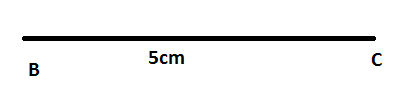
Step 1: First we need to draw a line $BC = 5cm$measured using ruler.
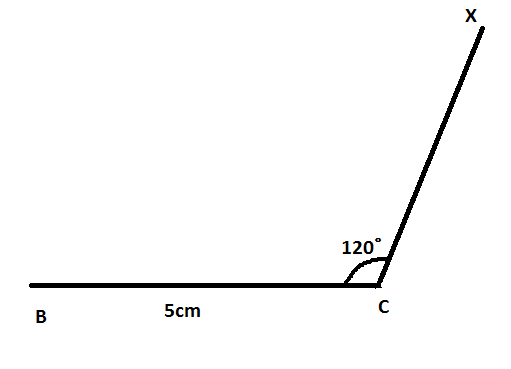
Step 2: Mark an angle${120^\circ }$using protractor at C. And then draw a line making\[\angle BCX = {120^\circ }\] .
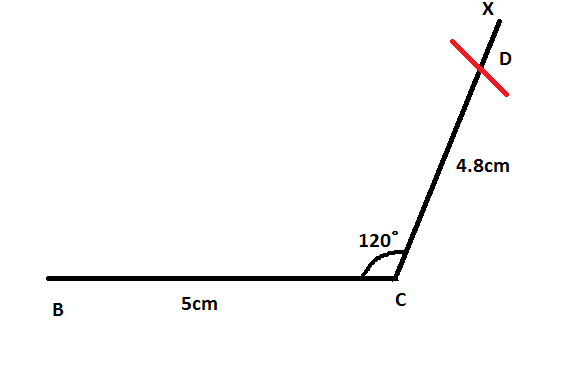
Step 3: Measure $CD = 4.8cm$ using a ruler, and draw an arc using compass $CD = 4.8cm$ cutting at the ray CX.
Step 4: Now, we need to draw an arc from B with $4.8cm$as radius.
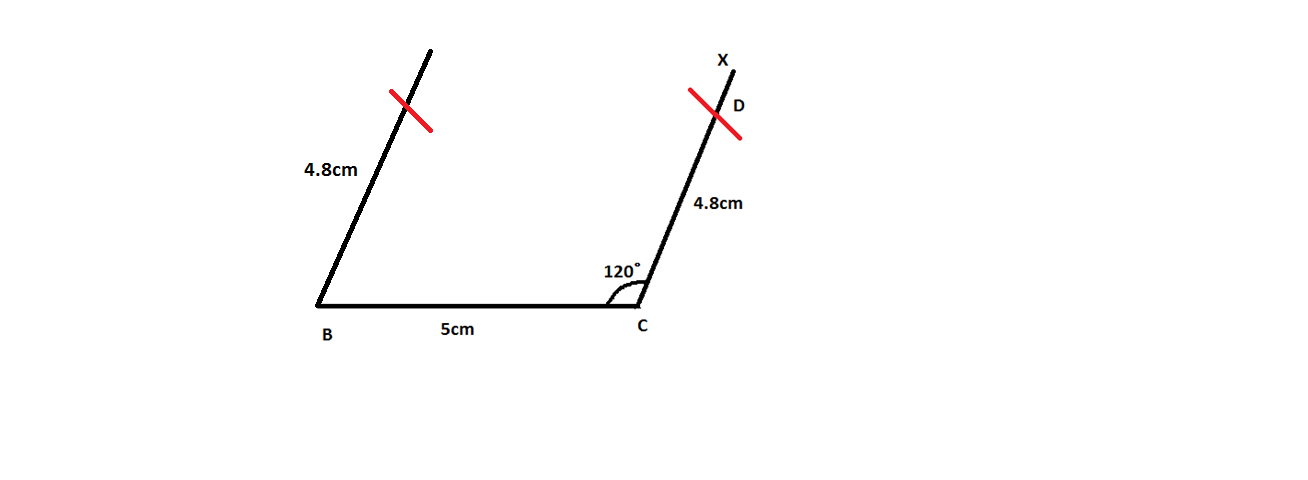
Step 5: And then, take$5cm$from D, and cut the arc drawn in the previous step. That point of intersection is A.
Step 6: Now, join all the lines. ABCD is the required parallelogram.
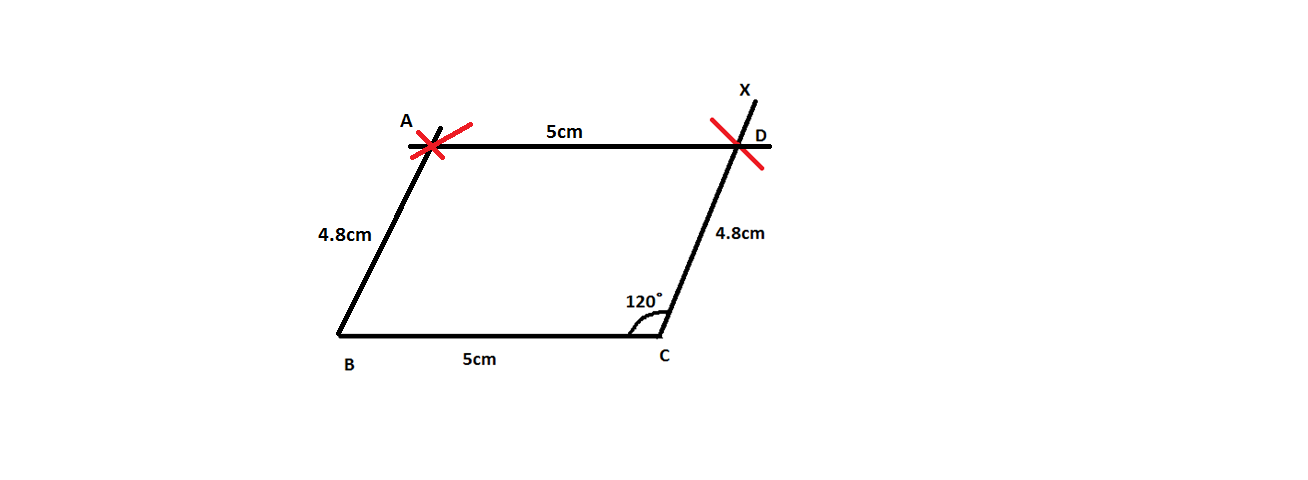
The constructed parallelogram is shown below.
Note:
A parallelogram is a two-dimensional geometrical shape containing four sides, four vertices, two pairs of parallel sides. Some of the properties of parallelograms are to be noted.
The opposite sides of the parallelogram are always congruent.
The opposite angles of the parallelogram are always congruent.
The diagonals of a parallelogram bisect each other in particular; each diagonal separates a parallelogram into two congruent triangles.
Here, we are asked to construct a parallelogram ABCD in which $BC = 5cm$,$\angle BCD = {120^\circ }$and $CD = 4.8cm$ .
Complete step by step answer:
Here, we are asked to construct a parallelogram ABCD in which $BC = 5cm$,$\angle BCD = {120^\circ }$and $CD = 4.8cm$ .
The steps that are involved in the construction of a parallelogram are as follows.
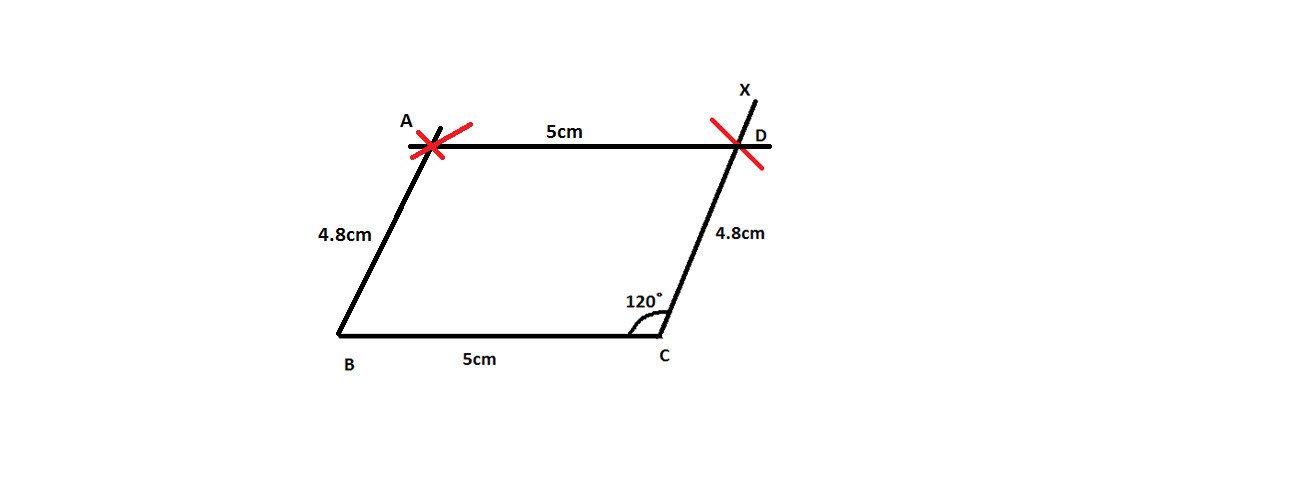
Step 1: First we need to draw a line $BC = 5cm$measured using ruler.
Step 2: Mark an angle${120^\circ }$using protractor at C. And then draw a line making\[\angle BCX = {120^\circ }\] .
Step 3: Measure $CD = 4.8cm$ using a ruler, and draw an arc using compass $CD = 4.8cm$ cutting at the ray CX.
Step 4: Now, we need to draw an arc from B with $4.8cm$as radius.
Step 5: And then, take$5cm$from D, and cut the arc drawn in the previous step. That point of intersection is A.
Step 6: Now, join all the lines. ABCD is the required parallelogram.
The constructed parallelogram is shown below.
Note:
A parallelogram is a two-dimensional geometrical shape containing four sides, four vertices, two pairs of parallel sides. Some of the properties of parallelograms are to be noted.
The opposite sides of the parallelogram are always congruent.
The opposite angles of the parallelogram are always congruent.
The diagonals of a parallelogram bisect each other in particular; each diagonal separates a parallelogram into two congruent triangles.
Recently Updated Pages
Master Class 11 English: Engaging Questions & Answers for Success

Master Class 11 Social Science: Engaging Questions & Answers for Success
Master Class 11 Maths: Engaging Questions & Answers for Success
Master Class 11 Chemistry: Engaging Questions & Answers for Success
Master Class 11 Biology: Engaging Questions & Answers for Success
Master Class 11 Physics: Engaging Questions & Answers for Success
Trending doubts
Explain the Treaty of Vienna of 1815 class 10 social science CBSE
Why is it 530 pm in india when it is 1200 afternoon class 10 social science CBSE
What is the full form of CNG A Complete Natural Gas class 10 social science CBSE
In cricket, what is a "Yorker" designed to do?
What is the full form of POSCO class 10 social science CBSE
Define Potential, Developed, Stock and Reserved resources