




Consider the regular hexagon ABCDEF with center at O (origin).
Find the resultant vector for $ \overrightarrow{AD}+\overrightarrow{EB}+\overrightarrow{FC} $ .
A. $ 2\overrightarrow{AB} $
B. $ 3\overrightarrow{AB} $
C. $ 4\overrightarrow{AB} $
D. None of these.
Answer
 Verified
607.5k+ views
Hint: A regular hexagon has 6 sides of equal length and 6 equal angles measuring $ 120{}^\circ $ each.
A regular hexagon can be divided into 6 identical equilateral triangles by joining each vertex with the center.
The resultant is the vector sum of two or more vectors. It is the result of adding two or more vectors together.
Vectors are added using the Triangle Law of vector addition:
$ \overrightarrow{PQ}+\overrightarrow{QR}=\overrightarrow{PR} $
Complete step by step answer:
Let's draw the diagram for the given vectors:
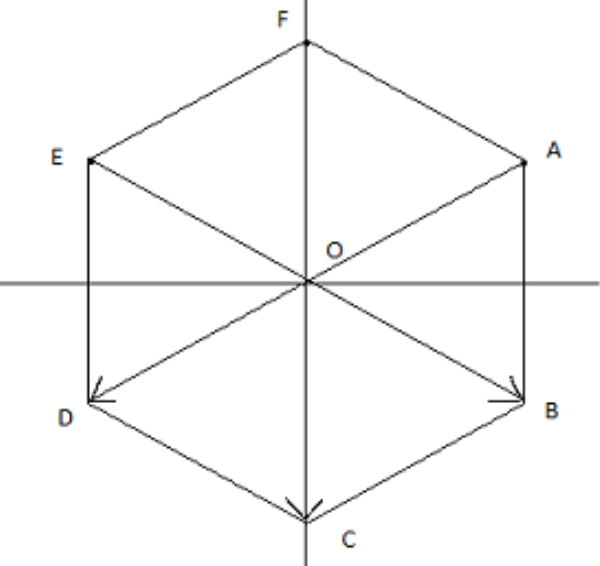
We know that the 6 equilateral triangles around the center are identical.
∴ $ \overrightarrow{AB}=\overrightarrow{OC} $ ... (1)
$ \overrightarrow{AD}=2\overrightarrow{AO} $ ... (2)
$ \overrightarrow{EB}=2\overrightarrow{OB} $ ... (3)
$ \overrightarrow{FC}=2\overrightarrow{OC} $ ... (4)
Now, $ \overrightarrow{AD}+\overrightarrow{EB}+\overrightarrow{FC} $
= $ 2\overrightarrow{AO}+2\overrightarrow{OB}+2\overrightarrow{OC} $ ... [Using (2), (3) and (4).]
= $ 2\left( \overrightarrow{AO}+\overrightarrow{OB} \right)+2\overrightarrow{AB} $ ... [Using (1).]
= $ 2\left( \overrightarrow{AB} \right)+2\overrightarrow{AB} $ ... [Using Triangle law of vector addition.]
= $ 4\overrightarrow{AB} $
The correct answer is C. $ 4\overrightarrow{AB} $ .
Note: The direction of a vector is important: $ \overrightarrow{AB}=-\overrightarrow{BA} $ .
The vector component along the x-axis, of a vector $ \overrightarrow{r} $ which makes an angle $ \theta $ with the positive direction of the x-axis, is $ \overrightarrow{r}\sin \theta $ and the component along the y-axis is $ \overrightarrow{r}\cos \theta $ .
A regular polygon has sides of equal length and equal angles as well. All vertices are at equal distances from the center, and all the sides are also at equal distances from the center.
A regular hexagon can be divided into 6 identical equilateral triangles by joining each vertex with the center.
The resultant is the vector sum of two or more vectors. It is the result of adding two or more vectors together.
Vectors are added using the Triangle Law of vector addition:
$ \overrightarrow{PQ}+\overrightarrow{QR}=\overrightarrow{PR} $
Complete step by step answer:
Let's draw the diagram for the given vectors:
We know that the 6 equilateral triangles around the center are identical.
∴ $ \overrightarrow{AB}=\overrightarrow{OC} $ ... (1)
$ \overrightarrow{AD}=2\overrightarrow{AO} $ ... (2)
$ \overrightarrow{EB}=2\overrightarrow{OB} $ ... (3)
$ \overrightarrow{FC}=2\overrightarrow{OC} $ ... (4)
Now, $ \overrightarrow{AD}+\overrightarrow{EB}+\overrightarrow{FC} $
= $ 2\overrightarrow{AO}+2\overrightarrow{OB}+2\overrightarrow{OC} $ ... [Using (2), (3) and (4).]
= $ 2\left( \overrightarrow{AO}+\overrightarrow{OB} \right)+2\overrightarrow{AB} $ ... [Using (1).]
= $ 2\left( \overrightarrow{AB} \right)+2\overrightarrow{AB} $ ... [Using Triangle law of vector addition.]
= $ 4\overrightarrow{AB} $
The correct answer is C. $ 4\overrightarrow{AB} $ .
Note: The direction of a vector is important: $ \overrightarrow{AB}=-\overrightarrow{BA} $ .
The vector component along the x-axis, of a vector $ \overrightarrow{r} $ which makes an angle $ \theta $ with the positive direction of the x-axis, is $ \overrightarrow{r}\sin \theta $ and the component along the y-axis is $ \overrightarrow{r}\cos \theta $ .
A regular polygon has sides of equal length and equal angles as well. All vertices are at equal distances from the center, and all the sides are also at equal distances from the center.
Recently Updated Pages
Master Class 11 English: Engaging Questions & Answers for Success

Master Class 11 Social Science: Engaging Questions & Answers for Success
Master Class 11 Maths: Engaging Questions & Answers for Success
Master Class 11 Biology: Engaging Questions & Answers for Success
Master Class 11 Physics: Engaging Questions & Answers for Success
Master Class 11 Chemistry: Engaging Questions & Answers for Success
Trending doubts
Explain the Treaty of Vienna of 1815 class 10 social science CBSE
What is the Total Duration of Football Match?
First Cotton Mill of India
In which year voting age was reduced from 21 to 18?
10 examples of evaporation in daily life with explanations
What planets have no moons Which one has only one moon class 10 physics CBSE