




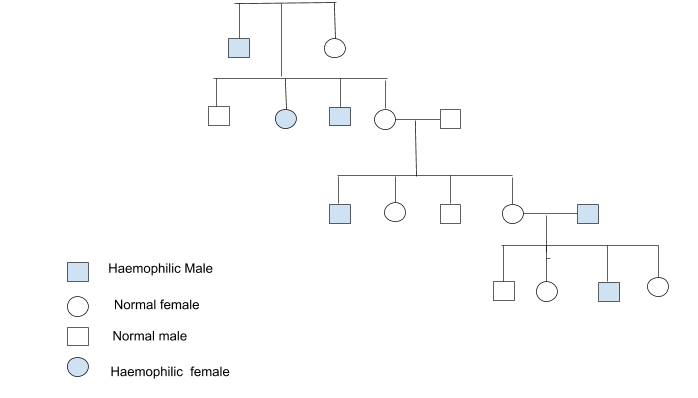
Consider the following pedigree over four generations and mark the correct answer below about the inheritance of haemophilia.
A) Haemophilia is X-linked dominant
B) Haemophilia is autosomal dominant
C) Haemophilia is x-linked recessive
D) Haemophilia is y-linked dominant
Answer
 Verified
607.2k+ views
Hint:Haemophilia is a largely hereditary genetic condition that impairs the capacity of the body to make blood clots, a mechanism that is important to avoid bleeding. This results in people bleeding after an injury for a longer period, quick swelling, and an increased risk of bleeding within joints or the brain.
Complete answer:
Characteristic signs differ according to severity. In general, internal or external bleeding episodes, called 'bleeds,' are symptoms. People with more severe haemophilia experience more severe and more frequent bleeding, while people with moderate haemophilia, even after surgery or severe injuries, typically experience more minor symptoms. In cases with severe haemophilia, symptoms that occur along a continuum between extreme and mild types are variable.
A condition carried by an X-linked gene is this disorder. There are two alleles for this gene. One where you do not have dominant haemophilia (H), and one where you do have recessive haemophilia (h). In women, as they have two X chromosomes, the disease is much less common. This is because if they are given one gene with haemophilia, they have a chance of having a non-hemophiliac gene from their other chromosome.
The haemophilia gene will cancel this, because they may not have the disorder. Of course, if there were two haemophilia genes given to a woman, they would have the disease. The mother (left side) in the test cross above is absolutely free of haemophilia.Father(top) is affected by haemophilia.
This is because the gene for haemophilia is not borne by the Y chromosome). In the two cases where the child may be a female, she carries the hemophilia gene, however it is counteracted by the non-hemophiliac gene, so while she would be a carrier, she would not have haemophilia.
Thus the correct answer is option (C) Haemophilia is X-linked recessive.
Note:Hemophilia is a recessive sex-linked condition. In males, these kinds of defects occur more frequently than in females.Hemophilia is more common among male children because they only inherit one X chromosome.
Complete answer:
Characteristic signs differ according to severity. In general, internal or external bleeding episodes, called 'bleeds,' are symptoms. People with more severe haemophilia experience more severe and more frequent bleeding, while people with moderate haemophilia, even after surgery or severe injuries, typically experience more minor symptoms. In cases with severe haemophilia, symptoms that occur along a continuum between extreme and mild types are variable.
A condition carried by an X-linked gene is this disorder. There are two alleles for this gene. One where you do not have dominant haemophilia (H), and one where you do have recessive haemophilia (h). In women, as they have two X chromosomes, the disease is much less common. This is because if they are given one gene with haemophilia, they have a chance of having a non-hemophiliac gene from their other chromosome.
| Xh | Y | |
| XH | XHXh | XHY |
| XH | XHXH | XHY |
The haemophilia gene will cancel this, because they may not have the disorder. Of course, if there were two haemophilia genes given to a woman, they would have the disease. The mother (left side) in the test cross above is absolutely free of haemophilia.Father(top) is affected by haemophilia.
This is because the gene for haemophilia is not borne by the Y chromosome). In the two cases where the child may be a female, she carries the hemophilia gene, however it is counteracted by the non-hemophiliac gene, so while she would be a carrier, she would not have haemophilia.
Thus the correct answer is option (C) Haemophilia is X-linked recessive.
Note:Hemophilia is a recessive sex-linked condition. In males, these kinds of defects occur more frequently than in females.Hemophilia is more common among male children because they only inherit one X chromosome.
Recently Updated Pages
Master Class 12 Business Studies: Engaging Questions & Answers for Success

Master Class 12 Biology: Engaging Questions & Answers for Success
Master Class 12 Chemistry: Engaging Questions & Answers for Success
Class 12 Question and Answer - Your Ultimate Solutions Guide
Master Class 11 Social Science: Engaging Questions & Answers for Success
Master Class 11 English: Engaging Questions & Answers for Success
Trending doubts
Which are the Top 10 Largest Countries of the World?
Draw a labelled sketch of the human eye class 12 physics CBSE
Differentiate between homogeneous and heterogeneous class 12 chemistry CBSE
Sulphuric acid is known as the king of acids State class 12 chemistry CBSE
Why is the cell called the structural and functional class 12 biology CBSE
Which is the correct genotypic ratio of mendel dihybrid class 12 biology CBSE