




What is the condition for zero error in screw gauge?
A.)When zero of circular scale is not coinciding with datum line
B.)When zero of circular scale is coinciding with datum line
C.)There is no specific condition for zero error.
D.)None of the above
Answer
 Verified
663.3k+ views
Hint: Error is basically the deviation of measured quantity from its true value. So. Zero error can be seen as a deviation of reading from calibrated zero point while working with an instrument. Basically, it is an indication of an instrument resulting in a non-zero value for some quantity when the quantity is actually zero.
Complete step-by-step answer:
A screw gauge is an instrument used to measure small lengths such as the thickness of a thin glass plate or the diameter of a wire, which are basically measured in milli-metre. It works on the principal of a screw in a nut, hence called a screw gauge.
It consists of a U-shaped metallic frame, a main scale and a circular scale fitted on a cylinder. There are calibrations done on horizontal main scale and circular scale, calibrations of which are used to find the required values of thickness.
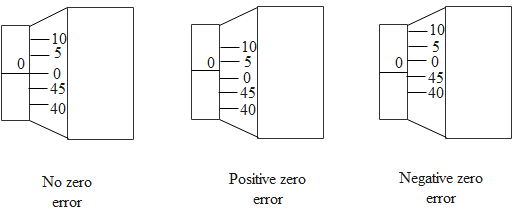
Either due to miscalibrated instrument or personal misjudgement while experimenting, the zero of circular scale may not coincide with the datum or reference line of the main scale thus causing an error in reading of the screw gauge. So, if the zero of the circular scale is above or below the zero of the main scale, then it is known as zero error.
Hence, the correct answer is .
Note: When the zero mark on the circular scale is below the reference line of the main scale, then the error is said to be a positive zero error. And when the zero mark on the circular scale is above the reference line of the main scale, then the error is said to be a negative zero error.
Complete step-by-step answer:
A screw gauge is an instrument used to measure small lengths such as the thickness of a thin glass plate or the diameter of a wire, which are basically measured in milli-metre. It works on the principal of a screw in a nut, hence called a screw gauge.
It consists of a U-shaped metallic frame, a main scale and a circular scale fitted on a cylinder. There are calibrations done on horizontal main scale and circular scale, calibrations of which are used to find the required values of thickness.
Either due to miscalibrated instrument or personal misjudgement while experimenting, the zero of circular scale may not coincide with the datum or reference line of the main scale thus causing an error in reading of the screw gauge. So, if the zero of the circular scale is above or below the zero of the main scale, then it is known as zero error.
Hence, the correct answer is .
Note: When the zero mark on the circular scale is below the reference line of the main scale, then the error is said to be a positive zero error. And when the zero mark on the circular scale is above the reference line of the main scale, then the error is said to be a negative zero error.
Recently Updated Pages
If x a + bt + ct2 where x is in meters and t is in class 11 physics CBSE

A car covers the first half distance between two places class 11 physics CBSE
The resultant of two vectors overrightarrow P and overrightarrow class 11 physics CBSE
Find the value of cos 135 class 11 maths CBSE
A mass M is held in place by an applied force F and class 11 physics CBSE
A solution of glucose in water is labelled as 10 dfracwv class 11 chemistry CBSE
Trending doubts
One Metric ton is equal to kg A 10000 B 1000 C 100 class 11 physics CBSE
Find the value of the expression given below sin 30circ class 11 maths CBSE
What do you mean by retardation What is its SI uni class 11 physics CBSE
Draw a diagram of nephron and explain its structur class 11 biology CBSE
10 examples of friction in our daily life
Difference between physical and chemical change class 11 chemistry CBSE