




Concentric circles of radii 1, 2, 3, …, 100 cm are drawn. The interior of the smallest circle is coloured red and the angular regions are coloured alternatively green and red, so that no two adjacent regions are of the same colour. The total area of the green region in sq. cm is equal to
(a) \[1000\pi \]
(b) \[5050\pi \]
(c) \[4950\pi \]
(d) \[5151\pi \]
Answer
 Verified
605.4k+ views
Hint: We solve this problem by using the formula of area of circle.
The formula of area of circle having the radius \[r\] is given as
\[A=\pi {{r}^{2}}\]
We also have the formula of summation of squares of first \[n\] natural numbers is given as
\[{{1}^{2}}+{{2}^{2}}+{{3}^{2}}+....+{{n}^{2}}=\dfrac{n\left( n+1 \right)\left( 2n+1 \right)}{6}\]
Complete answer:
Let us take a rough figure of the given circles as follows
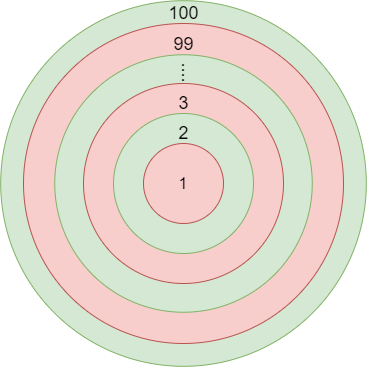
Here, we can see that circles of odd radii are red colour and circles of even radii are green in colour.
We are asked to find the total area of the green region.
Let us assume that the area of first green region that is 2 as \[{{A}_{1}}\]
We know that the formula of area of circle having the radius \[r\] is given as
\[A=\pi {{r}^{2}}\]
By using the above formula we get the area of first green region as
\[\begin{align}
& \Rightarrow {{A}_{1}}=\pi \left( {{2}^{2}} \right)-\pi \left( {{1}^{2}} \right) \\
& \Rightarrow {{A}_{1}}=\pi \left( {{2}^{2}}-{{1}^{2}} \right) \\
\end{align}\]
Now, let us assume that the area of next green region as \[{{A}_{2}}\]
By using the area of circle formula we get
\[\Rightarrow {{A}_{2}}=\pi \left( {{4}^{2}}-{{3}^{2}} \right)\]
Let us assume that the total area of the green region as \[A\] then we get
\[\begin{align}
& \Rightarrow A={{A}_{1}}+{{A}_{2}}+.....+{{A}_{n}} \\
& \Rightarrow A=\pi \left( {{2}^{2}}-{{1}^{2}} \right)+\pi \left( {{4}^{2}}-{{3}^{2}} \right)+....+\pi \left( {{100}^{2}}-{{99}^{2}} \right) \\
\end{align}\]
Now, let us divide the terms of even and odd terms separately then we get
\[\Rightarrow A=\pi \left( {{2}^{2}}+{{4}^{2}}+....+{{100}^{2}} \right)-\pi \left( {{1}^{2}}+{{3}^{2}}+....+{{99}^{2}} \right)\]
Now, let us add and subtract the even terms in the above equation then we get
\[\begin{align}
& \Rightarrow A=2\pi \left( {{2}^{2}}+{{4}^{2}}+....+{{100}^{2}} \right)-\pi \left( {{1}^{2}}+{{2}^{2}}+{{3}^{2}}+.....+{{99}^{2}}+{{100}^{2}} \right) \\
& \Rightarrow A=2\pi \times {{2}^{2}}\left( {{1}^{2}}+{{2}^{2}}+.....+{{50}^{2}} \right)-\pi \left( {{1}^{2}}+{{2}^{2}}+....+{{100}^{2}} \right) \\
& \Rightarrow A=8\pi \left( {{1}^{2}}+{{2}^{2}}+.....+{{50}^{2}} \right)-\pi \left( {{1}^{2}}+{{2}^{2}}+....+{{100}^{2}} \right) \\
\end{align}\]
We know that the formula of summation of squares of first \[n\] natural numbers is given as
\[{{1}^{2}}+{{2}^{2}}+{{3}^{2}}+....+{{n}^{2}}=\dfrac{n\left( n+1 \right)\left( 2n+1 \right)}{6}\]
By using this formula of sum of square of numbers in above equation then we get
\[\Rightarrow A=8\pi \left( \dfrac{50\left( 50+1 \right)\left( 2\times 50+1 \right)}{6} \right)-\pi \left( \dfrac{100\left( 100+1 \right)\left( 2\times 100+1 \right)}{6} \right)\]
\[\Rightarrow A=8\pi \left( \dfrac{50\times 51\times 101}{6} \right)-\pi \left( \dfrac{100\times 101\times 201}{6} \right)\]
Now, let us take the common terms out from both terms then we get
\[\begin{align}
& \Rightarrow A=\left( \dfrac{101\pi }{6} \right)\left( \left( 8\times 50\times 51 \right)-\left( 100\times 201 \right) \right) \\
& \Rightarrow A=\left( \dfrac{101\pi }{6} \right)\left( 20400-20100 \right) \\
& \Rightarrow A=\dfrac{101\pi \times 300}{6}=5050\pi \\
\end{align}\]
Therefore we can conclude that the area of green region is \[5050\pi \] sq. cm
So, option (b) is the correct answer.
Note:
Students may make mistakes in taking the area of the green region.
Here, we can see that the green region is not a complete circle which is the region.
The area of green region is obtained by difference of areas of two consecutive circles that is
\[\Rightarrow A=\pi \left( {{2}^{2}}-{{1}^{2}} \right)+\pi \left( {{4}^{2}}-{{3}^{2}} \right)+....+\pi \left( {{100}^{2}}-{{99}^{2}} \right)\]
But students may make mistakes when considering the figure.
They assume that the each region is a complete circle and take the equation as
\[\Rightarrow A=\pi \left( {{2}^{2}} \right)+\pi \left( {{4}^{2}} \right)+....+\pi \left( {{100}^{2}} \right)\]
This gives the wrong answer.
The formula of area of circle having the radius \[r\] is given as
\[A=\pi {{r}^{2}}\]
We also have the formula of summation of squares of first \[n\] natural numbers is given as
\[{{1}^{2}}+{{2}^{2}}+{{3}^{2}}+....+{{n}^{2}}=\dfrac{n\left( n+1 \right)\left( 2n+1 \right)}{6}\]
Complete answer:
Let us take a rough figure of the given circles as follows
Here, we can see that circles of odd radii are red colour and circles of even radii are green in colour.
We are asked to find the total area of the green region.
Let us assume that the area of first green region that is 2 as \[{{A}_{1}}\]
We know that the formula of area of circle having the radius \[r\] is given as
\[A=\pi {{r}^{2}}\]
By using the above formula we get the area of first green region as
\[\begin{align}
& \Rightarrow {{A}_{1}}=\pi \left( {{2}^{2}} \right)-\pi \left( {{1}^{2}} \right) \\
& \Rightarrow {{A}_{1}}=\pi \left( {{2}^{2}}-{{1}^{2}} \right) \\
\end{align}\]
Now, let us assume that the area of next green region as \[{{A}_{2}}\]
By using the area of circle formula we get
\[\Rightarrow {{A}_{2}}=\pi \left( {{4}^{2}}-{{3}^{2}} \right)\]
Let us assume that the total area of the green region as \[A\] then we get
\[\begin{align}
& \Rightarrow A={{A}_{1}}+{{A}_{2}}+.....+{{A}_{n}} \\
& \Rightarrow A=\pi \left( {{2}^{2}}-{{1}^{2}} \right)+\pi \left( {{4}^{2}}-{{3}^{2}} \right)+....+\pi \left( {{100}^{2}}-{{99}^{2}} \right) \\
\end{align}\]
Now, let us divide the terms of even and odd terms separately then we get
\[\Rightarrow A=\pi \left( {{2}^{2}}+{{4}^{2}}+....+{{100}^{2}} \right)-\pi \left( {{1}^{2}}+{{3}^{2}}+....+{{99}^{2}} \right)\]
Now, let us add and subtract the even terms in the above equation then we get
\[\begin{align}
& \Rightarrow A=2\pi \left( {{2}^{2}}+{{4}^{2}}+....+{{100}^{2}} \right)-\pi \left( {{1}^{2}}+{{2}^{2}}+{{3}^{2}}+.....+{{99}^{2}}+{{100}^{2}} \right) \\
& \Rightarrow A=2\pi \times {{2}^{2}}\left( {{1}^{2}}+{{2}^{2}}+.....+{{50}^{2}} \right)-\pi \left( {{1}^{2}}+{{2}^{2}}+....+{{100}^{2}} \right) \\
& \Rightarrow A=8\pi \left( {{1}^{2}}+{{2}^{2}}+.....+{{50}^{2}} \right)-\pi \left( {{1}^{2}}+{{2}^{2}}+....+{{100}^{2}} \right) \\
\end{align}\]
We know that the formula of summation of squares of first \[n\] natural numbers is given as
\[{{1}^{2}}+{{2}^{2}}+{{3}^{2}}+....+{{n}^{2}}=\dfrac{n\left( n+1 \right)\left( 2n+1 \right)}{6}\]
By using this formula of sum of square of numbers in above equation then we get
\[\Rightarrow A=8\pi \left( \dfrac{50\left( 50+1 \right)\left( 2\times 50+1 \right)}{6} \right)-\pi \left( \dfrac{100\left( 100+1 \right)\left( 2\times 100+1 \right)}{6} \right)\]
\[\Rightarrow A=8\pi \left( \dfrac{50\times 51\times 101}{6} \right)-\pi \left( \dfrac{100\times 101\times 201}{6} \right)\]
Now, let us take the common terms out from both terms then we get
\[\begin{align}
& \Rightarrow A=\left( \dfrac{101\pi }{6} \right)\left( \left( 8\times 50\times 51 \right)-\left( 100\times 201 \right) \right) \\
& \Rightarrow A=\left( \dfrac{101\pi }{6} \right)\left( 20400-20100 \right) \\
& \Rightarrow A=\dfrac{101\pi \times 300}{6}=5050\pi \\
\end{align}\]
Therefore we can conclude that the area of green region is \[5050\pi \] sq. cm
So, option (b) is the correct answer.
Note:
Students may make mistakes in taking the area of the green region.
Here, we can see that the green region is not a complete circle which is the region.
The area of green region is obtained by difference of areas of two consecutive circles that is
\[\Rightarrow A=\pi \left( {{2}^{2}}-{{1}^{2}} \right)+\pi \left( {{4}^{2}}-{{3}^{2}} \right)+....+\pi \left( {{100}^{2}}-{{99}^{2}} \right)\]
But students may make mistakes when considering the figure.
They assume that the each region is a complete circle and take the equation as
\[\Rightarrow A=\pi \left( {{2}^{2}} \right)+\pi \left( {{4}^{2}} \right)+....+\pi \left( {{100}^{2}} \right)\]
This gives the wrong answer.
Recently Updated Pages
Master Class 11 English: Engaging Questions & Answers for Success

Master Class 11 Social Science: Engaging Questions & Answers for Success
Master Class 11 Maths: Engaging Questions & Answers for Success
Master Class 11 Biology: Engaging Questions & Answers for Success
Master Class 11 Physics: Engaging Questions & Answers for Success
Master Class 11 Chemistry: Engaging Questions & Answers for Success
Trending doubts
Explain the Treaty of Vienna of 1815 class 10 social science CBSE
What is the full form of CNG A Complete Natural Gas class 10 social science CBSE
In cricket, what is a "Yorker" designed to do?
What is the full form of POSCO class 10 social science CBSE
Define Potential, Developed, Stock and Reserved resources
What were the majoritarian measures taken in Sri Lanka class 10 social science CBSE