




What is the composition of glomerular filtrate that enters the nephron?
Answer
 Verified
580.8k+ views
Hint: The Bowman’s capsule is the filtration unit of the glomerulus which has tiny slits during which filtrate may undergo into the nephron. The blood entering the glomerulus has both filterable and non-filterable components.
Complete answer:
The filterable blood components include water, nitrogenous waste, and nutrients which are transferred into the glomerulus to make the glomerular filtrate. The non-filterable blood components include blood cells, albumins, and platelets and they leave the glomerulus through the efferent arteriole.
The glomerular filtration is caused by the force of the difference between hydrostatic and pressure and is the initiative in urine formation and constitutes the essential physiologic function of the kidneys. It describes the method of blood filtration within the kidney, during which fluid, ions, glucose, and waste products are separated from the glomerular capillaries. Most of this material is reabsorbed by the body since the fluid travels through the varied parts of the nephron, but those components which aren't reabsorbed leave the body via urine.
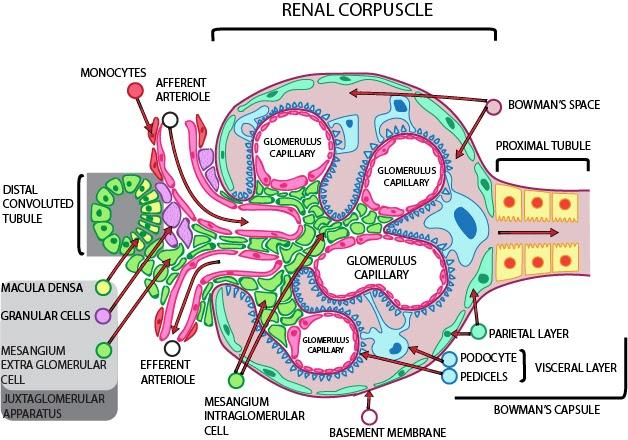
Blood plasma enters the afferent arteriole and flows into the glomerulus, a cluster of intertwined capillaries. The Bowman’s capsule (also called the glomerular capsule) surrounds the glomerulus and consists of a visceral layer (simple squamous epithelial cells— inner layer) and a parietal layer (simple squamous epithelial cells—outer layer).
Note:
The process by which glomerular filtration occurs is known as renal ultrafiltration. The force of hydrostatic pressure within the glomerulus (the force of pressure exerted from the pressure of the vessel itself) is that the drive that pushes filtrate out of the capillaries and into the splits within the nephron.
Complete answer:
The filterable blood components include water, nitrogenous waste, and nutrients which are transferred into the glomerulus to make the glomerular filtrate. The non-filterable blood components include blood cells, albumins, and platelets and they leave the glomerulus through the efferent arteriole.
The glomerular filtration is caused by the force of the difference between hydrostatic and pressure and is the initiative in urine formation and constitutes the essential physiologic function of the kidneys. It describes the method of blood filtration within the kidney, during which fluid, ions, glucose, and waste products are separated from the glomerular capillaries. Most of this material is reabsorbed by the body since the fluid travels through the varied parts of the nephron, but those components which aren't reabsorbed leave the body via urine.
Blood plasma enters the afferent arteriole and flows into the glomerulus, a cluster of intertwined capillaries. The Bowman’s capsule (also called the glomerular capsule) surrounds the glomerulus and consists of a visceral layer (simple squamous epithelial cells— inner layer) and a parietal layer (simple squamous epithelial cells—outer layer).
Note:
The process by which glomerular filtration occurs is known as renal ultrafiltration. The force of hydrostatic pressure within the glomerulus (the force of pressure exerted from the pressure of the vessel itself) is that the drive that pushes filtrate out of the capillaries and into the splits within the nephron.
Recently Updated Pages
Master Class 11 Social Science: Engaging Questions & Answers for Success

Master Class 11 English: Engaging Questions & Answers for Success
Master Class 11 Accountancy: Engaging Questions & Answers for Success
Master Class 11 Physics: Engaging Questions & Answers for Success
Master Class 11 Computer Science: Engaging Questions & Answers for Success
Master Class 11 Business Studies: Engaging Questions & Answers for Success
Trending doubts
One Metric ton is equal to kg A 10000 B 1000 C 100 class 11 physics CBSE
Find the value of the expression given below sin 30circ class 11 maths CBSE
Draw a diagram of nephron and explain its structur class 11 biology CBSE
10 examples of friction in our daily life
Proton was discovered by A Thomson B Rutherford C Chadwick class 11 chemistry CBSE
The teeth used for biting and cutting food are called class 11 biology CBSE