




Complete the reaction:
\[{C_6}{H_5}ONa + {C_2}{H_5}Cl \to \] ____________
Answer
 Verified
563.7k+ views
Hint: The reaction between sodium phenoxide and alkyl halides is a substitution reaction that depends on the type of alkoxide or phenoxide being used. The rate of the reaction is largely affected by the type of alkyl halide.
Complete answer:
The reaction between phenoxide and ethyl chloride is a well-known example of Williamson’s reaction which involves a substitution bimolecular mechanism to produce the corresponding ethers.
The alkyl group attached to the halogen breaks apart and forms a bond with the oxygen of the phenoxide group to give ethyl phenyl ether. The remaining sodium ions and chloride ions react with each other to form sodium chloride as a byproduct.
The reaction can be initiated by forming phenoxide ions from phenol that can be used to react with alkyl halides.
Since, the mechanism is \[{S_N}2\] in nature, the alkyl halide needs to be a primary alkyl halide as the reactivity decreases with increasing substitutions. A secondary or tertiary alkyl halide fails to produce an ether by substitution mechanism and elimination is preferred over a substitution reaction. Both protic or aprotic solvents can be used for this type of ether synthesis.
The reaction can be written as follows:
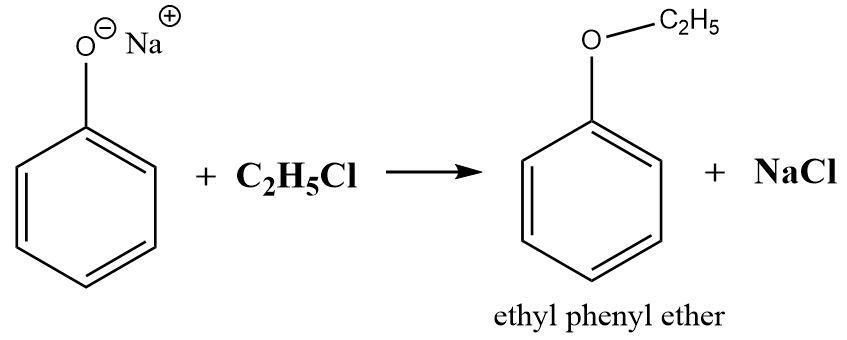
\[ \Rightarrow \] Hence the product formed is ethyl phenyl ether.
Note:
Alcohols are mildly acidic in nature and it is difficult to produce corresponding alkoxides but phenol is more acidic as compared to alcohols due to the resonance stabilization of their conjugate base and their phenoxide can be easily prepared by a simple reaction with sodium hydroxide.
Complete answer:
The reaction between phenoxide and ethyl chloride is a well-known example of Williamson’s reaction which involves a substitution bimolecular mechanism to produce the corresponding ethers.
The alkyl group attached to the halogen breaks apart and forms a bond with the oxygen of the phenoxide group to give ethyl phenyl ether. The remaining sodium ions and chloride ions react with each other to form sodium chloride as a byproduct.
The reaction can be initiated by forming phenoxide ions from phenol that can be used to react with alkyl halides.
Since, the mechanism is \[{S_N}2\] in nature, the alkyl halide needs to be a primary alkyl halide as the reactivity decreases with increasing substitutions. A secondary or tertiary alkyl halide fails to produce an ether by substitution mechanism and elimination is preferred over a substitution reaction. Both protic or aprotic solvents can be used for this type of ether synthesis.
The reaction can be written as follows:
\[ \Rightarrow \] Hence the product formed is ethyl phenyl ether.
Note:
Alcohols are mildly acidic in nature and it is difficult to produce corresponding alkoxides but phenol is more acidic as compared to alcohols due to the resonance stabilization of their conjugate base and their phenoxide can be easily prepared by a simple reaction with sodium hydroxide.
Recently Updated Pages
If x a + bt + ct2 where x is in meters and t is in class 11 physics CBSE

A car covers the first half distance between two places class 11 physics CBSE
The resultant of two vectors overrightarrow P and overrightarrow class 11 physics CBSE
Find the value of cos 135 class 11 maths CBSE
A mass M is held in place by an applied force F and class 11 physics CBSE
A solution of glucose in water is labelled as 10 dfracwv class 11 chemistry CBSE
Trending doubts
Find the value of the expression given below sin 30circ class 11 maths CBSE
One Metric ton is equal to kg A 10000 B 1000 C 100 class 11 physics CBSE
Draw a diagram of nephron and explain its structur class 11 biology CBSE
10 examples of friction in our daily life
Proton was discovered by A Thomson B Rutherford C Chadwick class 11 chemistry CBSE
Bond order ofO2 O2+ O2 and O22 is in order A O2 langle class 11 chemistry CBSE