




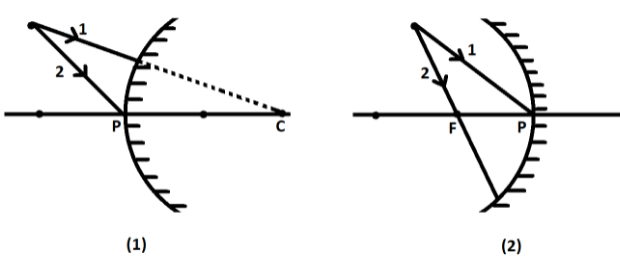
Complete the following diagrams in figure by drawing the reflected rays for the incident rays $1$ and $2$.
Answer
 Verified
546.9k+ views
Hint: In order to answer the above question, we will understand the types of mirror that are used. We will learn about the general guidelines which need to be followed whenever a ray of light falls on any kind of mirror. Finally, using those guidelines, we will draw the reflected rays of the following diagrams.
Complete step by step answer:
A mirror is a reflective surface that reflects light and creates either a real or a virtual image. When an object is positioned in front of a mirror, the mirror reflects the image of the same object. The incident rays are emitted from the target, and the picture is created by the reflected rays. The images are categorised as either a real image or a virtual image based on the interaction of light. A real image is created when light rays actually converge, while virtual images are created when light rays appear to diverge from a point.
Ray diagrams assist us in tracing the direction of light for anyone viewing a point on an image of an object. The incident and reflected rays are represented by lines with arrows in a ray diagram. It also aids us in determining the direction of movement of light.Mirrors with curved surfaces and are painted on one side are known as spherical mirrors. Convex mirrors are spherical mirrors with painted inward surfaces, while concave mirrors are spherical mirrors with painted outward surfaces.
There are certain guidelines that the rays falling on Concave and Convex Mirrors should follow:
-A ray is reflected obliquely as it hits concave or convex mirrors at their pole if the incident ray strikes the pole obliquely.
-When a ray hits concave or convex mirrors parallel to the principal axis, the reflected ray moves through the focus on the principal axis.
-When a ray passes into focus and bounces off concave or convex mirrors, the reflected ray is parallel to the principal axis.
-After reflection, a ray passing through the spherical mirror's centre of curvature will retrace its course.
Diagram 1: If we look at the first figure, we can see that the mirror is a convex mirror as the inner side of the mirror is coloured. We can see that one of the rays was incident perpendicular to the surface of the convex mirror and is passing virtually through the centre of curvature which is behind the reflective surface of the lens. Now, considering the fourth point in the guidelines, we can say that the ray will retrace its way back to the object.
The second ray strikes the mirror at the pole. Using the first point in the guidelines above, the ray is striking the pole obliquely and is reflected back obliquely as shown in the figure. The rays do not meet originally and hence, the rays are extended virtually and the image is formed at the intersection of them.
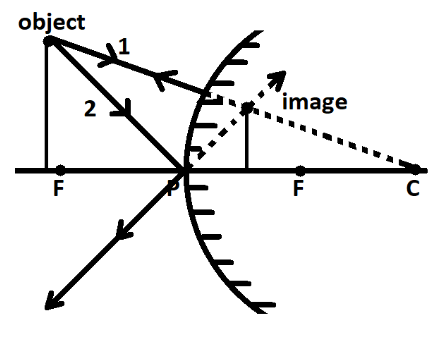
The image formed in this case is vertical and imaginary. The image is also diminished from the original size of the object.
Diagram 2: Now, looking at the second picture, we can conclude that the mirror is a concave mirror as the mirror is painted on its outside. We can see that the first ray strikes obliquely straight at the pole of the mirror. Using the first point in the guidelines above, the ray is striking the pole obliquely and is reflected back obliquely as shown in the figure.
The second ray is passing through the focal length of the mirror and striking the mirror. Using the third point in the guidelines described above, the ray will get reflected and pass in parallel to the principal axis.
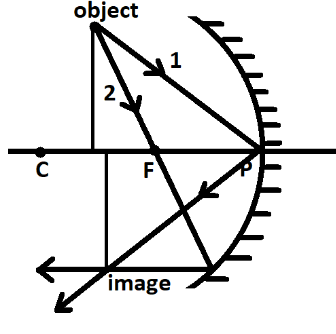
The image is formed by the intersection of the two reflected rays. The image formed in this case is real and inverted. The image is magnified with respect to the size of the object.
Note: It is very important to keep in mind the general guidelines that the rays should follow while falling on a concave or a convex mirror which are described above in the solution. For a convex mirror, it is necessary to keep in mind that the image formed is always virtual and erect whereas, for a concave mirror, the image formed is always real and inverted.
Complete step by step answer:
A mirror is a reflective surface that reflects light and creates either a real or a virtual image. When an object is positioned in front of a mirror, the mirror reflects the image of the same object. The incident rays are emitted from the target, and the picture is created by the reflected rays. The images are categorised as either a real image or a virtual image based on the interaction of light. A real image is created when light rays actually converge, while virtual images are created when light rays appear to diverge from a point.
Ray diagrams assist us in tracing the direction of light for anyone viewing a point on an image of an object. The incident and reflected rays are represented by lines with arrows in a ray diagram. It also aids us in determining the direction of movement of light.Mirrors with curved surfaces and are painted on one side are known as spherical mirrors. Convex mirrors are spherical mirrors with painted inward surfaces, while concave mirrors are spherical mirrors with painted outward surfaces.
There are certain guidelines that the rays falling on Concave and Convex Mirrors should follow:
-A ray is reflected obliquely as it hits concave or convex mirrors at their pole if the incident ray strikes the pole obliquely.
-When a ray hits concave or convex mirrors parallel to the principal axis, the reflected ray moves through the focus on the principal axis.
-When a ray passes into focus and bounces off concave or convex mirrors, the reflected ray is parallel to the principal axis.
-After reflection, a ray passing through the spherical mirror's centre of curvature will retrace its course.
Diagram 1: If we look at the first figure, we can see that the mirror is a convex mirror as the inner side of the mirror is coloured. We can see that one of the rays was incident perpendicular to the surface of the convex mirror and is passing virtually through the centre of curvature which is behind the reflective surface of the lens. Now, considering the fourth point in the guidelines, we can say that the ray will retrace its way back to the object.
The second ray strikes the mirror at the pole. Using the first point in the guidelines above, the ray is striking the pole obliquely and is reflected back obliquely as shown in the figure. The rays do not meet originally and hence, the rays are extended virtually and the image is formed at the intersection of them.
The image formed in this case is vertical and imaginary. The image is also diminished from the original size of the object.
Diagram 2: Now, looking at the second picture, we can conclude that the mirror is a concave mirror as the mirror is painted on its outside. We can see that the first ray strikes obliquely straight at the pole of the mirror. Using the first point in the guidelines above, the ray is striking the pole obliquely and is reflected back obliquely as shown in the figure.
The second ray is passing through the focal length of the mirror and striking the mirror. Using the third point in the guidelines described above, the ray will get reflected and pass in parallel to the principal axis.
The image is formed by the intersection of the two reflected rays. The image formed in this case is real and inverted. The image is magnified with respect to the size of the object.
Note: It is very important to keep in mind the general guidelines that the rays should follow while falling on a concave or a convex mirror which are described above in the solution. For a convex mirror, it is necessary to keep in mind that the image formed is always virtual and erect whereas, for a concave mirror, the image formed is always real and inverted.
Recently Updated Pages
Master Class 12 Business Studies: Engaging Questions & Answers for Success

Master Class 12 Biology: Engaging Questions & Answers for Success
Master Class 12 Chemistry: Engaging Questions & Answers for Success
Class 12 Question and Answer - Your Ultimate Solutions Guide
Master Class 11 Social Science: Engaging Questions & Answers for Success
Master Class 11 English: Engaging Questions & Answers for Success
Trending doubts
Explain the Treaty of Vienna of 1815 class 10 social science CBSE
Which Indian city is known as the "City of Victory"?
Which instrument is used to measure the Blood Pressure?
Who Won 36 Oscar Awards? Record Holder Revealed
What is the median of the first 10 natural numbers class 10 maths CBSE
Why is it 530 pm in india when it is 1200 afternoon class 10 social science CBSE