




Compare Resonance Energy why?
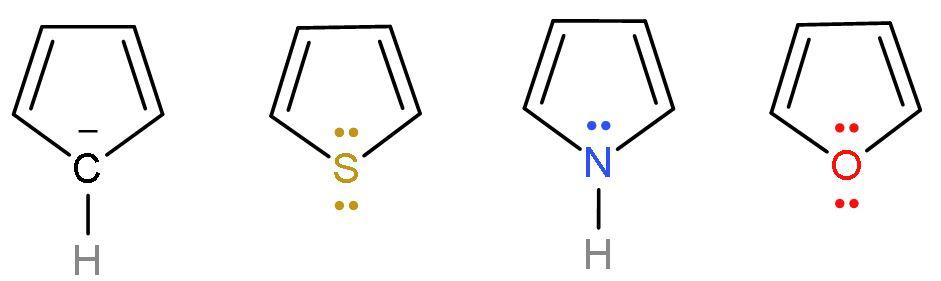
Answer
 Verified
629.7k+ views
Hint: The resonance energy is dependent on the stability and aromaticity of the compound. Resonance energy $\propto $ stability of the compound $\propto $ aromaticity. The main concept here, to differentiate the compounds is the electronegativity of the atoms attached like oxygen, carbon, sulphur and nitrogen. All the compounds are isoelectronic in terms of $\pi -$ electrons.
Complete step by step answer:
Let us first discuss the features of the compounds and then, we will see the concept to differentiate the four compounds.
All the above compounds are aromatic. So, stability will be seen through a new concept. Here, the concept is based on the ‘electronegativity of the elements’ present in the compounds.
-The electronegativity will play a role here, as the electronegativity of an element will pull the electron cloud towards itself. Thus, there will be an uneven charge distribution and less likely to undergo resonance. More the electronegativity of the hetero atoms, less will be the aromaticity of the compound. We know that oxygen is the most electronegative atom among all. The order of electronegativity is $\text{O}>\text{N}>\text{S}>\text{C}$.
So, it is clear that furan is least and cyclopentadienyl anion is the most aromatic compound. The order of aromaticity and resonance energy will be cyclopentadienyl anion$ > $thiophene$ > $pyrrole$ > $furan.
Note: One more factor comes into play here, that is bond length. The bond length of the element with carbon will increase in the order, $\left( \text{C}-\text{S} \right)>\left( \text{C}-\text{O} \right)>\left( \text{C}-\text{N} \right)>\left( \text{C}-\text{C} \right)$. As the bond length increases, the bonding or overlapping of elements will become difficult. Thus, shows more reactivity.
Complete step by step answer:
Let us first discuss the features of the compounds and then, we will see the concept to differentiate the four compounds.
| S. No. | Structures | Name of the compound | Features |
| 1. | 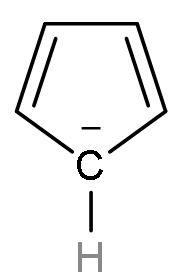
| Cyclopentadienyl anion | It is a homocyclic (made of the same atom only) compound which is made of carbon atoms. It is an aromatic compound as it follows Huckel’s rule or (4n+2) $\pi $-electrons. Because it has 6 $\pi $ electrons, two from negative charge and four from $\left( \text{C}-\text{C} \right)$ double bond. |
| 2. | 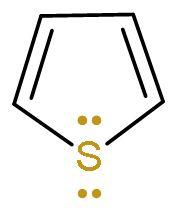
| Thiophene | It is a heterocyclic (made of different atoms) compound which is made of carbon atom and sulphur atom. It is an aromatic compound as it follows Huckel’s rule or (4n+2) $\pi $-electrons. Because it has 6 $\pi $ electrons, two from lone pairs of sulphur and four from $\left( \text{C}-\text{C} \right)$ double bond. |
| 3. | 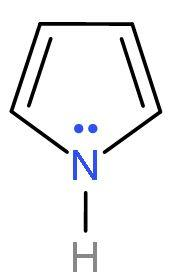
| Pyrrole | It is a heterocyclic (made of different atoms) compound which is made of carbon atom and nitrogen atom. It is an aromatic compound as it follows Huckel’s rule or (4n+2) $\pi $-electrons. Because it has 6 $\pi $ electrons, two from lone pairs of nitrogen and four from $\left( \text{C}-\text{C} \right)$ double bond. |
| 4. | 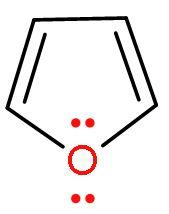
| Furan | It is a heterocyclic (made of different atoms) compound which is made of carbon atom and oxygen atom. It is an aromatic compound as it follows Huckel’s rule or (4n+2) $\pi $-electrons. Because it has 6 $\pi $ electrons, two from lone pair of oxygen and four from $\left( \text{C}-\text{C} \right)$ double bond. It looks similar to Thiophene. |
All the above compounds are aromatic. So, stability will be seen through a new concept. Here, the concept is based on the ‘electronegativity of the elements’ present in the compounds.
-The electronegativity will play a role here, as the electronegativity of an element will pull the electron cloud towards itself. Thus, there will be an uneven charge distribution and less likely to undergo resonance. More the electronegativity of the hetero atoms, less will be the aromaticity of the compound. We know that oxygen is the most electronegative atom among all. The order of electronegativity is $\text{O}>\text{N}>\text{S}>\text{C}$.
So, it is clear that furan is least and cyclopentadienyl anion is the most aromatic compound. The order of aromaticity and resonance energy will be cyclopentadienyl anion$ > $thiophene$ > $pyrrole$ > $furan.
Note: One more factor comes into play here, that is bond length. The bond length of the element with carbon will increase in the order, $\left( \text{C}-\text{S} \right)>\left( \text{C}-\text{O} \right)>\left( \text{C}-\text{N} \right)>\left( \text{C}-\text{C} \right)$. As the bond length increases, the bonding or overlapping of elements will become difficult. Thus, shows more reactivity.
Recently Updated Pages
Master Class 11 English: Engaging Questions & Answers for Success

Master Class 11 Social Science: Engaging Questions & Answers for Success
Master Class 11 Maths: Engaging Questions & Answers for Success
Master Class 11 Biology: Engaging Questions & Answers for Success
Master Class 11 Physics: Engaging Questions & Answers for Success
Master Class 11 Chemistry: Engaging Questions & Answers for Success
Trending doubts
One Metric ton is equal to kg A 10000 B 1000 C 100 class 11 physics CBSE
Difference Between Prokaryotic Cells and Eukaryotic Cells
Find the value of the expression given below sin 30circ class 11 maths CBSE
Difference between physical and chemical change class 11 chemistry CBSE
Two of the body parts which do not appear in MRI are class 11 biology CBSE
Draw a diagram of a plant cell and label at least eight class 11 biology CBSE