




When the clock shows time 5:20, the angle formed between the two hands is
(a) Obtuse
(b) Right
(c) Acute
(d) None of these
Answer
 Verified
600.3k+ views
Hint: We will draw a rough sketch to see how the clock looks at the time indicating 5:20. Then we will look at the types of angles and their definitions. After that, we will see the diagram and identify the type of angle made by the two hands of the clock. This will lead us to the desired answer.
Complete step by step solution:
The time shown on the clock is 5:20. So, the hour hand should be on 5 and the minute hand should show that 20 minutes have passed. We know that there are 12 intervals on the clock and each interval marks the passing of 5 minutes using the minute hand. So, for the minute hand to show that 20 minutes have passed, it should point to the fourth interval. We will draw a rough diagram to display the positions of the two hands of the clock as follows,
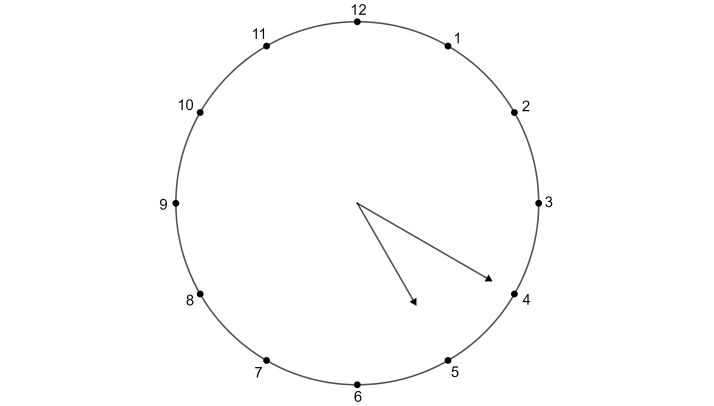
We know that the angle is called an acute angle when it is less than $90{}^\circ $ and it is called an obtuse angle when it is greater than $90{}^\circ $. If the angle is equal to $90{}^\circ $, then it is called a right angle. From the figure, we can see that the hour hand is pointing at 5 and the minute hand is pointing at 4. The angle between the two hands appears to be less than $90{}^\circ $. Hence, we can conclude that the angle formed by the two hands while indicating the time 5:20 is an acute angle.
The correct option is (c).
Note: In this type of question, it is always useful to draw a rough diagram to understand the given information. We should be familiar with the types of angles and their definitions. The way in which the time is denoted is an important part of this question. There are different formats with which we can denote at the same time. So, we should pay close attention to such information to avoid making any mistakes.
Complete step by step solution:
The time shown on the clock is 5:20. So, the hour hand should be on 5 and the minute hand should show that 20 minutes have passed. We know that there are 12 intervals on the clock and each interval marks the passing of 5 minutes using the minute hand. So, for the minute hand to show that 20 minutes have passed, it should point to the fourth interval. We will draw a rough diagram to display the positions of the two hands of the clock as follows,
We know that the angle is called an acute angle when it is less than $90{}^\circ $ and it is called an obtuse angle when it is greater than $90{}^\circ $. If the angle is equal to $90{}^\circ $, then it is called a right angle. From the figure, we can see that the hour hand is pointing at 5 and the minute hand is pointing at 4. The angle between the two hands appears to be less than $90{}^\circ $. Hence, we can conclude that the angle formed by the two hands while indicating the time 5:20 is an acute angle.
The correct option is (c).
Note: In this type of question, it is always useful to draw a rough diagram to understand the given information. We should be familiar with the types of angles and their definitions. The way in which the time is denoted is an important part of this question. There are different formats with which we can denote at the same time. So, we should pay close attention to such information to avoid making any mistakes.
Recently Updated Pages
Master Class 12 Business Studies: Engaging Questions & Answers for Success

Master Class 12 Biology: Engaging Questions & Answers for Success
Master Class 12 Chemistry: Engaging Questions & Answers for Success
Class 12 Question and Answer - Your Ultimate Solutions Guide
Master Class 11 Social Science: Engaging Questions & Answers for Success
Master Class 11 English: Engaging Questions & Answers for Success
Trending doubts
Explain the Treaty of Vienna of 1815 class 10 social science CBSE
Which Indian city is known as the "City of Victory"?
Which instrument is used to measure the Blood Pressure?
Who Won 36 Oscar Awards? Record Holder Revealed
What is the median of the first 10 natural numbers class 10 maths CBSE
Why is it 530 pm in india when it is 1200 afternoon class 10 social science CBSE