




Clitellum in earthworm are present in which of the following segments?
A. 19, 20, 21
B. 14, 15, 16
C. Last 3 segments
D. First three
Answer
 Verified
660k+ views
Hint: This is the non-segmented section located near the anterior end of the body of earthworm.
Complete answer:
Earthworms are terrestrial invertebrates belonging to the class clitellata of phylum Annelida. They are commonly found in soil and they consume a wide variety of organic matter, such as living protozoa, rotifers, plant matter, nematodes, bacteria, fungi and other microorganisms. Their body is externally segmented with corresponding internal segmentation.
The clitellum is part of the reproductive system of earthworms. It is a thick saddle-like ring found in the epidermis (skin) of the worm. It is a non-segmented glandular section near the head at the anterior end of the body. It secretes a viscid sac where eggs are stored. It is particularly located between the fourteenth and seventeenth segments of the body.
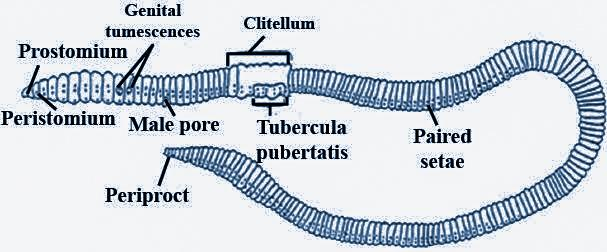
Additional Information:
> The clitellum can only be seen in the sexually mature worms and used in sexual reproduction of some annelids.
> It may be white, reddish-brown or orange-red in colour. When the clitellum is orange it means the earthworm is ready to mate.
> Clitellum secretes a viscous fluid to form a cocoon for its eggs.
> The alimentary canal of the earthworm consists of mouth and buccal cavity (running through the first one or two segments), pharynx (running about four segments in length), oesophagus, crop, gizzard and intestine.
> Except for the mouth and the anal segments, each segment carries setae and nephridia.
So, the correct answer is option (B) 14, 15, 16 segments.
Notes:
- Gizzard uses stones eaten by earthworms to grind the food completely.
- Setae are bristles like hairs used to anchor parts of the body during movement.
- Nephridia is found in pairs and removes metabolic waste from the body. It performs a function similar to vertebrate kidneys.
Complete answer:
Earthworms are terrestrial invertebrates belonging to the class clitellata of phylum Annelida. They are commonly found in soil and they consume a wide variety of organic matter, such as living protozoa, rotifers, plant matter, nematodes, bacteria, fungi and other microorganisms. Their body is externally segmented with corresponding internal segmentation.
The clitellum is part of the reproductive system of earthworms. It is a thick saddle-like ring found in the epidermis (skin) of the worm. It is a non-segmented glandular section near the head at the anterior end of the body. It secretes a viscid sac where eggs are stored. It is particularly located between the fourteenth and seventeenth segments of the body.
Additional Information:
> The clitellum can only be seen in the sexually mature worms and used in sexual reproduction of some annelids.
> It may be white, reddish-brown or orange-red in colour. When the clitellum is orange it means the earthworm is ready to mate.
> Clitellum secretes a viscous fluid to form a cocoon for its eggs.
> The alimentary canal of the earthworm consists of mouth and buccal cavity (running through the first one or two segments), pharynx (running about four segments in length), oesophagus, crop, gizzard and intestine.
> Except for the mouth and the anal segments, each segment carries setae and nephridia.
So, the correct answer is option (B) 14, 15, 16 segments.
Notes:
- Gizzard uses stones eaten by earthworms to grind the food completely.
- Setae are bristles like hairs used to anchor parts of the body during movement.
- Nephridia is found in pairs and removes metabolic waste from the body. It performs a function similar to vertebrate kidneys.
Recently Updated Pages
Master Class 11 Maths: Engaging Questions & Answers for Success

Master Class 11 Economics: Engaging Questions & Answers for Success
Master Class 11 Biology: Engaging Questions & Answers for Success
Class 11 Question and Answer - Your Ultimate Solutions Guide
Master Class 11 English: Engaging Questions & Answers for Success
Master Class 11 Social Science: Engaging Questions & Answers for Success
Trending doubts
Difference Between Prokaryotic Cells and Eukaryotic Cells
Find the value of the expression given below sin 30circ class 11 maths CBSE
One Metric ton is equal to kg A 10000 B 1000 C 100 class 11 physics CBSE
Two of the body parts which do not appear in MRI are class 11 biology CBSE
10 examples of friction in our daily life
Draw a diagram of nephron and explain its structur class 11 biology CBSE