




Chui-Mui (Mimosa pudica) plant belongs to which family?
A) Caesalpiniaceae
B) Papilionaceae
C) Mimosoideae
D) None of the above
Answer
 Verified
644.4k+ views
Hint: Mimosa pudica and Pisum sativum belong to the same family.
Complete Answer:
Here the name of Chui-Mui plant, what comes to our brain is a plant who is shy enough to fold its leaves when touched slightly. Well, there is a scientific reason behind that. Actually, when the Chui-Mui plant folds its leaves when touched, it is said to be showing thigmonastic movement. It is a type of movement which occurs in response to touch. It is non-directional, so it does not involve any growth.
As soon as the Chui-Mui plant is touched, the cells of that point lose water and become flaccid. Soon the stimulus spreads to other cells and the water escapes from the leaves via pulvinus. This results in drooping of leaves.
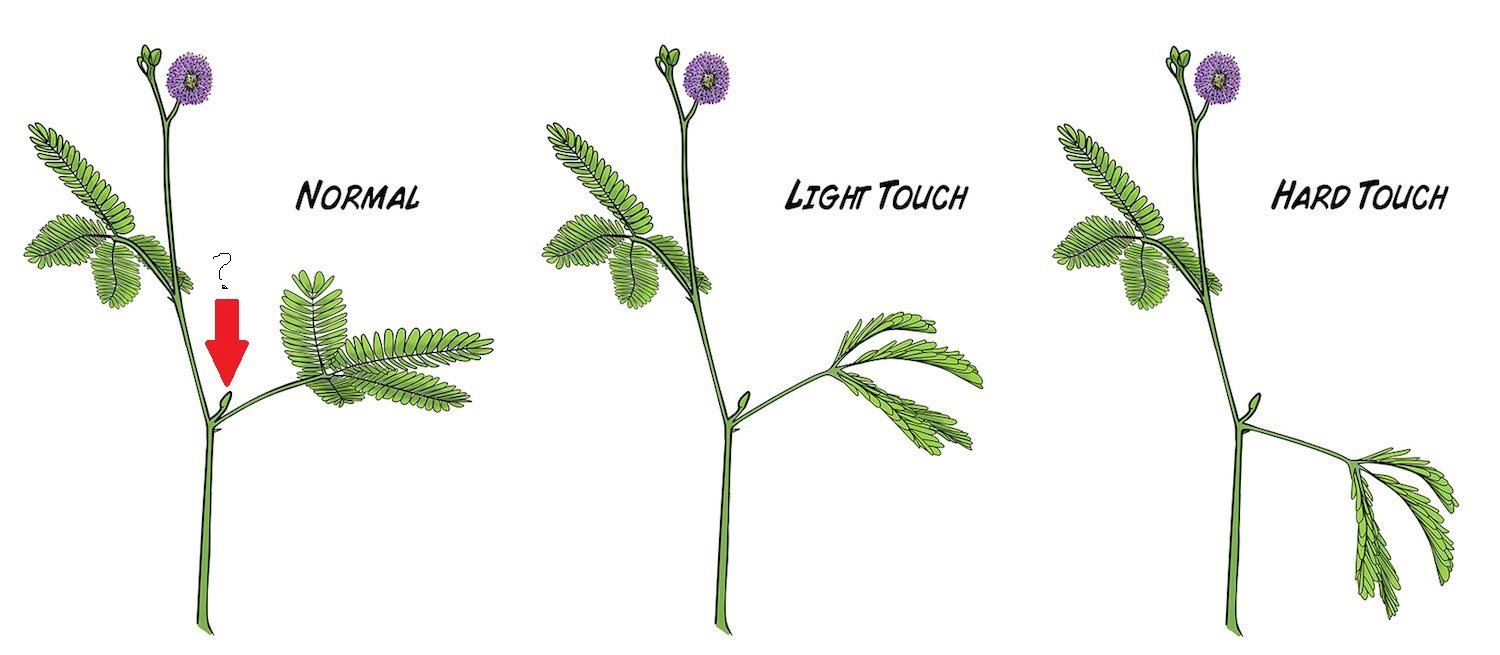
Now, let’s talk about the plant. It belongs to the family Fabacease, to which our famous legumes also belong. The whole classification of Mimosa pudica is given below:
Kingdom Plantae – Plants
Subkingdom Tracheobionta – Vascular plants
Superdivision Spermatophyta – Seed plants
Division Magnoliophyta – Flowering plants
Class Magnoliopsida – Dicotyledons
Subclass Rosidae
Order Fabales
Family Fabaceae – Pea family
Subfamily - Mimosoideae
Genus Mimosa L. – sensitive plant P
Species Mimosa pudica L. – shameplant
Since, the question is about the family of Mimosa pudica, which is Fabaceae, and in the option, its subfamily is mentioned, we will select option D as the correct answer.
Therefore, the correct answer is option D.
Note: Thigmonasty as seen in Chui-Mui plants is different from thigmotropism as seen in tendrils of money plants. Thigmotropism is the directional movement that also occurs in response to touch, but is responsible for causing the growth of the plant.
Complete Answer:
Here the name of Chui-Mui plant, what comes to our brain is a plant who is shy enough to fold its leaves when touched slightly. Well, there is a scientific reason behind that. Actually, when the Chui-Mui plant folds its leaves when touched, it is said to be showing thigmonastic movement. It is a type of movement which occurs in response to touch. It is non-directional, so it does not involve any growth.
As soon as the Chui-Mui plant is touched, the cells of that point lose water and become flaccid. Soon the stimulus spreads to other cells and the water escapes from the leaves via pulvinus. This results in drooping of leaves.
Now, let’s talk about the plant. It belongs to the family Fabacease, to which our famous legumes also belong. The whole classification of Mimosa pudica is given below:
Kingdom Plantae – Plants
Subkingdom Tracheobionta – Vascular plants
Superdivision Spermatophyta – Seed plants
Division Magnoliophyta – Flowering plants
Class Magnoliopsida – Dicotyledons
Subclass Rosidae
Order Fabales
Family Fabaceae – Pea family
Subfamily - Mimosoideae
Genus Mimosa L. – sensitive plant P
Species Mimosa pudica L. – shameplant
Since, the question is about the family of Mimosa pudica, which is Fabaceae, and in the option, its subfamily is mentioned, we will select option D as the correct answer.
Therefore, the correct answer is option D.
Note: Thigmonasty as seen in Chui-Mui plants is different from thigmotropism as seen in tendrils of money plants. Thigmotropism is the directional movement that also occurs in response to touch, but is responsible for causing the growth of the plant.
Recently Updated Pages
Basicity of sulphurous acid and sulphuric acid are

Master Class 11 English: Engaging Questions & Answers for Success
Master Class 11 Physics: Engaging Questions & Answers for Success
Master Class 11 Computer Science: Engaging Questions & Answers for Success
Master Class 11 Chemistry: Engaging Questions & Answers for Success
Master Class 11 Social Science: Engaging Questions & Answers for Success
Trending doubts
Difference Between Prokaryotic Cells and Eukaryotic Cells
Two of the body parts which do not appear in MRI are class 11 biology CBSE
One Metric ton is equal to kg A 10000 B 1000 C 100 class 11 physics CBSE
10 examples of friction in our daily life
Draw a diagram of nephron and explain its structur class 11 biology CBSE
What will happen if the mucus is not secreted by the class 11 biology CBSE