




Choose the type of mouthparts of insects in which the two labella are interconnected by Dutton's membrane.
A) Piercing and sucking type
B) Sponging type
C) Siphoning
D) frog and chewing type
Answer
 Verified
537k+ views
Hint: One on either side of the head, a chewing insect has a pair of mandibles. The mandibles are located posterior to the maxillae and caudal to the labrum. The mandibles are a chewing insect's largest and most durable mouthparts, which it uses to masticate, cut, break, crush, and chew food.
Complete answer:
Mouthparts in insects are adapted in a variety of ways to satisfy the needs of their feeding habits. Cockroaches, grasshoppers, Dragonflies, and beetles have the most primitive biting and chewing mouth bits. Mosquito larvae, houseflies, butterflies, and honeybee larvae have biting and chewing mouth bits. Female mosquitoes, bedbugs, the head louse, tsetse fly, and Lac insects are piercing and sucking forms.
Male mosquito, sucking sort Housefly is a sucking and sponging sort of fly. The butterfly is a syphoning kind. Female mosquitoes feed on the blood of vertebrates.
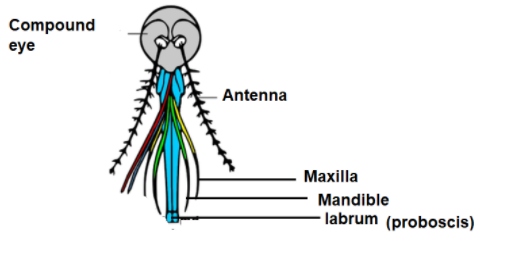
A) The piercing and sucking mouth sections are the most common. The lower lip, or labium, is altered to form an elongated proboscis. Labelle is the sensory lobes at the tip of the proboscis that is bound by Dutton's membrane.
B) Sponging type- The function of this type of mouth is to absorb liquid. In this, the labium is elbowed in shape and has a fleshy appearance. It is found in flies.
C) Siphoning- This insect's mouth is adapted for sucking liquid like blood or nectar from the flowers. They have a long proboscis which is formed by the pair of maxillae. They lack mandibles. Examples of such insects include female mosquitos.
D) Frog and chewing type- This type is found in grasshoppers. It consists of the labrum or the upper lip, mandibles, maxillae or the lower lip, hypopharynx and epipharynx. It is the most primitive kind of mouth structure.
Note: The mouth of a mosquito, also known as a proboscis, is more than just a single tiny spear. It's a complex system of six small, needle-like mouthparts known as stylets that pierce the skin, locate blood vessels, and make it easy for mosquitoes to suck blood. These bugs even know where to bite.
Complete answer:
Mouthparts in insects are adapted in a variety of ways to satisfy the needs of their feeding habits. Cockroaches, grasshoppers, Dragonflies, and beetles have the most primitive biting and chewing mouth bits. Mosquito larvae, houseflies, butterflies, and honeybee larvae have biting and chewing mouth bits. Female mosquitoes, bedbugs, the head louse, tsetse fly, and Lac insects are piercing and sucking forms.
Male mosquito, sucking sort Housefly is a sucking and sponging sort of fly. The butterfly is a syphoning kind. Female mosquitoes feed on the blood of vertebrates.
A) The piercing and sucking mouth sections are the most common. The lower lip, or labium, is altered to form an elongated proboscis. Labelle is the sensory lobes at the tip of the proboscis that is bound by Dutton's membrane.
B) Sponging type- The function of this type of mouth is to absorb liquid. In this, the labium is elbowed in shape and has a fleshy appearance. It is found in flies.
C) Siphoning- This insect's mouth is adapted for sucking liquid like blood or nectar from the flowers. They have a long proboscis which is formed by the pair of maxillae. They lack mandibles. Examples of such insects include female mosquitos.
D) Frog and chewing type- This type is found in grasshoppers. It consists of the labrum or the upper lip, mandibles, maxillae or the lower lip, hypopharynx and epipharynx. It is the most primitive kind of mouth structure.
Note: The mouth of a mosquito, also known as a proboscis, is more than just a single tiny spear. It's a complex system of six small, needle-like mouthparts known as stylets that pierce the skin, locate blood vessels, and make it easy for mosquitoes to suck blood. These bugs even know where to bite.
Recently Updated Pages
Master Class 12 Economics: Engaging Questions & Answers for Success

Master Class 12 English: Engaging Questions & Answers for Success
Master Class 12 Social Science: Engaging Questions & Answers for Success
Master Class 12 Maths: Engaging Questions & Answers for Success
Master Class 12 Physics: Engaging Questions & Answers for Success
Master Class 9 General Knowledge: Engaging Questions & Answers for Success
Trending doubts
One Metric ton is equal to kg A 10000 B 1000 C 100 class 11 physics CBSE
Difference Between Prokaryotic Cells and Eukaryotic Cells
Two of the body parts which do not appear in MRI are class 11 biology CBSE
1 ton equals to A 100 kg B 1000 kg C 10 kg D 10000 class 11 physics CBSE
Draw a diagram of nephron and explain its structur class 11 biology CBSE
10 examples of friction in our daily life