




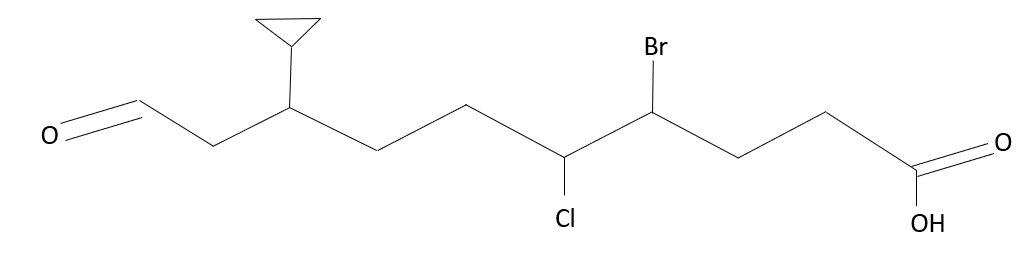
Choose the correct name according to IUPAC nomenclature regarding the above structure.
A.4-Bromo-5-chloro-8-cyclopropyl-10-formyl-decanoic acid
B.4-Bromo-5-chloro-8-cyclopropyl-10-oxo-decanoic acid
C.4-Bromo-5-chloro-10-oxo-8-cyclopropyl nonanoic acid
D.4-Bromo-5-chloro-1-hydroxy-8-cyclopropyl decan-10-dione
Answer
 Verified
591.9k+ views
Hint: IUPAC stands for the International Union of Pure and Applied Chemistry. The IUPAC name of an organic compound consists of four parts namely, root word, suffixes, prefixes, infixes. The root word indicates the number of carbon atoms in the longest possible continuous carbon chain also known as the parent chain. The root words used for carbon chain are meth, eth, prop, etc. The suffix comprises ane, ene, diene, yne, etc. This indicates the degree of saturation. The prefix is used to indicate the side chains, substituents, and low functional groups. Some examples are methyl, isobutyl, alkoxy, nitro. Ultimately, infix like cyclo, spiro, bicyclo is added between the prefixes and root words.
Complete step by step answer:
The naming of this compound starts from the carboxylic acid side, and looking at the picture, bromine is at the 4th position and chlorine atom is substituted at the 5th position. The cyclopropyl group is present at the 8th position and ultimately, the oxo group. Hence, the IUPAC name of this compound is 4-Bromo-5-chloro-8-cyclopropyl-10-oxo-decanoic acid.
Thus, the right option is (B).
The correct name according to IUPAC nomenclature regarding the above structure is 4-Bromo-5-chloro-8-cyclopropyl-10-oxo-decanoic acid.
Note:
The headquarters of IUPAC is located in North Carolina. IUPAC is best known for its standardizing nomenclature in chemistry and other fields of science, but IUPAC has publications in many fields including chemistry, biology, and physics. There are few rules to assign the name of organic compounds, those are based on; the selection of parent chain, numbering the parent chain, use of commas, prioritizing the functional groups. Saturated compounds do not undergo polymerization, whereas unsaturated compounds undergo polymerization making it is named more complex. The IUPAC for heterocyclic compounds differs in the rules.
Complete step by step answer:
The naming of this compound starts from the carboxylic acid side, and looking at the picture, bromine is at the 4th position and chlorine atom is substituted at the 5th position. The cyclopropyl group is present at the 8th position and ultimately, the oxo group. Hence, the IUPAC name of this compound is 4-Bromo-5-chloro-8-cyclopropyl-10-oxo-decanoic acid.
Thus, the right option is (B).
The correct name according to IUPAC nomenclature regarding the above structure is 4-Bromo-5-chloro-8-cyclopropyl-10-oxo-decanoic acid.
Note:
The headquarters of IUPAC is located in North Carolina. IUPAC is best known for its standardizing nomenclature in chemistry and other fields of science, but IUPAC has publications in many fields including chemistry, biology, and physics. There are few rules to assign the name of organic compounds, those are based on; the selection of parent chain, numbering the parent chain, use of commas, prioritizing the functional groups. Saturated compounds do not undergo polymerization, whereas unsaturated compounds undergo polymerization making it is named more complex. The IUPAC for heterocyclic compounds differs in the rules.
Recently Updated Pages
Master Class 12 Business Studies: Engaging Questions & Answers for Success

Master Class 12 Biology: Engaging Questions & Answers for Success
Master Class 12 Chemistry: Engaging Questions & Answers for Success
Class 12 Question and Answer - Your Ultimate Solutions Guide
Master Class 11 Social Science: Engaging Questions & Answers for Success
Master Class 11 English: Engaging Questions & Answers for Success
Trending doubts
Which are the Top 10 Largest Countries of the World?
Draw a labelled sketch of the human eye class 12 physics CBSE
Name the crygenes that control cotton bollworm and class 12 biology CBSE
Differentiate between homogeneous and heterogeneous class 12 chemistry CBSE
Ribosomal RNA is actively synthesised in A Nucleoplasm class 12 biology CBSE
How many molecules of ATP and NADPH are required information class 12 biology CBSE