




How chlorobenzene is obtained from aniline?
Answer
 Verified
591.6k+ views
Hint: We know that we can prepare chlorobenzene from aniline by using Sand Meyer reaction, by using a fitting reaction we can prepare diphenyl from chlorobenzene. Diazotization is the reaction of a substituted aromatic amine with nitrous acid to form an aromatic diazonium salt. Usually, sodium nitrate and hydrochloric acid react at $ 0\text{ }{}^\circ C\text{ }to\text{ }5\text{ }{}^\circ C $ to generate the nitrous acid.
Complete step by step solution:
Sandmeyer reaction: “The Sandmeyer reaction is a chemical reaction used to synthesize aryl halides from aryl diazonium salts using copper salts as reagents or catalysts. It is an example of a radical-nucleophilic aromatic substitution”. It is a two-step reaction in the first step aniline is going to convert to benzene diazonium chloride using sodium Nitrate and aqueous hydrochloric acid.
The Sandmeyer reaction: The Sandmeyer reaction is the $ CuX $ -catalyzed reaction of an aromatic diazonium salt with a halide ion to form an aromatic halide.
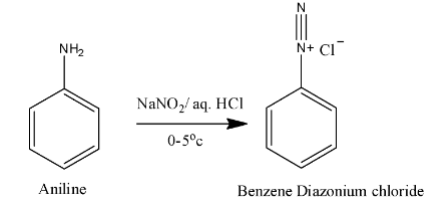
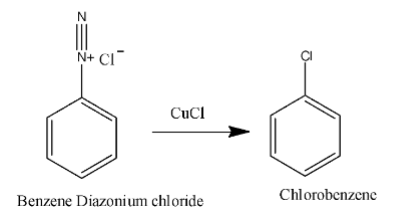
In the second step benzene diazonium chloride reacts with cuprous chloride and forms chloro benzene. Aryl diazonium chloride is very reactive; whenever aryl diazonium chloride forms it will react with cuprous chloride and forms chlorobenzene.
Fittig reaction: “Fittig reaction is the chemical reaction of aryl halides with sodium metal in the presence of dry ether to give substituted aromatic compounds”. Two moles of chlorobenzene react in presence of sodium and dry ether and forms biphenyl compounds and two moles of sodium chloride (insoluble in dry ether)
Note:
Remember that don’t be confused with Sandmeyer reaction and Fittig reaction Sandmeyer reaction: Preparation of chlorobenzene from Aniline by using sodium nitrate, aq. Hydrochloric acid and cuprous chloride. Fittig reaction: Preparation of Diphenyl form Chlorobenzene by using sodium metal and dry ether.
Complete step by step solution:
Sandmeyer reaction: “The Sandmeyer reaction is a chemical reaction used to synthesize aryl halides from aryl diazonium salts using copper salts as reagents or catalysts. It is an example of a radical-nucleophilic aromatic substitution”. It is a two-step reaction in the first step aniline is going to convert to benzene diazonium chloride using sodium Nitrate and aqueous hydrochloric acid.
The Sandmeyer reaction: The Sandmeyer reaction is the $ CuX $ -catalyzed reaction of an aromatic diazonium salt with a halide ion to form an aromatic halide.
In the second step benzene diazonium chloride reacts with cuprous chloride and forms chloro benzene. Aryl diazonium chloride is very reactive; whenever aryl diazonium chloride forms it will react with cuprous chloride and forms chlorobenzene.
Fittig reaction: “Fittig reaction is the chemical reaction of aryl halides with sodium metal in the presence of dry ether to give substituted aromatic compounds”. Two moles of chlorobenzene react in presence of sodium and dry ether and forms biphenyl compounds and two moles of sodium chloride (insoluble in dry ether)
Note:
Remember that don’t be confused with Sandmeyer reaction and Fittig reaction Sandmeyer reaction: Preparation of chlorobenzene from Aniline by using sodium nitrate, aq. Hydrochloric acid and cuprous chloride. Fittig reaction: Preparation of Diphenyl form Chlorobenzene by using sodium metal and dry ether.
Recently Updated Pages
Master Class 11 Social Science: Engaging Questions & Answers for Success

Master Class 11 English: Engaging Questions & Answers for Success
Master Class 11 Accountancy: Engaging Questions & Answers for Success
Master Class 11 Physics: Engaging Questions & Answers for Success
Master Class 11 Computer Science: Engaging Questions & Answers for Success
Master Class 11 Business Studies: Engaging Questions & Answers for Success
Trending doubts
One Metric ton is equal to kg A 10000 B 1000 C 100 class 11 physics CBSE
Find the value of the expression given below sin 30circ class 11 maths CBSE
Draw a diagram of nephron and explain its structur class 11 biology CBSE
10 examples of friction in our daily life
Proton was discovered by A Thomson B Rutherford C Chadwick class 11 chemistry CBSE
How many kilometers are there in 100 meters class 11 maths CBSE