



Chlorination of alkanes is a photochemical process. It is initiated by the process of
A. Heterolysis
B. Homolysis
C. Pyrolysis
D. hydrolysis
Answer
 Verified
631.8k+ views
Hint: Chlorination of alkanes is a radical substitution reaction. Alkanes react with halogens in presence of sunlight or UV light. The reaction proceeds via a radical chain mechanism.
Complete answer:
Alkanes are extremely stable and inert due to non-polar C-H bond and C-C bond. Due to this unreactive nature of alkanes radical substitution method used for halogenations of alkane.
Chlorination of alkane is a substitution reaction where one hydrogen atom of an alkane is substituted by a chlorine group. As we have given, chlorination of alkanes is a photochemical process. Thus, the reaction is carried out in presence of sunlight or UV light. The three main steps of the mechanism are initiation, propagation and termination.
The first step of the radical chain mechanism is as follows:
Initiation: In presence of UV light Cl-Cl bond undergoes homolytic cleavage and generates two chlorine radicals and initiates the chain process.
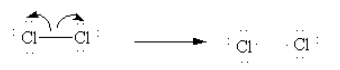
Here, we can see that two electrons in Cl-Cl bonds are equally distributed between the two chlorine atoms after the cleavage of the bond.
If after the cleavage of the bond, the two electrons in bonds are equally distributed between the two bonding atoms it is known as homolysis.
Hence, photochemical chlorination of alkane is initiated by the process of homolysis.
Thus, the correct option is (B) homolysis.
If after the cleavage of the bond, the two electrons in bonds are unequally distributed between the two bonding atoms it is known as heterolysis.
Option (A) is incorrect as two electrons in Cl-Cl bonds are equally distributed between the two chlorine atoms after the cleavage of the bond.
Pyrolysis is the thermal decomposition of organic compounds. As this is not a pyrolysis reaction so option (C) is incorrect.
Hydrolysis is the addition of a water molecule to an organic compound. As this is not a hydrolysis reaction so option (D) is incorrect.
Note:
Due to less reactivity of alkane, the halogenations reaction takes place only under photochemical conditions. As radicals are unstable so the chlorine radical form in the first step of reaction abstract proton from alkane and give alkyl radical. The alkyl radical again being unstable abstract chlorine atom from chlorine molecule and give chlorine radical. Thus halogenations reaction proceeds.
Complete answer:
Alkanes are extremely stable and inert due to non-polar C-H bond and C-C bond. Due to this unreactive nature of alkanes radical substitution method used for halogenations of alkane.
Chlorination of alkane is a substitution reaction where one hydrogen atom of an alkane is substituted by a chlorine group. As we have given, chlorination of alkanes is a photochemical process. Thus, the reaction is carried out in presence of sunlight or UV light. The three main steps of the mechanism are initiation, propagation and termination.
The first step of the radical chain mechanism is as follows:
Initiation: In presence of UV light Cl-Cl bond undergoes homolytic cleavage and generates two chlorine radicals and initiates the chain process.
Here, we can see that two electrons in Cl-Cl bonds are equally distributed between the two chlorine atoms after the cleavage of the bond.
If after the cleavage of the bond, the two electrons in bonds are equally distributed between the two bonding atoms it is known as homolysis.
Hence, photochemical chlorination of alkane is initiated by the process of homolysis.
Thus, the correct option is (B) homolysis.
If after the cleavage of the bond, the two electrons in bonds are unequally distributed between the two bonding atoms it is known as heterolysis.
Option (A) is incorrect as two electrons in Cl-Cl bonds are equally distributed between the two chlorine atoms after the cleavage of the bond.
Pyrolysis is the thermal decomposition of organic compounds. As this is not a pyrolysis reaction so option (C) is incorrect.
Hydrolysis is the addition of a water molecule to an organic compound. As this is not a hydrolysis reaction so option (D) is incorrect.
Note:
Due to less reactivity of alkane, the halogenations reaction takes place only under photochemical conditions. As radicals are unstable so the chlorine radical form in the first step of reaction abstract proton from alkane and give alkyl radical. The alkyl radical again being unstable abstract chlorine atom from chlorine molecule and give chlorine radical. Thus halogenations reaction proceeds.
Recently Updated Pages
Which will be the least stable resonating structure class 11 chemistry CBSE

How many 5 digit telephone numbers can be construc-class-11-maths-CBSE
How do you find the angle of the resultant vector class 11 physics CBSE
Draw labelled diagram of the following i Gram seed class 11 biology CBSE
1 Quintal is equal to a 110 kg b 10 kg c 100kg d 1000 class 11 physics CBSE
What is the need and importance of classification class 11 biology CBSE
Trending doubts
One Metric ton is equal to kg A 10000 B 1000 C 100 class 11 physics CBSE
Find the value of the expression given below sin 30circ class 11 maths CBSE
Draw a diagram of nephron and explain its structur class 11 biology CBSE
10 examples of friction in our daily life
Proton was discovered by A Thomson B Rutherford C Chadwick class 11 chemistry CBSE
How many kilometers are there in 100 meters class 11 maths CBSE