




How many chambers are present in the human heart?
a) 2
b) 3
c) 4
d) 6
Answer
 Verified
629.1k+ views
Hint: Heart is a pumping organ. It pumps blood throughout the body. In humans, the oxygenated and deoxygenated blood never mixes with each other.
Complete answer:
Heart is a muscular organ. The conduction system causes the heart to beat rhythmically. It contracts and relaxes continuously.
In humans the right side of the heart receives deoxygenated blood. This blood enters the lungs to get purified. The oxygenated blood then enters the heart again and then circulates throughout the body. Thus the blood comes in contact with the heart twice. This is double circulation. Throughout the circulation, the right and the left side blood never gets mixed. This is because of septum between the two sides.
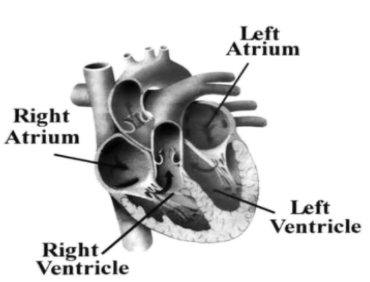
Heart consists of receiving chambers. These are known as Auricles of Atria. These chambers receive blood from the body and from the lungs. The blood flowing from the body into the heart is deoxygenated whereas the blood entering from the lungs into the heart is oxygenated. Thus to avoid mixing, there are two receiving chambers. These are the Left Auricle and the Right Auricle.
The blood from Auricles enters the distributing chambers. These are known as Ventricles.The oxygenated blood circulates in the body and deoxygenated blood enters the lungs. Thus to avoid mixing, there are two distributing chambers also. These are the Left Ventricle and the Right Ventricle.
Receiving chambers are smaller and Distributing chambers are larger in size.
Thus the human heart has four chambers. Answer is option C.
Note: Vertebrates show increase in the chambers of the heart. This increases the efficiency of the blood flow. Pisces have two chambers i.e. one auricle and one ventricle. Amphibians and reptiles (except crocodiles ) show three-chambered hearts. It consists of two Auricles and one Ventricle. Aves and mammals and crocodiles show four-chambered hearts .
Complete answer:
Heart is a muscular organ. The conduction system causes the heart to beat rhythmically. It contracts and relaxes continuously.
In humans the right side of the heart receives deoxygenated blood. This blood enters the lungs to get purified. The oxygenated blood then enters the heart again and then circulates throughout the body. Thus the blood comes in contact with the heart twice. This is double circulation. Throughout the circulation, the right and the left side blood never gets mixed. This is because of septum between the two sides.
Heart consists of receiving chambers. These are known as Auricles of Atria. These chambers receive blood from the body and from the lungs. The blood flowing from the body into the heart is deoxygenated whereas the blood entering from the lungs into the heart is oxygenated. Thus to avoid mixing, there are two receiving chambers. These are the Left Auricle and the Right Auricle.
The blood from Auricles enters the distributing chambers. These are known as Ventricles.The oxygenated blood circulates in the body and deoxygenated blood enters the lungs. Thus to avoid mixing, there are two distributing chambers also. These are the Left Ventricle and the Right Ventricle.
Receiving chambers are smaller and Distributing chambers are larger in size.
Thus the human heart has four chambers. Answer is option C.
Note: Vertebrates show increase in the chambers of the heart. This increases the efficiency of the blood flow. Pisces have two chambers i.e. one auricle and one ventricle. Amphibians and reptiles (except crocodiles ) show three-chambered hearts. It consists of two Auricles and one Ventricle. Aves and mammals and crocodiles show four-chambered hearts .
Recently Updated Pages
Master Class 11 English: Engaging Questions & Answers for Success

Master Class 11 Social Science: Engaging Questions & Answers for Success
Master Class 11 Maths: Engaging Questions & Answers for Success
Master Class 11 Chemistry: Engaging Questions & Answers for Success
Master Class 11 Biology: Engaging Questions & Answers for Success
Master Class 11 Physics: Engaging Questions & Answers for Success
Trending doubts
One Metric ton is equal to kg A 10000 B 1000 C 100 class 11 physics CBSE
Difference Between Prokaryotic Cells and Eukaryotic Cells
Find the value of the expression given below sin 30circ class 11 maths CBSE
1 ton equals to A 100 kg B 1000 kg C 10 kg D 10000 class 11 physics CBSE
Two of the body parts which do not appear in MRI are class 11 biology CBSE
What are hard magnetic materials class 11 physics CBSE